
Staring at a complex P&ID, feeling like you’re trying to decode a secret language? Get one symbol wrong, and you face huge project delays or serious safety risks. I’m here to help you make sense of it all.
The standard symbol for a gate valve on any professional P&ID is simple: two triangles touching the pipeline, with a line through the middle. This is known as a bowtie. This tells you it’s an on/off valve, designed to completely stop the flow.
Getting these symbols right is the very first step to a successful project. It is like learning your ABCs before you try to read a book. When you instantly spot a symbol for a gate valve, you’re not just looking at a line on paper. You’re seeing the flow, the control points, and the safety measures of a whole system. This is a vital skill for everyone, from a fresh-faced engineer to a seasoned project lead like Hassan. So, let’s explore why this simple drawing is so important and how you will get really good at reading it.
Introduction: The Critical Role of Valve Symbols in Engineering
Feeling lost in the “alphabet soup” of symbols on a P&ID is a common experience. But misreading one leads to costly mistakes and puts people at risk. I’ll show you why they are the absolute blueprint for your project.
Think of valve symbols as a universal language for engineers. They show the type, job, and state of every single valve in a system. This way, everyone from the design team in the office to the maintenance crew in the field is on the same page.
I grew up watching my father spread huge, complicated blueprints across our dining room table. He’d point to the different shapes and tell me what they meant. “Emily,” he’d say, “this little drawing, this symbol for a gate valve, tells a whole story. It tells you where you stop everything dead in its tracks. If you mix it up, the story falls apart.” He was so right. These symbols are the backbone of any process industry. They aren’t just squiggles; they are exact instructions that keep plants running safely and efficiently. For an engineer like Hassan, who designs entire refineries, one wrong symbol isn’t a typo—it’s a disaster that affects the process and the people working there. This shared visual language is what lets a diverse team of experts work together like a well-oiled machine.
The Blueprint for Safety and Efficiency
First, let’s talk about safety. Valve symbols are a huge part of that. Picture a high-pressure steam line that needs to be shut down for repairs. The P&ID must show exactly where the isolation valves are. The correct symbol for a gate valve lets the maintenance team find and close the right valve with confidence, preventing a dangerous accident. During risk assessments like a HAZOP study, which an engineer like Hassan leads, these diagrams are combed over with a fine-tooth comb. The team checks that every line has the right type of valve for isolation or emergency shutdown, all based on these symbols. A simple drawing error, like showing a control valve where a positive shut-off gate valve should be, means the system is not safe.
A Universal Language Across Disciplines
Now think about a huge project, like building a new chemical plant. You have chemical engineers plotting the process, mechanical engineers laying out the pipes, and electrical engineers wiring the controls. They all speak the same language through P&IDs. The symbol for a gate valve means the exact same thing to all of them. The chemical engineer sees an isolation point. The mechanical engineer knows to add a gate valve of a certain size. The electrical engineer sees if it needs a motor to open and close it. This common language stops the confusion that leads to ordering wrong parts, assembling things incorrectly, and causing massive delays. It lets people from different backgrounds and even different companies work together smoothly.
Cost and Time Savings
In every project, time is money. Getting the valve symbols right from day one saves a ton of both. When a P&ID clearly shows every symbol for a gate valve, the purchasing team knows exactly what to buy. No guesswork involved. This avoids the expensive mistake of ordering hundreds of the wrong valves. It also prevents time-consuming rework on-site. If a pipe is built based on a bad drawing, it must be cut out and completely redone. By making sure the P&ID is accurate, you’re helping the project move smoothly from the drawing board to the construction site, keeping it on schedule and on budget.
صمام البوابة Symbols in Piping and Instrumentation Diagrams (P&ID)
You’ve seen that little bowtie-shaped symbol on a diagram and felt a bit unsure. Getting the symbol for a gate valve wrong brings a project to a screeching halt. Let’s look at exactly what it means.
The basic symbol for a gate valve is two triangles pointing at each other on the process line, looking like a bowtie. Different versions show if it’s normally open or closed, or what kind of actuator it has. But it always means simple on/off service.
When I first started working on the factory floor, I had to learn how a drawing translates to the actual equipment we were building. An old foreman took me out to a finished piping assembly. He pointed to a gate valve, then tapped the blueprint. “See this?” he said, pointing to the symbol for a gate valve. “Those two triangles are the body. The line going up is the handwheel you turn. We just build what the drawing tells us.” That lesson never left me. The symbol for a gate valve isn’t just a shape; it’s a direct picture of a real thing and its job. Learning these symbols is about connecting the plan on paper to the plant in real life.
Breaking Down the Basic Symbol for a Gate Valve
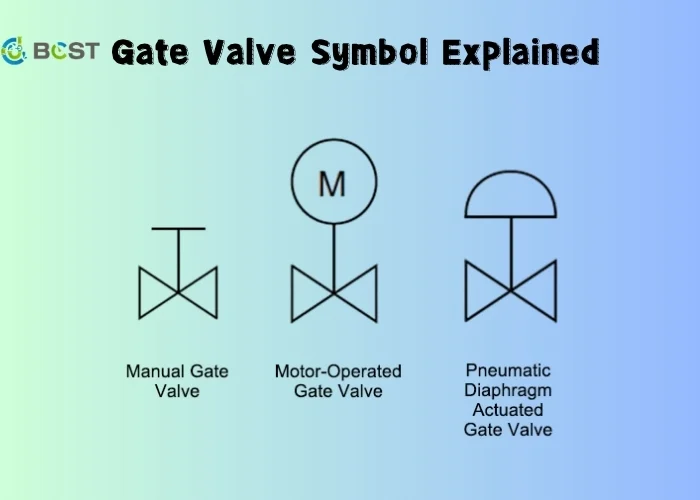
Let’s take a closer look at the standard symbol for a gate valve. It’s made of two triangles that sit on the main process line in the diagram, with their points touching. These triangles show the body of the valve. The shape tells you there’s a gate inside that moves up and down to open or close the path for the fluid. When it’s open, the path is wide open, which is why gate valves are perfect for on/off isolation where you don’t want a lot of pressure drop. A vertical line comes up from where the triangles meet. This line is the valve stem and actuator. A small ‘T’ at the top of this line indicates a manual valve operated by a handwheel. This is the most common symbol for a gate valve you will see.
Common Variations You’ll Encounter
While the basic symbol is easy, diagrams often give you more info. Engineers add small marks to the symbol for these details. For instance, if a gate valve needs to stay in one position during normal work, it is colored in. A shaded or filled-in symbol for a gate valve means it’s “Normally Closed” (NC). An empty one means it’s “Normally Open” (NO). The symbol also tells you how it’s operated. Instead of a ‘T’ for a handwheel, you will see letters. An ‘M’ in a box on top means it has a motor (electric actuator). A small half-circle over the stem means it’s moved by air pressure (pneumatic actuator).
| Symbol Variation | Meaning | Common Application |
|---|---|---|
| Basic Symbol | Standard Manual Gate Valve | General on/off isolation. |
| Shaded/Filled Symbol | Normally Closed (NC) Gate Valve | Emergency shutdown lines, drain lines. |
| Symbol with ‘M’ | Motor (Electric) Actuated | Remote operation, large valves requiring high torque. |
| Symbol with ‘P’ | Pneumatic Actuated | Automated process control, fast-acting systems. |
| Symbol with ‘H’ | Hydraulic Actuated | High-pressure, high-force applications. |
Context is Everything on a P&ID
أ symbol for a gate valve never stands alone. To really get its purpose, you have to look at what’s around it on the P&ID. Check the lines hooked up to it. Arrows show the flow direction. Line numbers and notes tell you what’s flowing, at what pressure and temperature. Next to the valve symbol, you’ll find a tag number, like GV-101. That number links to a list with all the details: size, material, pressure rating, and more. For an expert engineer like Hassan, reading this context is automatic. He sees the symbol for a gate valve, instantly checks the line specs, and knows if it’s the right valve for the job.
Comparison of Gate Valve Symbols with Other الصمام الرموز
Ball valve, globe valve, gate valve—their symbols look alike at first. Picking the wrong one messes up how your whole system works. Let’s clear up the main differences so you never get them mixed up again.
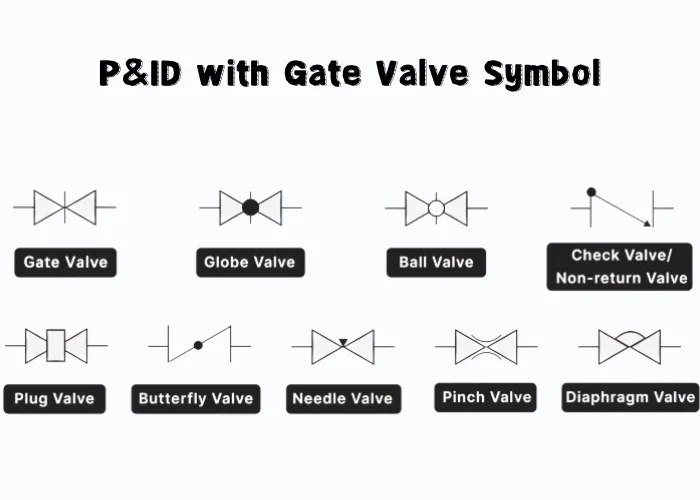
ال symbol for a gate valve (the two triangles) is for on/off flow. A ball valve symbol looks similar but adds an open circle in the middle, telling you it’s a quick-action valve. A globe valve symbol uses a solid, filled-in circle, showing it’s made for throttling flow.
One of the most frequent mix-ups I see when working with clients is between these basic valve symbols. I once got a P&ID from a client for a new chemical dosing system. They had put a symbol for a gate valve on a line that needed very precise flow control. I knew right away that we had to fix it. A gate valve is awful for regulating flow; it vibrates, wears out fast, and they’d never get a stable flow. We switched it to a globe valve symbol on the drawing before a single part was ordered. That simple change on paper saved them from a huge operational headache and the cost of replacing the wrong valve down the road. It just goes to show, knowing the difference between the symbol for a gate valve and others is a practical skill, not just theory.
Gate Valve vs. Ball Valve Symbol
ال symbol for a gate valve and a ball valve look very similar. They both have the “bowtie” shape. But the ball valve symbol has a small open circle right in the middle. That circle represents the “ball” inside the valve, and it tells you something important about its function. The gate valve symbol is for a slow-acting valve used for isolation. A ball valve, which you open or close with a quick quarter-turn, is for fast on/off action. When you see that circle, think “fast shut-off.” On a P&ID, you’ll find the symbol for a gate valve on big process lines where you don’t open and close it often. You’ll see ball valves on smaller utility lines where workers need to open or close them quickly and frequently.
Gate Valve vs. Globe Valve Symbol
This is the most important difference to understand. The symbol for a gate valve is for an isolation valve—it’s either all the way open or all the way shut. It gives you a clear, straight path for flow. The symbol for a globe valve, on the other hand, fills the bowtie with a solid black circle. That solid dot represents the plug inside, which is designed to regulate or “throttle” the flow. When you see a globe valve symbol, you know its job is to control how much is flowing, not just to start or stop it. Using a gate valve for throttling is a bad idea; you will get poor control and damage the valve. That clear visual difference between the open symbol for a gate valve and the solid dot of the globe valve is a reminder: one is for on/off, the other is for control.
A Quick Reference Table
Seeing the most common symbols side-by-side helps build your confidence. Each one tells you the valve’s main job with just a glance. Getting comfortable with the symbol for a gate valve and what makes it different from the others is a key skill.
| نوع الصمام | Symbol Description | الوظيفة الأساسية | Key Visual Cue |
|---|---|---|---|
| صمام البوابة | Two opposing triangles (“bowtie”). | On/Off Isolation (Slow) | Open center |
| صمام كروي | Two triangles with an open circle in the center. | Quick On/Off | Open circle |
| صمام الكرة الأرضية | Two triangles with a solid circle in the center. | Throttling / Regulation | Solid circle |
| فحص الصمام | Triangle with a perpendicular line, shows flow direction. | Prevent Backflow | Arrow-like shape |
| صمام الفراشة | Triangles with a tilted line and circle. | On/Off or Throttling (Large Pipes) | Tilted “wafer” |
When you review a P&ID, use this as a mental checklist. Does this pipe just need to be shut off? Look for the clear symbol for a gate valve. Does it need fast action? Look for the ball valve symbol. Does it need to control the flow rate? Find the globe valve symbol.
When sourcing valves for your project, they must match the P&ID perfectly. The details from symbols like the symbol for a gate valve determine how well your system will perform. For years, our clients, including demanding engineers like Hassan, have trusted BCST Valve. We know a gate valve is a critical safety and performance component. At BCST, we build valves that meet the exact standards your plans require, making sure the symbol on the page becomes a reliable part in the field. To see our range of industrial valves, please visit صمام BCST.
Frequently Asked Questions (FAQs)
Q1: What is the main difference between the symbol for a gate valve and a globe valve?
A: The symbol for a gate valve has two open triangles (“bowtie”) for simple on/off isolation. A globe valve symbol has a solid black circle in the middle, showing its job is to throttle or regulate flow.
Q2: Why is the symbol for a gate valve so common on P&IDs?
A: Because gate valves are the go-to choice for basic on/off isolation in pipelines across almost every industry. Their simple, straight-through design causes very little pressure drop, making them ideal for many situations.
Q3: Can the symbol for a gate valve show if it’s open or closed?
A: Yes, it absolutely does on detailed drawings. A plain, empty symbol means “Normally Open” (NO), while a shaded or solid-black symbol for a gate valve means “Normally Closed” (NC).
Final Thought
Learning the symbol for a gate valve is about more than just reading a drawing; it’s about understanding how to build a safe, efficient, and successful project. And when you need real-world valves that perform as reliably as your plans, trust BCST to deliver proven quality every time.


 English
 Arabic
 Russian
 French
 Spanish