
What Valves Can Work as Shield Against Corrosive Media?
Your plant struggles with aggressive chemicals eating through traditional valves. Corrosion causes dangerous leaks, costly downtime, and constant replacements. You need a solution that protects your operations. You have different types of ball valves for corrosive environments. Also you have PTFE Lined Valves.
PFA lined valves offer superior corrosion resistance for your most aggressive chemical processing applications. They feature a fused perfluoroalkoxy (PFA) lining that acts as an impermeable barrier. This ensures bubble-tight shutoff and extends valve lifespan where other materials quickly fail.

This special lining is not just a coating; it is a meticulously applied barrier. It protects your entire system from the harshest environments. Understanding this technology will help you make smarter decisions about your plant’s most critical assets. As Emily, I have personally seen the difference a properly specified PFA lined valve can make. Hassan always reminds us that PFA lined valves manufacturers developed this technology to meet the most extreme needs in chemical resistance.
What Does PFA Stand for and How Does It Protect Your Valves?
You hear “PFA” often in corrosive environments, but what exactly is it? You need to know if this material can genuinely protect your valuable assets from chemical attack and prevent failures.
PFA stands for Perfluoroalkoxy. In PFA lined valves, it refers to a high-performance fluoropolymer plastic that offers exceptional chemical resistance and high temperature resistance. This lining creates an inert barrier inside the valve, preventing corrosive media from ever touching the metallic valve body.

The Chemistry Behind PFA’s Robust Protection
When we talk about “what does PFA stand for in valves?”, we are talking about a material designed to withstand extreme conditions. PFA is a fluoropolymer, much like PTFE, but with distinct advantages. Its full name, Perfluoroalkoxy, reveals part of its secret: a structure that incorporates perfluorinated side chains with oxygen atoms. This unique molecular design gives PFA its exceptional properties.
The key to PFA’s protection lies in its chemical inertness. This means PFA does not react with almost any industrial chemical. Think of it as a super-tough, non-stick shield inside your valve. When you have aggressive media like concentrated acids, strong bases, or industrial solvents flowing through your pipes, these chemicals would quickly degrade traditional metal valves. Stainless steel, carbon steel, and even specialty alloys can corrode. The result is valve leakage, process contamination, and ultimately, complete valve failure.
This is where PFA shines. The lining, typically applied by rotational molding or injection molding techniques, creates a seamless, non-porous barrier. This barrier completely isolates the fluid from the metallic parts of the PFA lined valve. The material’s high temperature resistance property is also crucial. PFA can withstand continuous operating temperatures up to 260°C (500°F). This makes it suitable for many high-temperature chemical processing applications where PTFE might soften or deform.
Furthermore, PFA has excellent permeation resistance. This means even small, volatile molecules have difficulty penetrating the PFA layer. This is vital for maintaining product purity and preventing fugitive emissions of hazardous substances. Its smooth, non-stick surface also prevents particle buildup, which is essential for ensuring flow control valve efficiency and preventing blockages in process lines. Hassan always emphasizes, “When you specify PFA equipment or PFA lined valves, you are not just buying a valve; you are investing in a durable, long-term solution against the most chemically hostile environments.”
| PFA Property | Benefit in Valves | Why This Matters for You |
|---|---|---|
| Chemical Inertness | Resists attack from almost all chemicals. | Prevents corrosion, ensures process purity. |
| High Temperature Resistance | Operates up to 260°C (500°F) continuously. | Suitable for hot chemical processing. |
| Impermeable Barrier | Prevents fluid from contacting metal. | Eliminates fugitive emissions, protects valve body. |
| Smooth Surface | Non-stick properties, resists buildup. | Reduces pressure drop, easy to clean. |
| Mechanical Strength | Maintains integrity under pressure, less cold flow. | Longer valve lifespan, reliable sealing. |
What Is the Difference Between PFA Lined Valves and PTFE Lined Valves?
You need to select the best fluoropolymer-lined valve for your aggressive application. Both PFA and PTFE are options, but choosing the wrong one can lead to premature failure. What truly separates these two high-performance materials for your valve needs?
The main difference between PFA lined and PTFE lined valves lies in their temperature resistance, permeation resistance, and mechanical properties. PFA offers higher continuous operating temperatures, lower cold flow (deformation under pressure), and superior permeation resistance. PTFE is often more cost-effective but has a lower temperature limit and can experience more cold flow.
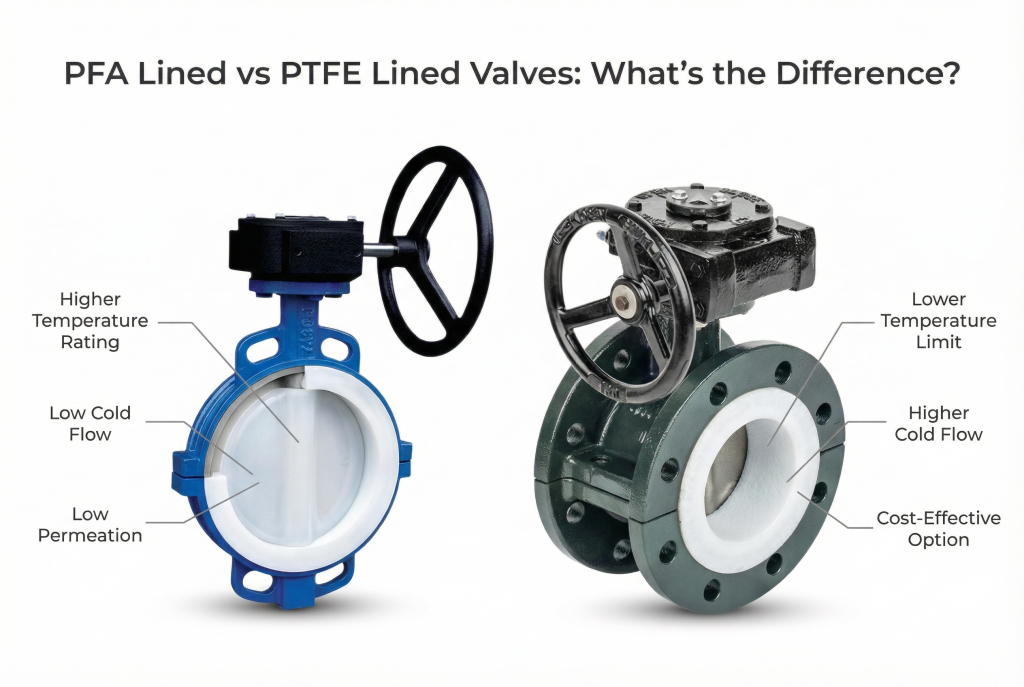
Selecting the Right Fluoropolymer for Your Industrial Needs
Choosing between PFA lined and PTFE lined valves is a common dilemma in chemical processing plants. While both are fluoropolymers and offer excellent corrosion resistance, their subtle differences can significantly impact valve performance and longevity. As Emily, I learned early on that understanding these nuances is crucial for valve selection. Hassan, our Chief Engineer, often advises, “Never assume PTFE is always enough, especially in high temperature resistance applications. PFA has its place for a reason.”
Let’s break down “what is the difference between PFA lined and PTFE lined?” from a technical perspective:
- Manufacturing Process and Material Properties:
- PTFE (Polytetrafluoroethylene): This is a thermoplastic with an incredibly high melt viscosity. PTFE linings are typically applied by paste extrusion or ram extrusion techniques. This process can sometimes leave trace amounts of porosity, although modern PTFE linings are largely free of this. PTFE is slightly softer and more prone to frictional wear compared to PFA. It also exhibits cold flow, meaning it can deform slowly under continuous pressure at room temperature.
- PFA (Perfluoroalkoxy): PFA is a melt-processable fluoropolymer. This means it can be injection molded and rotational molded, similar to conventional thermoplastics. This melt processability allows for a much denser, more homogeneous, and virtually non-porous lining. This almost eliminates the potential for pinholes or voids that could allow aggressive media to reach the valve body. PFA also has better tensile strength and is less susceptible to cold flow than PTFE, making it more dimensionally stable, especially under pressure.
- Temperature Resistance:
- PTFE typically has a maximum continuous operating temperature of around 200°C (392°F). Beyond this, it can start to soften, deform, and lose its sealing integrity.
- PFA offers superior high temperature resistance, with a maximum continuous operating temperature up to 260°C (500°F). This extended range makes PFA the preferred choice for hotter chemical processing streams.
- Permeation Resistance (for Gases):
- PFA generally offers better permeation resistance to gases and small molecules. This is due to its denser, less porous structure. This is critical for processes involving highly permeable or toxic gases where even tiny amounts of leakage or absorption into the lining are unacceptable.
- PTFE can be slightly more permeable to gases, which in some aggressive media applications, could lead to issues.
- التكلفة: PTFE lined valves are usually more cost-effective than PFA lined valves for similar sizes and pressure ratings. This makes them a popular choice when PTFE’s temperature and performance limits are sufficient for the application. PFA commands a higher price because of its advanced properties and manufacturing complexity.
In summary, if you are dealing with aggressive chemicals at moderate temperatures and need good corrosion resistance on a budget, PTFE lined valves are a strong candidate. However, for high temperature resistance, superior permeation resistance, and robust mechanical strength to prevent cold flow, PFA lined valves are the definitive choice.
| Property | PTFE Lined Valves | PFA Lined Valves | Ideal Application Scenario |
|---|---|---|---|
| Max. Operating Temperature | ~200°C (392°F) | ~260°C (500°F) | PTFE: Moderate temp. PFA: High temp. |
| Cold Flow / Deformation | More susceptible | Less susceptible, better dimensional stability | PTFE: Lower pressure/static. PFA: High pressure/dynamic conditions. |
| Permeation Resistance | Good, but can be higher for gases | Excellent, highly impermeable for gases | PTFE: General gases. PFA: Highly volatile/toxic gases. |
| Surface Purity & Porosity | Low, minor porosity possible | Very high, virtually non-porous | PTFE: Good purity. PFA: Ultra-high purity, aggressive acids. |
| التكلفة | أقل | أعلى | PTFE: Budget-conscious projects. PFA: Critical, high-value processes. |
| Manufacturing Method | Paste extrusion, ram extrusion | Injection molding, rotational molding | Affects lining quality and consistency. |
What Is PFA Used For?
You need to understand the full scope of PFA’s utility beyond just valve linings. Knowing “what is PFA used for” can help you identify other areas in your plant where corrosion and contamination are issues, improving overall system integrity.
PFA most commonly refers to perfluoroalkoxy alkane, a high-performance fluoropolymer used where excellent chemical resistance, purity, and high-temperature capability are required. This includes valve linings and pipe linings in chemical processing and pharmaceutical manufacturing, as well as components for semiconductor manufacturing, laboratory equipment, and protective coatings.
The Versatility of PFA in Critical Industries
The question “What is PFA used for?” opens up a broader discussion beyond just PFA lined valves. It highlights PFA’s role as a critically important fluoropolymer in industries where absolute purity and corrosion resistance are non-negotiable. Emily has witnessed PFA’s adoption in various sectors as plants strive for higher standards. Hassan often categorizes PFA as a “solution material” for problems conventional materials cannot solve.
One of the most prominent uses for PFA is in Chemical Processing Industries. Here, it is not just valve linings, but also pipe fittings, lined pipes, and storage tank linings that benefit from PFA’s resistance to aggressive media. Imagine miles of piping carrying concentrated sulfuric acid or nitric acid. PFA provides an impermeable barrier, protecting workers and the environment from hazardous leaks, and preventing process fluid contamination. The high temperature resistance of PFA allows these processes to operate effectively at elevated temperatures without material degradation.
Another vital application is in Pharmaceutical Manufacturing and Biotechnology. These industries demand the highest levels of purity and contamination control. PFA tubing, PFA equipment for fluid transfer, and even PFA reactor linings are common. Its non-stick properties and inertness ensure that process fluids, which can be extremely sensitive, remain uncontaminated. This is essential for producing safe and effective medicines. The easy-to-clean surface of PFA also supports stringent CIP (clean-in-place) and SIP (sterilize-in-place) protocols.
ال Semiconductor Manufacturing industry also heavily relies on PFA. Here, ultra-high purity is paramount. PFA tubing, PFA components for fluid handling, and storage containers are used for transporting and storing corrosive and high-purity chemicals, such as hydrofluoric acid or deionized water, used in wafer fabrication. Any trace contamination can ruin entire batches of microchips. PFA’s minimal leachable content and excellent chemical inertness make it the material of choice for these critical applications.
Beyond these, PFA appears in Laboratory Equipment (beakers, flasks, bottles for sensitive samples), Wire and Cable Insulation (due to its excellent electrical properties and heat resistance), and as Non-Stick Coatings for certain high-temperature applications. Everywhere you see a demand for extreme corrosion resistance, high temperature resistance, and uncompromising purity, you will find PFA equipment playing a crucial role. This broad utility confirms why PFA is such a valued material in industrial applications.
| PFA Application Sector | Typical PFA Products Used | Key Advantages Provided by PFA | Impact on Your Operations |
|---|---|---|---|
| المعالجة الكيميائية | Valve linings, pipe linings, tank linings, fittings | Corrosion resistance, high temp resistance | Extended equipment life, improved safety, reduced downtime. |
| المستحضرات الصيدلانية | Tubing, fittings, reactor linings, vessels | Ultra-high purity, contamination control | Product integrity, regulatory compliance, quality assurance. |
| Semiconductor Mfg. | Tubing, fluid handling components, storage | Ultra-high purity, inertness, low ion leachable | Prevention of yield loss, consistent microchip quality. |
| Laboratory Equipment | Beakers, flasks, bottles, stir bars | Chemical inertness, non-stick, easy cleaning | Accurate results, sample integrity, safe chemical handling. |
| Wire & Cable Insulation | Insulation for high-performance cables | Electrical insulation, heat resistance, flexibility | Reliable data transmission, extended cable life in harsh spots. |
خاتمة
PFA lined valves are essential for handling aggressive media with high temperature resistance and uncompromising purity. Their superior chemical inertness and mechanical strength ensure long-term, reliable performance in your most demanding industrial applications.
Ready to protect your critical processes?


 English
 Arabic
 Russian
 French
 Spanish