
Liquid Hydrogen is Not Liquid Nitrogen: Upgrading Your Specs for -253°C
Key Takeaways for Cryogenic Ball Valves in LH2 Service
- Extreme Temperature: LH2 requires valves designed for -253°C, significantly colder than LN2 (-196°C) or LNG (-162°C).
- Hydrogen Embrittlement: Standard cryogenic materials like 316L stainless steel may not suffice for LH2 due to embrittlement risks.
- Tiny Molecule, Big Challenge: Hydrogen’s small molecular size demands superior primary and secondary sealing to prevent leaks.
- Specialized Testing: Standard cryogenic tests are insufficient; LH2 service requires specific leak rate, thermal shock, and material compatibility testing at target temperatures.
- System Upgrades: Converting LNG infrastructure to LH2 requires comprehensive re-evaluation of all valve specifications and materials.
As the world pivots towards a hydrogen economy, the need for safe, reliable, and efficient management of liquid hydrogen (LH2) has become paramount. For engineers and project managers accustomed to the demands of Liquid Natural Gas (LNG) or Liquid Nitrogen (LN2), the leap to LH2 presents an entirely new spectrum of challenges, particularly when it comes to vital components like cryogenic ball valves. An instrumentation engineer’s experience with a valve designed for -196°C or -162°C simply won’t translate directly to a system handling LH2 at a staggering -253°C. This article plants your flag firmly in the future, providing a definitive primer for new energy process engineers on why liquid hydrogen valve specification demands a comprehensive upgrade in thinking, materials, and testing protocols, far beyond what’s acceptable for its cryo-cousins.
Understanding Cryogenic Conditions: LN2, LNG, and the LH2 Frontier
While all are characterized by ultra-low temperatures, the specific properties of liquid hydrogen introduce distinct and magnified challenges.
Key Temperatures and Properties: -162°C vs. -196°C vs. -253°C
The scale of cold involved is crucial:
- Liquid Natural Gas (LNG): Boils at approximately -162°C (-260°F). Less dense than water.
- Liquid Nitrogen (LN2): Boils at -196°C (-320°F). Commonly used for general cryogenic cooling and inert environments.
- Liquid Hydrogen (LH2): Boils at an astonishing -253°C (-423°F), making it the coldest liquid commercially handled.
This temperature differential means thermal contractions are more severe, requiring meticulous design for expansion and contraction in valves. The thermal stresses on materials and seals are significantly higher for LH2.
The Hydrogen Challenge: Tiny Molecule, Extreme Cold
Beyond the temperature, hydrogen’s molecular properties are critical. Hydrogen is the smallest and lightest molecule, granting it exceptional penetrating power. This translates directly to a heightened risk of:
- Permeation: Hydrogen can seep through materials that would be impermeable to larger molecules like methane (LNG).
- Diffusion: It can diffuse into the microstructure of metals, leading to insidious material degradation, particularly at cryogenic temperatures.
These characteristics amplify the need for flawless sealing and material integrity in every component of a cryogenic ball valve for liquid hydrogen service.
Material Selection Beyond 316L: Battling Hydrogen Embrittlement
Standard materials suitable for LNG and LN2 may exhibit dangerous behavior when exposed to LH2.
Why Standard Cryogenic Materials Fall Short for LH2
For most cryogenic applications (LN2, LNG), austenitic stainless steels like AISI 304L and فولاذ 316L المقاوم للصدأ are the go-to materials. Their excellent ductility and toughness are maintained at very low temperatures. However, for LH2 service, the phenomenon of hydrogen embrittlement at cryogenic temperatures becomes a significant concern. Hydrogen can severely degrade the mechanical properties of certain metals, leading to a loss of ductility and premature brittle fracture under stress. This risk is exacerbated at the extremely low temperatures of LH2.
Advanced Alloys and Non-Metallic Components
To counteract hydrogen embrittlement and ensure reliable performance, valve manufacturers must specify materials with enhanced resistance. This often includes:
- Higher Nickel Alloys: Specific grades of austenitic stainless steel with higher nickel content, or nickel-based superalloys (e.g., Inconel, Monel), offer superior resistance to hydrogen embrittlement.
- Non-Metallic Seals: Specialized polymers like PTFE, PCTFE, and certain composite materials are critical for seats and stem packing. These must demonstrate long-term integrity, extremely low permeation rates, and resilience to thermal cycling at -253°C.
| مميزة | Standard Cryogenic (LN2/LNG) | Liquid Hydrogen (LH2) |
|---|---|---|
| Operating Temperature | -162°C to -196°C | -253°C |
| Primary Body Material | 304L/316L Stainless Steel | High-Nickel Alloys, specialized high-strength austenitic steels |
| Embrittlement Risk | Low to Moderate (not hydrogen-induced) | High (Hydrogen Embrittlement) |
| Sealing Material | PTFE, reinforced PTFE | PCTFE, specialized composites, advanced PTFE formulations |
| Leakage Rates (Max.) | Typically < 10⁻⁵ std cc/sec He | Often < 10⁻⁷ std cc/sec He (more stringent) |
Sealing in the Extreme: Preventing LH2 Leaks
Given hydrogen’s small size and its explosive nature, leak prevention is a non-negotiable aspect of valve design.
Enhanced Seat and Packing Designs
Leak paths that are inconsequential for other cryogens become critical for LH2. This drives innovation in valve design:
- PTFE-based Seats: For softer seats, specialized spring-energized or reinforced PTFE designs are essential to maintain preload and seal integrity across enormous thermal shifts.
- Metal-to-Metal Seats: For more robust applications, precision-machined metal seats often feature secondary soft seals or bellows designs for fugitive emissions control.
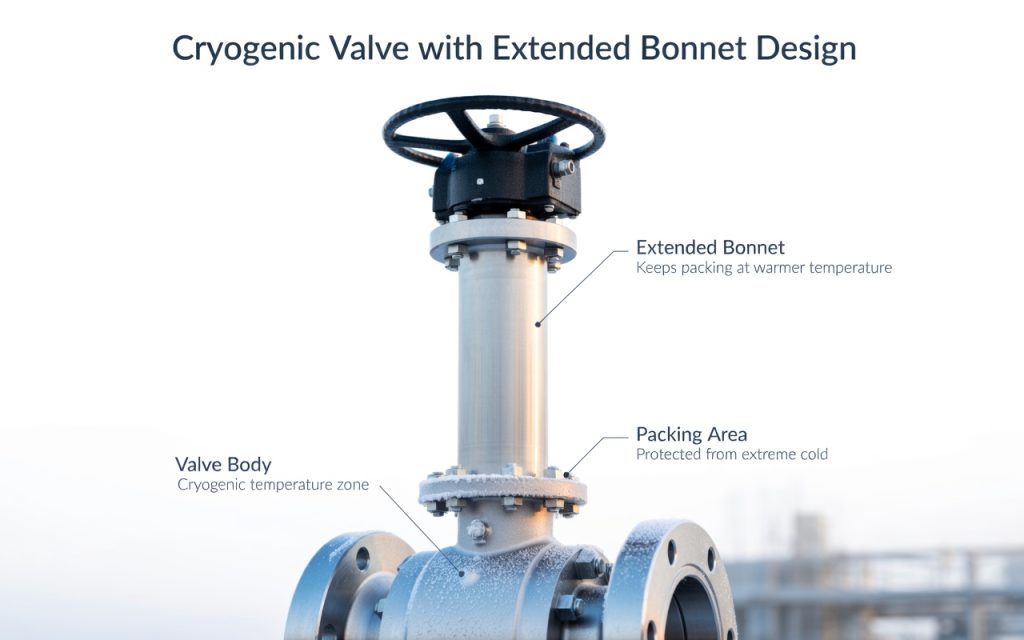
- Live-Loaded Packing: Gland packing for the stem often incorporates live-loading (e.g., Belleville washers) to maintain constant compressive force, compensating for thermal cycling and wear. Stem extensions are standard to keep packing at ambient temperatures.
Water Ingress and Ice Formation Prevention
The external low temperatures present another challenge: preventing moisture from the ambient air from condensing and freezing on the valve body. Ice formation can impede valve operation, damage delicate components, and obscure potential leaks. Effective insulation and extended bonnets are crucial, often combined with dry nitrogen purges in critical areas to maintain an inert atmosphere around the stem packing.

Rigorous Testing Protocols for LH2 Service
The increased risks associated with LH2 necessitate more stringent testing than for other cryogenic applications.
Cryogenic Testing at -253°C
While API 622, API 624, and ISO 15848-1 provide guidelines for fugitive emissions, and standards like API 6FA cover fire safety, cryogenic testing specific to LH2 is critical. Valves destined for LH2 must be functionally tested at the actual operating temperature of -253°C. This involves specialized cryogenic test facilities capable of achieving and maintaining these extreme conditions. Testing focuses on:
- Seat and Body Leakage: Measured using highly sensitive mass spectrometer leak detectors with helium as the test medium, aiming for ultra-low leak rates, often in the range of 10⁻⁷ std cc/sec He.
- Thermal Cycling: Repeated cycles between ambient and -253°C to evaluate the valve’s response to thermal stress, contraction, and expansion.
- Operational Torque: Ensuring the valve can be operated smoothly at cryogenic temperatures with acceptable torque levels.
Leakage Rates and Permeation
The permissible leakage rates for LH2 valves are significantly more stringent than for other cryogens due to hydrogen’s flammability and small molecular size. Manufacturers must not only achieve a tight seal but also verify that the materials themselves exhibit negligible hydrogen permeation, which can be a slow, persistent leak path over time.
Upgrading Existing LNG Systems for Hydrogen Service
For organizations looking to transition or integrate hydrogen into existing energy infrastructure, simply swapping out valves and components is not an option. Upgrading LNG systems for hydrogen requires a holistic engineering approach.
Every component in the fluid path – from pipes and fittings to sensors and valves – must be re-evaluated against the unique demands of LH2. This includes:
- Material Recertification: Existing 316L lines might be acceptable if stresses are low and embrittlement risks are managed, but critical components like valves typically require upgraded materials.
- Insulation & Cryogenic Protection: Enhanced vacuum jacketed piping and advanced insulation schemes are necessary to handle the lower temperatures and prevent boil-off.
- Safety Systems: New or upgraded leak detection, ventilation, and emergency shutdown systems must be designed to account for hydrogen’s unique properties (e.g., its wide flammability range, colorless and odorless nature).
- Valve Replacement: All LNG cryogenic ball valves must be replaced with purpose-built LH2 valves, specifically designed and tested for -253°C service and resistance to hydrogen embrittlement.
Frequently Asked Questions About Cryogenic Ball Valves for Liquid Hydrogen
Q: Why is liquid hydrogen so much more challenging than LNG for valve design?
Liquid hydrogen operates at -253°C, which is significantly colder than LNG (-162°C). This extreme temperature introduces greater thermal contraction and stress on materials. Additionally, hydrogen’s super-small molecular size means increased permeation and a higher risk of hydrogen embrittlement in certain metals, requiring more advanced materials, ultra-tight sealing, and specialized testing to prevent leaks and ensure structural integrity.
Q: Can stainless steel 316L be used for LH2 valves?
While 316L stainless steel is commonly used for LN2 and LNG applications, its suitability for LH2 (-253°C) is limited and generally not recommended for critical valve components. The primary concern is hydrogen embrittlement, where hydrogen can diffuse into the metal and degrade its mechanical properties, leading to brittle failure. For LH2, higher nickel alloys or specialized stainless steels with enhanced resistance to hydrogen embrittlement are typically required.
Q: What is hydrogen embrittlement and how does it affect cryogenic valves?
Hydrogen embrittlement is a process where materials, particularly certain metals, become brittle and lose their ductility and fracture toughness due to the absorption of hydrogen. In cryogenic valves handling LH2, this can lead to catastrophic failure as hydrogen atoms penetrate the metal’s lattice structure, initiating cracks or causing sudden fracture under stress. Selecting materials with high resistance to hydrogen embrittlement is critical for the safety and longevity of LH2 valves.
Q: Are standard API 6D cryogenic tests sufficient for LH2 valves?
No, standard API 6D cryogenic tests, which typically validate performance at LN2 temperatures (-196°C), are generally not sufficient for LH2 valves. The extreme temperature difference (-253°C) and unique properties of hydrogen demand more rigorous and specific testing. LH2 valves require functional testing at their actual operating temperature, with stricter leak rate requirements (often 10⁻⁷ std cc/sec He or lower), advanced thermal cycling, and verification of material behavior under LH2-specific conditions.
خاتمة
Designing and specifying cryogenic ball valves for liquid hydrogen service is an engineering discipline demanding precision, advanced material science, and rigorous testing protocols far beyond what’s accepted for other cryogens. The challenges presented by -253°C and hydrogen’s unique molecular properties, specifically hydrogen embrittlement and permeation, necessitate a holistic approach to valve selection. For project managers, instrumentation engineers, and new energy professionals, understanding these distinctions is not just good practice—it’s essential for the safety, reliability, and long-term success of the burgeoning hydrogen economy. At BCST Valve, we are at the forefront of this evolution, providing expertly engineered solutions for the most demanding cryogenic applications.
Seeking advanced cryogenic valve solutions for your LH2 project?


 English
 Arabic
 Russian
 French
 Spanish