
Buyer’s Guide: How to Select the Right Programmable Ball Valve for Your Application
Programmable ball valves are the backbone of modern automated fluid control systems, enabling precision, efficiency, and remote management. However, with a myriad of options available—from materials and sizes to actuator types and control signals—selecting the *right* programmable ball valve can be a complex task. According to a study, 70% of failures are linked to sizing/selection issues.
This comprehensive buyer’s guide from BCST Valve will walk you through the critical selection criteria, helping you make an informed decision that ensures optimal performance, longevity, and cost-effectiveness for your specific needs. If you’re new to these intelligent devices, start with our comprehensive overview: What Is a Programmable Ball Valve? The Ultimate Guide.
Understanding Your Application: The Foundation of Selection
The “perfect” programmable ball valve doesn’t exist in a vacuum; its suitability is entirely dictated by your specific application. Before diving into specifications, ask yourself these fundamental questions:
- What Fluid or Gas Will be Flowing? (Media Type)
- Is it water, oil, gas, chemicals, food products, abrasive slurries?
- Is it corrosive, viscous, or clean?
- What are the Operating Conditions?
- Maximum and minimum process pressure?
- Maximum and minimum process temperature?
- Ambient temperature of the installation environment?
- What Type of Control is Needed?
- Simple On/Off isolation?
- Modulating/Proportional flow control (e.g., 0-100% open)?
- Diverting or mixing flow (3-way or 4-way)?
- What is the Installation Environment?
- Indoor or outdoor?
- Wet, dusty, or potentially explosive atmosphere?
- Accessible or remote location?
- What are the System Integration Requirements?
- Connecting to a PLC, DCS, smart home hub, or standalone controller?
- Requires feedback signals (open/closed status, position)?
Key Selection Criteria: Breaking Down Valve & Actuator Components
A programmable ball valve is a system of two main parts: the valve body and the actuator. Each has its own set of critical specifications.
1. Valve Body Specifications (The Mechanical Part)
- Material:
- Brass/Bronze: Good for water, air, non-corrosive fluids. Cost-effective.
- Stainless Steel (304, 316, 316L): Excellent for corrosive media, high temperatures, food & beverage, pharmaceuticals.
- PVC/CPVC (Plastics): Ideal for highly corrosive chemicals, demineralized water, but with lower pressure/temperature limits.
- Exotic Alloys (e.g., Duplex, Hastelloy): For extremely aggressive environments or specific industry requirements.
- Size (DN/NPS): Must match your pipeline diameter to ensure proper flow and avoid reductions that cause pressure drop.
- Pressure Rating (PN/Class): Defines the maximum pressure the valve can safely withstand. Always choose a valve with a pressure rating comfortably above your system’s maximum operating pressure.
- Temperature Range: Both valve body and seat materials must withstand your fluid’s minimum and maximum operating temperatures.
- Port Type:
- Full Port: Bore size matches pipe ID, offering minimal pressure drop and ideal for viscous fluids or slurries.
- Standard/Reduced Port: Bore is smaller than pipe ID, resulting in a slight pressure drop but a more compact and cost-effective valve.
- منفذ V: Features a ‘V’-shaped opening in the ball, providing excellent progressive flow control (modulating).
- End Connections: How the valve connects to your piping.
- Threaded (NPT, BSP): Common for smaller sizes.
- Flanged (ANSI, DIN): For larger sizes, easier installation/removal.
- Welded (Socket Weld, Butt Weld): For high-pressure/temperature, leak-tight applications.
- Compression, Victaulic, Clamp: Specific applications.
- Seat Material: Affects sealing performance and compatibility.
- PTFE (تفلون): Standard for general purpose, good chemical resistance, common for bubble-tight seals.
- RPTFE (Reinforced PTFE): Improved temperature/pressure limits.
- PEEK: Higher temperature and pressure capabilities than PTFE, good wear resistance.
- Metal Seats: For very high temperatures, abrasive media, or fire-safe applications.
2. Actuator Specifications (The “Smart” Part)
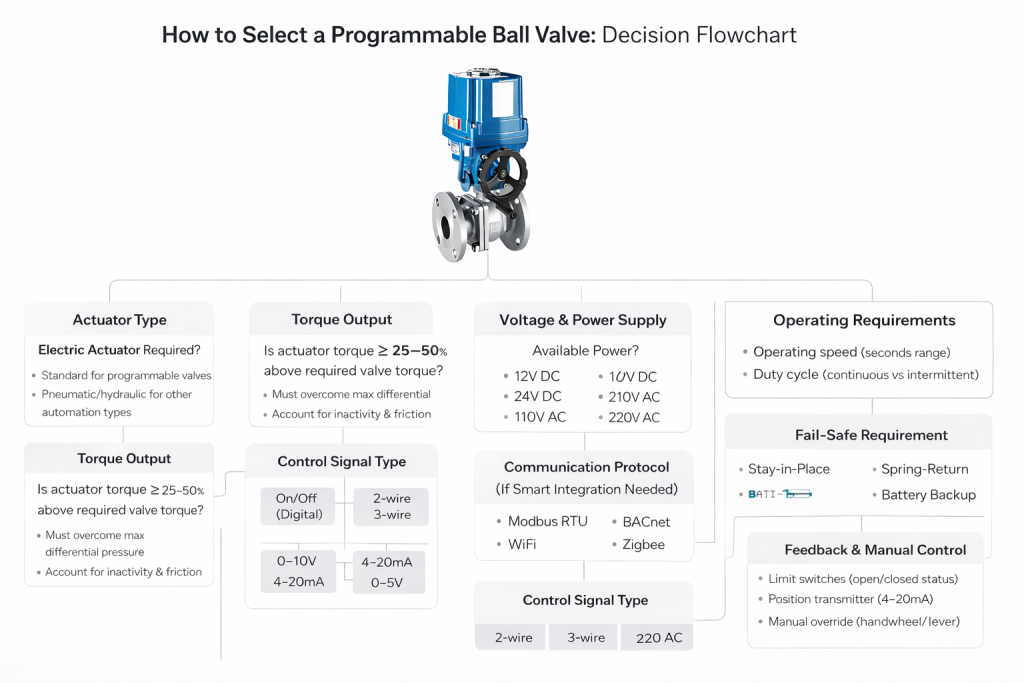
- Actuator Type: For “programmable” valves, an محرك كهربائي is almost always used. (Pneumatic or hydraulic are alternatives for other types of automated valves but less common for programmable ball valves).
- Torque Output: This is critical. The actuator’s torque must be sufficient to reliably open and close the ball valve, especially under maximum differential pressure and after periods of inactivity. Always specify an actuator with a torque rating at least 25-50% higher than the valve’s maximum required torque.
- Voltage & Power Supply: Must match your available power (e.g., 12V DC, 24V DC, 110V AC, 220V AC).
- Control Signal Type:
- On/Off (Digital): Standard for simple open or close commands. Typically 2-wire for power, 3-wire for power and control.
- Modulating (Analog): For proportional flow control. Common signals include 0-10V DC, 4-20mA DC, 0-5V DC.
- Communication Protocols: For integration into sophisticated systems (e.g., Modbus RTU, BACnet, WiFi, Zigbee).
- Operating Speed: How quickly does the valve need to respond? Electric actuators typically operate in seconds to tens of seconds.
- Duty Cycle: Indicates how frequently the actuator can operate. Some are rated for continuous duty, others for intermittent use.
- Fail-Safe Mechanism: What happens during a power loss?
- Stay-in-Place: Most common, the valve remains in its last commanded position.
- Spring-Return: A spring automatically drives the valve to a predetermined “safe” position (open or closed) upon loss of power.
- Battery Backup: An internal battery allows the actuator to complete a cycle or maintain position during a power outage.
- Enclosure Rating (IP Code/NEMA): Essential for environmental protection.
- IP65: Dust-tight and protected against water jets.
- IP67: Dust-tight and protected against temporary immersion in water.
- NEMA ratings: Broader standards often used in North America, addressing corrosion resistance, hazardous locations, etc.
- Feedback Signals:
- Limit Switches: Provide basic open/closed status.
- Position Transmitter: Provides a continuous signal (e.g., 4-20mA) indicating the exact percentage open.
- Manual Override: A handwheel or lever to operate the valve manually during power outages or for maintenance.
Common Pitfalls and How to Avoid Them
- Under-Sizing Actuator Torque: The most common mistake. Causes premature actuator failure. Always factor in safety margins!
- Ignoring Media Compatibility: Leads to rapid corrosion, seal failure, and system contamination. Double-check all wetted parts (valve body, ball, seats) against your fluid.
- Incorrect Environmental Rating: An actuator without proper IP/NEMA rating will fail quickly in dusty, wet, or hazardous outdoor environments.
- Overlooking Fail-Safe Requirements: Critical for safety and process integrity. A power outage shouldn’t lead to catastrophic failure.
- Mismatching Control Signals/Voltage: Ensures the valve can communicate and receive power from your control system.
Installation and Programming: The Next Steps
Once you’ve selected your valve, proper installation and programming are crucial for bringing your automated system to life. From mounting the valve correctly to wiring the actuator and configuring its logic, each step ensures reliable operation. For a detailed walkthrough, refer to our practical guide: Step-by-Step Guide on How to Install and Program Your Valve.
BCST Quality Assurance: Your Partner in Automated Flow Control
At BCST Valve, we specialize in high-quality programmable ball valves designed for diverse and demanding applications. Our commitment to robust engineering and rigorous testing ensures that every valve meets industry standards and exceeds performance expectations. Consulting with our experts can streamline your selection process and guarantee a solution perfectly tailored to your project’s unique requirements.
خاتمة
Selecting the right programmable ball valve is a critical decision that impacts the efficiency, safety, and longevity of your fluid control system. By carefully evaluating your application’s requirements and diligently considering the specifications of both the valve body and the electric actuator, you can ensure a reliable and effective automation solution.
Don’t just buy a valve; invest in a tailored solution that powers your automation goals. Leverage detailed information, avoid common pitfalls, and choose a trusted supplier like BCST Valve to ensure your operation runs smoothly for years to come.
Confused about which programmable ball valve is right for you?


 English
 Arabic
 Russian
 French
 Spanish