
Reaching a critical valve shouldn’t mean climbing a rickety ladder or entering a cramped pit. Those situations are unsafe and slow you down, costing real time and money.
A gate valve stem extension is a simple but critical part that extends the operating mechanism of a valve. It lets you operate a gate valve that is buried, high overhead, or otherwise out of reach from a safe and convenient spot, ensuring both safety and control.
I grew up watching my dad sketch out complex piping systems. He would point to a valve drawn in an awkward spot on a blueprint and say, “That’s a problem waiting to happen.” Inaccessible valves are a headache in so many plants. They put your team at risk and stall critical processes. That’s where a gate valve stem extension comes in. It’s a straightforward mechanical fix that brings control of that valve right to your fingertips. To see why this simple device is so valuable, you need to understand how it’s built and where it makes the biggest difference. It’s more than just a piece of metal—it’s an essential tool for a safer, more efficient plant.
Understanding the صمام البوابة Stem Extension and Its Mechanics
You’re not sure about all the parts of a stem extension? Choosing the wrong setup leads to failures, expensive repairs, and safety risks that no one wants on their site.
A gate valve stem extension is a mechanical assembly that connects the valve’s own operating nut to a handwheel or actuator in a different location. It works by transferring the turning force you apply from a safe distance directly down to the valve stem to open or close it.
Diving Deeper into the Mechanics
To make the right choice for your system, you have to know what makes a gate valve stem extension work. Don’t mistake it for just a long metal stick; it’s an engineered system built to reliably transfer force over a distance. I remember talking with a chief engineer, Hassan, who was designing a huge water treatment plant. He spent an entire afternoon just debating the material for the stem extension’s guide bushings. Why? Because he knew if that single part failed from corrosion in 10 years, the entire line would have to shut down for a costly repair. That’s the level of detail that matters.
Key Components of a Gate Valve Stem Extension
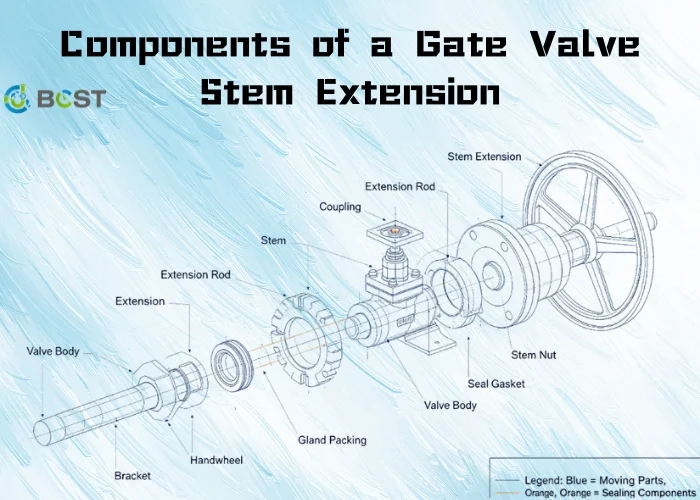
The whole assembly has several crucial parts that work together. Getting the material and design right for each one is key to making the entire gate valve stem extension last.
| المكوّن | الوظيفة | Common Materials |
|---|---|---|
| Extension Stem/Rod | The main shaft that covers the distance from the operator to the valve. | الفولاذ المقاوم للصدأ, الفولاذ الكربوني |
| Stem Nut Adapter | Connects the extension rod to the operating nut right on the gate valve. | Ductile Iron, Bronze |
| Universal Joints | Used if the extension has to go around corners or change angles. | الفولاذ المقاوم للصدأ |
| Guide Bushings | Support the extension rod along its length to keep it from bending or vibrating. | Bronze, Polymer |
| Operating Nut/Handwheel | The part you turn, located at the easy-to-reach end of the extension. | Cast Iron, Ductile Iron |
Knowing these parts helps you ask the right questions. Are you specifying stainless steel for your gate valve stem extension because of a corrosive environment? Are you adding enough guide bushings for a particularly long run? This kind of thinking is what separates a quick, temporary fix from a reliable solution that will last for decades.
Common Applications of Gate الصمام Stem Extensions
You see those access covers on the sidewalk or in a plant floor, but do you know exactly why they’re there? Misunderstanding the application leads to installing a system that isn’t up to the job.
Gate valve stem extensions are essential anywhere a valve is not easy to reach. You’ll find them on buried pipelines for water and wastewater, in crowded industrial plants, and in special marine or cryogenic applications.
Diving Deeper into Applications
The problem of operating a valve from far away comes up in almost every industry, and the gate valve stem extension is an incredibly versatile solution. An engineer like Hassan, who has to map out an entire refinery, thinks about this from day one. He’s not just placing valves; he’s planning how a person will safely operate and service every single one for the next 30 years. Let’s look at the main scenarios where these devices are an absolute must.
Primary Use Cases for a Gate Valve Stem Extension
Different job sites have unique challenges, and in these cases, a gate valve stem extension is the only practical answer.
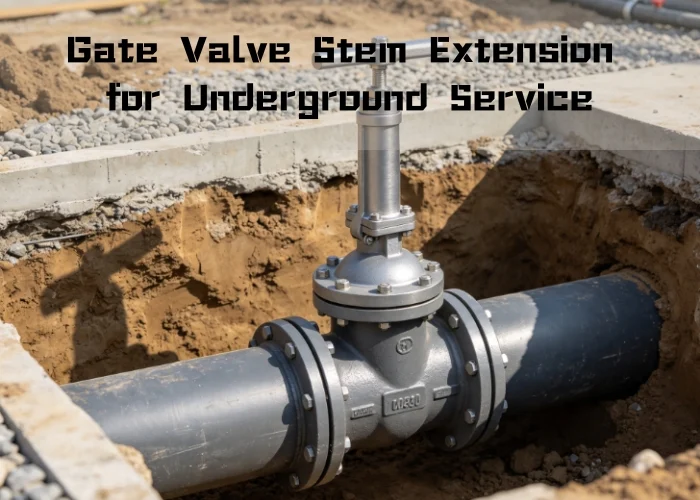
- Underground Services: This is the most common place you’ll see them. In cities and towns, water and sewer mains have gate valves buried deep under the street. A gate valve stem extension brings the control point up to the surface, protected by a valve box. This lets utility crews shut off water for repairs without having to dig up the whole street. The next time you see city workers using a long T-key on the sidewalk, you’ll know they are using a gate valve stem extension.
- Industrial Plant Piping: Big facilities like chemical plants and refineries are packed tight with pipes stacked on multiple levels. Valves end up meters in the air or tucked in corners behind other equipment. A gate valve stem extension allows operators to control these valves from the safety of a walkway. This means no one has to climb a ladder or set up scaffolding just to turn a valve—a common cause of workplace accidents.
- Specialized and Hazardous Environments: Some places are just too dangerous for people. In LNG plants, for example, valves are inside super-cold insulated boxes. A special gate valve stem extension goes through the insulation so the valve can be operated from outside. In marine applications, like inside a ship’s ballast tanks, these extensions give crews control from a safe deck.
The Key Benefits of Using a Gate Valve Stem Extension
You know a stem extension fixes an access problem, but is it worth the extra design thought and cost? Ignoring the benefits means you are designing a system that is inefficient and unsafe.
The main advantages are a huge boost in operator safety, much better operational efficiency, and added protection for the valve itself, which helps it last longer.
Diving Deeper into the Benefits
This isn’t just about convenience. Installing a gate valve stem extension is one of the smartest decisions you can make for safety, time, and your budget. My dad used to say, “The price tag is what you pay today. The التكلفة is what you pay over 20 years if you do it wrong.” A gate valve stem extension is a perfect example—it saves you from the high cost of accidents and downtime. The difference becomes obvious when you compare operations with and without one.
Comparing Operations With and Without a Stem Extension
The benefits go far beyond just being able to reach the valve.
| أسبكت | Without a Gate Valve Stem Extension | With a Gate Valve Stem Extension |
|---|---|---|
| Operator Safety | High risk. The operator has to climb, enter a confined space, or get near hazards. | Low risk. The operator stays in a safe, designated area, well away from the hazard. |
| Operational Speed | Slow. Needs special permits, extra equipment like lifts, and more people. | Fast. One operator turns the valve in a few moments with a standard tool. |
| Cost & Efficiency | High cost. More labor hours, potential for downtime, and higher risk of injury. | Low cost. Less labor, minimal downtime to operate, and much lower safety risks. |
| Valve Protection | The valve is exposed to soil stress, water, or getting hit by equipment. | The valve is better protected. The operating parts are shielded from direct impact. |
It all boils down to this: a gate valve stem extension turns a risky, time-consuming job into a safe, routine task. It’s proactive engineering. You’re not just fixing an access problem; you’re preventing accidents and ensuring you have total control when it matters most.
Thinking this proactively about your system requires a supplier who gets it. You need a partner who understands the technical details and has seen it all before. At مجموعة BCST, we’re not just order-takers; we draw on a family legacy of manufacturing to make sure you get the right solution for your project. We specialize in robust, reliable valves and accessories, including the custom gate valve stem extension that will fit your needs perfectly.
Frequently Asked Questions (FAQs)
Q1: How do you measure for a gate valve stem extension?
Measure the exact distance from the center of the valve’s operating nut to where you want the handwheel to be. Give this “face-to-face” length to your supplier for a perfect fit.
Q2: Can a stem extension be added to an existing gate valve?
Yes. A stem extension is retrofitted onto an existing valve. This requires knowing the valve’s model and stem nut dimensions to ensure the adapter fits correctly.
Q3: What maintenance do gate valve stem extensions require?
They require very little maintenance. Periodically check for corrosion, lubricate any moving parts like universal joints, and ensure buried valve boxes are clear of dirt and rocks.
Final Thought
Ultimately, the gate valve stem extension is a simple device that delivers huge returns in safety, efficiency, and reliability. When you need a solution built for the long haul, trust BCST to bring the expertise and quality parts that keep your plant running safely.


 English
 Arabic
 Russian
 French
 Spanish