
Anatomy of a Gas Turbine Fuel Valve Failure
A single gas turbine fuel valve failure triggers an unscheduled shutdown, and the financial meter starts running immediately. For combined cycle plants, this can mean losing $50,000–$200,000+ per day in lost generation alone.
A multi-day gas turbine unscheduled outage cost quickly crosses $1–2 million when repair costs, contractual penalties, and emergency procurement are included. The root cause is almost never dramatic; it’s often a gas turbine fuel control valve that was under-specified, poorly maintained, or simply ignored until it was too late.
This guide dissects the failure sequence, the three critical technical failure modes, the true financial anatomy of an outage, and concrete steps plant managers can take to prevent this costly scenario. For a deeper dive into the fundamental principles, consult our Fuel Control Valve: Complete Guide.
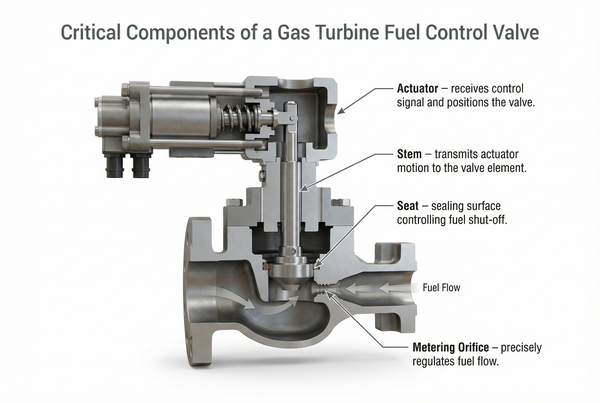
The Role of the Fuel Valve in a Gas Turbine System
In the Brayton cycle, fuel is precisely metered into the combustor where it mixes with compressed air and ignites. Too much or too little fuel can be catastrophic for efficiency, emissions, and even the structural integrity of the turbine.
The fuel valve plays a dual, non-negotiable role: it provides precise gas turbine fuel metering valve for optimal efficiency and economy, and it functions as a critical emergency shutoff for safety. This dual responsibility makes it a single point of failure in many legacy installations.
Real-time data confirms its criticality: hydraulic control valves are responsible for approximately 10% of turbine dependability issues and 23% of failed starts. When this one valve fails, the entire system is at risk.
What Makes Fuel Valve Service So Demanding?
Gas turbine fuel valves operate under relentless conditions. They face ambient temperatures of 300–500°C, continuous high vibration, and demanding duty cycles. The risk of fuel contamination from impurities further exacerbates wear and tear.
Safety standards, such as SIL 2/SIL 3 ratings, mandate extremely fast response times, often requiring a ≤200ms shutoff. Standard industrial valves are simply not designed to endure these conditions or meet such stringent response needs. Fuel valves must be fire-safe and often feature a block-and-bleed design for added safety.
The Consequences of Getting It Wrong
In a trip scenario, a valve responding just 500ms too slow can trigger a cascade of downstream consequences. The Parker/Marcus Hook Energy case highlights this: EHSVs failing every 3,100 hours versus an expected 32,000 hours, consuming maintenance budgets and repeatedly exposing them to outages.
This translates to constant operational disruption and increased risk. A gas turbine fuel system failure isn’t just about a broken component; it’s about compromised safety, efficiency, and financial stability.
The Three Technical reasons— How Gas Turbine Fuel Valves Actually Fail
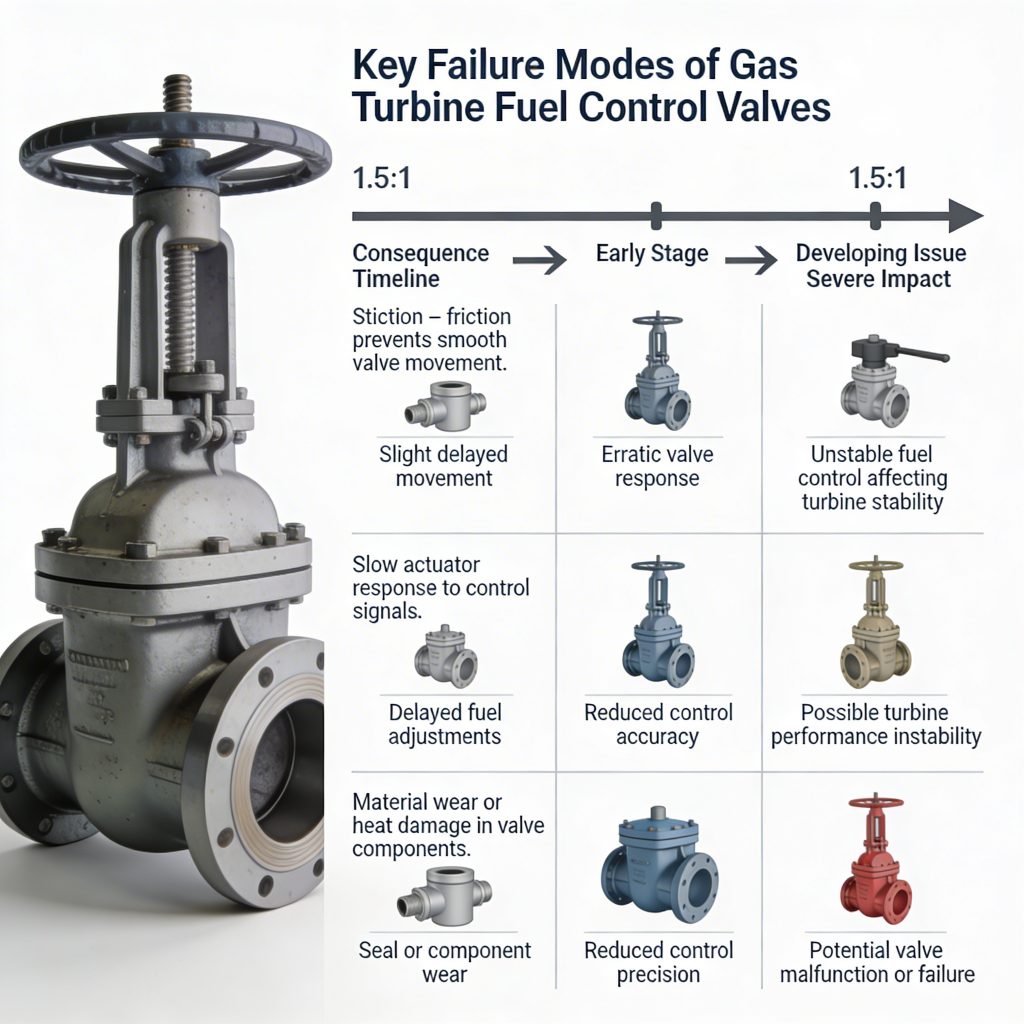
The failure of gas turbine fuel valves often comes down to one of three insidious technical issues. These “villains” are frequently overlooked or misunderstood, leading to costly and preventable outages.

#1 Stiction (The Silent Killer)
Gas turbine valve stiction is static friction that prevents a valve spool from moving until a significant control signal threshold (deadband) is crossed. It often develops due to contamination, oxidation of spool surfaces, thermal cycling, or infrequent operation, particularly in hydraulic control valve turbine failure scenarios.
This is dangerous because the valve appears functional during routine checks, but fails under actual load or trip conditions. This diagnostic gap means warnings are missed until it’s too late. The real consequence? Stiction causes fuel metering error, leading to combustor instability, potential temperature exceedance, and severe hot section damage.
#2 Inadequate Response Time
Modern safety standards (SIL 2/3) require fuel valve shutoff response times of ≤200ms. However, older pneumatic and motor-actuated valves commonly achieve 500ms to 2 seconds. “Response times of half a second to a second are commonplace — such systems operate at risk.” (Turbomachinery Magazine, paraphrased).
During an emergency trip, 200ms of extra fuel flow at turbine operating conditions is enough to cause significant damage, a flame-out, or a failed hot restart attempt. Plants often overlook this because valves that are “slow but working” pass routine inspections. This failure mode is only truly revealed during a critical trip event, making fuel shutoff delay a critical issue.
#3 Material Failure and Thermal Degradation
The extreme high-temperature environments of gas turbines inevitably degrade seal materials, coatings, and metal alloys over time. This leads to issues like seat leakage.
Coking, where fuel oil residue bakes onto valve seats, causes partial fuel bypass even when the valve is supposed to be fully closed. Hot corrosion, from sulfur and vanadium contaminants attacking valve body materials, is another significant problem. Lastly, continuous pressure fluctuations in the fuel line can lead to fatigue cracking, a form of material fatigue.
The Failure Sequence — From First Warning Sign to Full Shutdown
The path to a multi-million-dollar shutdown rarely starts with a bang. It often begins with subtle warnings, gradually escalating over hours or days, tracing the root cause of plant shutdown back to a small, under-specified component.
Hour 0 — The Warning Signs Nobody Acted On
The control room logs subtle DCS alarms: a slightly elevated exhaust temperature spread, a minor fuel flow deviation, perhaps one valve position feedback discrepancy. These signals are below the trip threshold and often dismissed as sensor drift.
The intervention window is missed. At this point, a $2,000 valve service call or diagnostic could have resolved the issue. Instead, the problem progresses silently, waiting for the opportune moment to strike.
Hour 6 — The Trip Event
A load transient occurs, demanding rapid valve modulation. The stiction-induced deadband prevents the fuel control valve from responding quickly enough. The gas turbine trips on high exhaust temperature.
An attempted restart fails. The fuel valve cannot achieve the required response time, leading to a second trip. The plant is now offline, capacity payments are forfeited, and an emergency notification is sent to the grid operator. This is a gas turbine forced outage in full swing.
Hour 24 — The Diagnostic Gap
The maintenance team inspects the valve. On the bench, it “moves freely” – because stiction is load-dependent and rarely visible during bench tests. The valve is reinstalled, the turbine attempts a restart, and trips again within hours.
The root cause remains unidentified. The OEM is called, but their inspection team has a 48-hour lead time. The cost meter ticks rapidly: lost generation ($50–150K/day), emergency labor, and the need to procure peaking power to cover the generation gap.
Day 4 — Root Cause Identified, Parts on Order
A metallurgical inspection finally reveals coking on the valve seat and spool wear beyond serviceable limits. The replacement valve isn’t stocked on-site, and the OEM quotes a 7–14 day lead time for the specified component.
By this point, the plant remains offline or operates at a significantly reduced load, perhaps on secondary fuel with manual override. The cumulative financial exposure has reached $800K–$1.5M+, all preventable.
The Real Financial Anatomy of a Gas Turbine Fuel Valve Failure
The direct and indirect costs associated with a gas turbine unscheduled outage cost quickly balloon, far exceeding the price of a critical component. Understanding the true cost of gas turbine downtime is crucial for making informed investment decisions.
The Hidden Costs Nobody Puts in the Budget
Beyond the direct financial losses, there are numerous hidden costs. These include impacts on reputation and reliability ratings with grid operators, significant staff overtime costs, and contractor mobilization fees. Regulatory reporting obligations for extended forced outages add another layer of complexity.
Furthermore, post-incident insurance premiums can rise, and accelerated inspection intervals may be mandated. These intangible costs significantly increase the burden of an outage.
What Plant Managers and Reliability Engineers Can Do Right Now
Moving from understanding the risks to implementing solutions is crucial. Proactive steps can significantly reduce the likelihood and impact of a gas turbine fuel valve failure.
Step 1 — Audit Your Current Fuel Valve Specification
Review the SIL rating, actuator type, response time certification, and material specification of your existing fuel valves. Red flags include motor-actuated valves in critical service, a lack of SIL rating, age exceeding 10 years without reconditioning, or no spare on-site.
Ensure critical valves are fire-safe certified and consider redundant shutoff architectures, like a block-and-bleed setup, for enhanced safety.
Step 2 — Implement a Valve Health Monitoring Program
Proactive monitoring is key. Track valve position feedback versus control signals to identify early signs of stiction. Trend response time for any degradation. Consider partial stroke testing monthly and ensuring a full functional test is performed at every planned outage.
Tools like DCS diagnostics, partial stroke testing, and acoustic monitoring can provide valuable insights for condition-based monitoring and predictive maintenance. Our Gas Turbine Fuel Valve Maintenance Checklist offers a comprehensive guide.
Step 3 — Stock Critical Spare Parts On-Site
The OEM lead time problem is real: critical valve components routinely have 7–14 day lead times. This delay, during a forced outage, is far more expensive than the cost of stocking a spare.
Stock at least one complete valve assembly (including actuator) for each critical service, plus all associated elastomeric seal kits. This ensures immediate replacement and minimizes downtime.
Step 4 — Upgrade Under-Specified Legacy Valves
The time to upgrade under-specified valves is during the next planned outage window, not after the next trip. Proactive replacement saves millions. When specifying new valves, look for pneumatic actuation, SIL 2/3 certification, and ≤200ms response time.
Choose fire-safe designs and specify a redundant shutoff architecture where appropriate. For detailed guidance, revisit our How to Specify a Gas Turbine Fuel Control Valve article.
FAQ — Questions Plant Managers Ask After a Fuel Valve Failure
Q1: What is the most common cause of gas turbine fuel valve failure?
The two most frequent failure modes are stiction, caused by spool contamination or wear, and seat leakage, often from coking. Both are progressive issues that can be detected with proper monitoring before they lead to an unplanned trip.
Q2: How much does a gas turbine unscheduled outage cost per day?
Lost generation revenue alone for combined cycle plants runs between a lot per day. When you add emergency repair labor, replacement parts, OEM mobilization, peaking power procurement, and capacity penalties, a 7-day forced outage can easily exceed $1–2 million in total exposure.
Q3: What is valve stiction and why is it dangerous in a gas turbine?
Stiction is static friction that prevents a valve from moving until a large control signal threshold is crossed. This creates a “deadband” where the valve doesn’t respond to small changes, which is dangerous during load transients or emergency trips when precise and rapid fuel modulation (or shutoff) is needed immediately.
Q4: How often should gas turbine fuel control valves be inspected?
Partial stroke tests should be performed monthly to detect increasing stiction or a degrading response. Full functional testing with response time measurement should occur at every planned outage, typically every 8,000–24,000 operating hours, depending on the specific maintenance program.
Q5: Can a slow fuel valve response time cause a gas turbine to fail?
Yes. While modern safety standards require a ≤200ms shutoff response, many legacy motor-actuated valves commonly achieve response times of 500ms to 2 seconds, operating at significant risk. During a trip event, the extra fuel delivered in that time gap can easily cause combustor damage or a failed restart attempt, leading to an outage.
Q6: What is the difference between a planned and unplanned gas turbine outage in terms of cost?
Planned outages are scheduled, parts are pre-staged, and labor is contracted in advance, making costs predictable and budgeted. Unplanned outages, by contrast, involve emergency mobilization, premium freight for parts, and immediate lost generation revenue from day one, typically making them 3–5 times more expensive than equivalent work performed during a planned and properly managed shutdown.
خاتمة
The $2 million shutdown doesn’t begin with a catastrophic system failure; it begins with a gas turbine fuel control valve that was under-specified, under-monitored, and under-valued until the moment it mattered most. The financial case for premium specification, rigorous monitoring, and proactive replacement is not an engineering argument—it is an unambiguous business case.
If your gas turbine’s fuel control valve specification hasn’t been reviewed in the last five years, now is the time—before the next planned outage window closes. Take control of your plant’s reliability and maximize your operational uptime.
Ready to optimize your fuel control valve performance?


 English
 Arabic
 Russian
 French
 Spanish