
Did You Specify Fail-Safe or Fail-Stupid?
Specifying an automated valve seems straightforward. But getting one detail wrong—the fail-safe mode—can turn your multi-million dollar safety system into a liability that causes the very disaster it was meant to prevent.
The critical difference is this: “Fail-Closed” means the valve closes on power loss, stopping a flow. “Fail-Open” means the valve opens on power loss, starting or continuing a flow. Choosing the wrong ball valve actuator for the fail-safe mode can have catastrophic consequences.
When is ‘Fail-Closed’ the Only Safe Choice?
A flammable chemical is feeding a tank that is about to overflow. If the power fails, what must the inlet valve do? For the vast majority of applications, a power loss must result in the process stopping. In these cases, a “Fail-Closed” ball valve actuator is the only responsible choice.
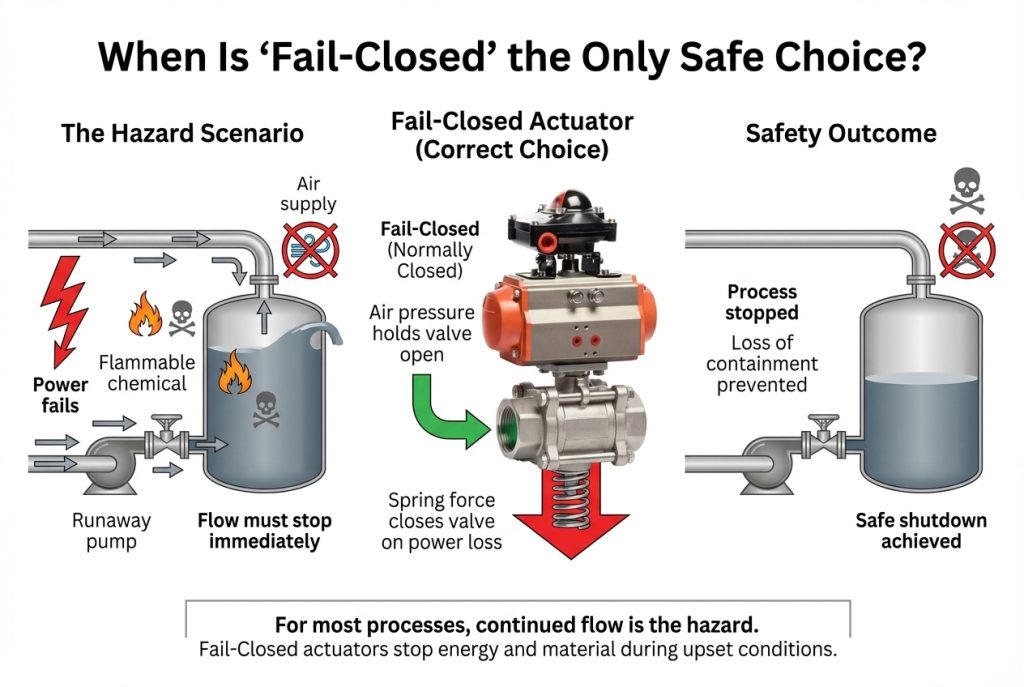
Dive Deeper: Stopping the Flow to Prevent a Hazard
The “Fail-Closed” (FC) or “Normally Closed” (NC) configuration is the default for a reason. Its purpose is to halt material movement during an upset. You choose Fail-Closed when the continuation of flow is the primary hazard.
| Application Example | Hazard of Continued Flow |
|---|---|
| Fuel Gas Line to a Burner | An uncontrolled release of fuel can cause a massive explosion. |
| Chemical Dosing Line | Overdosing a reactor can cause a dangerous off-spec reaction. |
| Tank Inlet Valve | The tank could overfill, leading to a major spill. |
Why Would You Ever Want a Valve to ‘Fail-Open’?
It seems counterintuitive, but sometimes the most dangerous thing a valve can do is close. A “Fail-Open” ball valve actuator is specified when the stoppage of flow is the condition that creates the hazard. This is common in cooling systems, as this AIChE study indicates, where loss of flow can quickly lead to overheating and equipment failure.
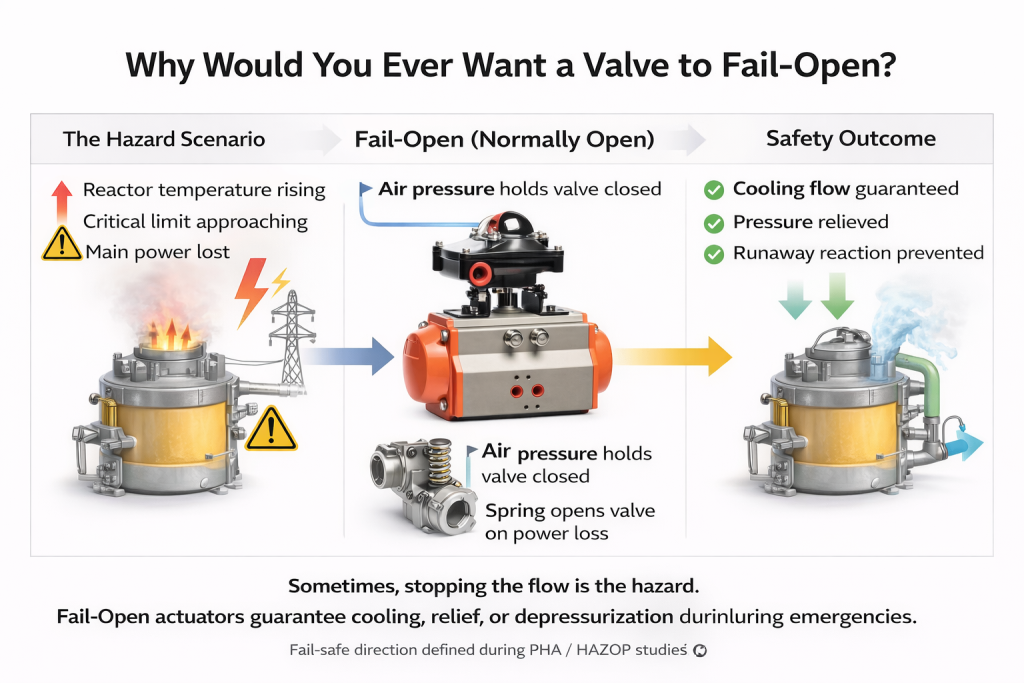
Dive Deeper: Starting the Flow to Mitigate a Hazard
The “Fail-Open” (FO) or “Normally Open” (NO) configuration is a critical decision to guarantee a flow path for cooling or pressure relief during an emergency. You deliberately create a flow path to bring the process to a safe state.
| Application Example | Hazard of Stopped Flow |
|---|---|
| Reactor Cooling Water Inlet | Loss of cooling will cause a runaway reaction and potential rupture. |
| Emergency Pressure Vent Line | A blocked vent path can cause a vessel to over-pressurize and explode. |
| Fire Deluge System Valve | A closed valve prevents fire water from being delivered. |
Conclusion: A Critical Safety Function
The fail-safe mode of a ball valve actuator is not a simple preference; it is a critical safety function determined by a rigorous analysis of your process. “Fail-safe” means it fails to a state that mitigates the hazard. Getting this right is fundamental to building a safe, reliable plant.


 English
 Arabic
 Russian
 French
 Spanish