
Are you struggling to achieve consistent, reliable control over your fluid systems? Manual valves lead to operator error and slow response times, while complex pneumatic systems require a massive investment in air compressors and infrastructure, leading to constant maintenance headaches with leaks and moisture problems.
أن electric ball valve with an actuator is your all-in-one solution for precise, automated flow control. This integrated system provides reliable, remote on/off operation without the need for compressed air, making it the superior choice for modern industrial automation, HVAC, and water treatment applications.
Real-World Insight: I remember talking with Hassan, a Chief Engineer for a new food processing plant. His team was debating between مشغل هوائي and electric actuators for dozens of process lines. Hassan pointed out that while pneumatics are fast, the cost of running and maintaining clean, dry compressed air throughout the facility would be enormous. He opted for our electric actuated ball valves. A year later, he told me the energy savings alone paid for the initial cost difference, and his maintenance team was thrilled they didn’t have to chase air leaks. It’s a powerful lesson in looking at the total cost of ownership, not just the upfront price.
What Is an Electric Ball Valve with an Electric Actuator?
Are you confused by the different terms used for automated valves? Understanding the core components and how they work together is the first step to making a confident choice for your system to choose the right electric ball valve actuator.
أن صمام كروي كهربائي is a quarter-turn shutoff valve that is opened and closed by a motorized electric actuator. This complete system consists of the valve body, the actuator that provides the rotational force, and the internal electronics that control its movement. It’s a self-contained automation package.
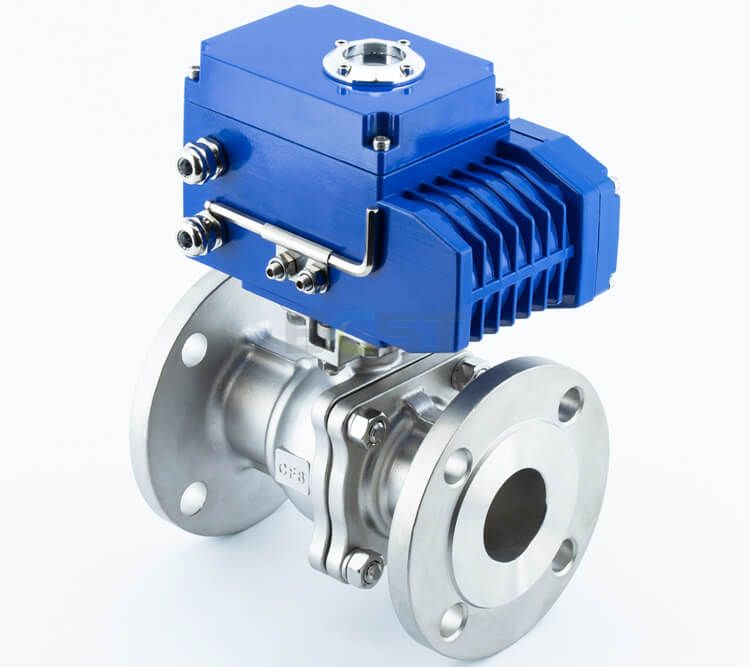
Let’s break down exactly how this powerful combination works and the technology that makes it so reliable. You’ll often hear terms like “motorized ball valve,” “automated ball valve,” or “electrically actuated valve”—they all refer to this same integrated system. The key distinction is that it uses electricity, not compressed air like a pneumatic actuator.
The actuator contains a small but powerful electric motor connected to a gear system. When power is applied, the motor drives the gears, which turn the valve stem exactly 90 degrees to open or close the ball valve. This simple, direct action is incredibly reliable. Inside the actuator, electronic torque limiters act as a safety mechanism, preventing the motor from over-torquing and damaging the valve’s internal seats or stem. At the same time, internal micro-switches are activated at the end of the open and close cycles, providing a clear electrical signal back to your control system (like a PLC or BMS) to confirm the valve’s exact position. Modern actuators pack in even more smart technology, like multi-voltage capability (accepting anything from 12VDC to 240VAC), manual overrides for power-outage situations, and even anti-condensation heaters for use in damp or cold environments.
Why Choose Electric Actuated Ball Valves Over Manual or Pneumatic Options?
Is the higher initial cost of an electric valve giving you pause? The long-term operational benefits and superior performance deliver a return on investment that manual or pneumatic options simply can’t match.
Electric actuated ball valves provide unmatched precision, reliability, and automation capabilities with a lower total cost of ownership. They eliminate the need for costly compressed air infrastructure and a prone to human error, making them the smarter choice for modern process control.

When you move from a manual valve to an electric one, you unlock the power of automation. You can operate valves in remote or hazardous locations from a central control room, integrate them with SCADA or PLC systems for programmed sequences, and achieve rapid response times for emergency shutdowns. For high-cycle applications, it eliminates operator fatigue and ensures perfect, repeatable positioning every single time.
The advantages over pneumatic systems are just as compelling. You completely eliminate the need for expensive air compressors, dryers, filters, lubricators, and the extensive piping needed to support them. There are no air leaks to chase down, and the slower, more controlled rotation of an electric actuator prevents the damaging water hammer that fast-acting pneumatic systems can cause. From an energy standpoint, an electric actuator only consumes power during its short cycle time. A pneumatic system, on the other hand, requires a compressor to run constantly to maintain system pressure, representing a significant continuous energy drain. This efficiency, combined with weatherproof enclosures (NEMA 4X, IP67) and a typical lifespan exceeding 100,000 cycles, makes the electric ball valve a more durable, efficient, and cost-effective long-term solution.
What Technical Specifications and Standards Do You Need to Know?
Feeling overwhelmed by datasheets and technical jargon? Focusing on a few key standards and specifications will ensure you select an actuator and valve that are perfectly matched and will integrate seamlessly into your system.
The most critical specifications are the ISO 9001 mounting standard, pressure/temperature ratings, torque requirements, and electrical compatibility. Getting these four things right ensures the valve will perform safely, fit correctly, and last for its intended service life.
Let’s dive into the details that matter most.
- ISO 9001 Mounting Standard: This is the international standard that dictates the dimensions of the mounting pad on the top of the valve and the drive square that connects to the actuator. Adherence to this standard is a game-changer because it guarantees that an ISO 9001 compliant actuator from one manufacturer will bolt directly onto an ISO 9001 compliant valve from another, without needing custom brackets or adapters. It simplifies installation, replacement, and future upgrades immensely.
- تصنيفات الضغط ودرجة الحرارة: The valve body will have clear pressure ratings, typically from 720 to 1,000 PSI (or ANSI Class 150-300), and temperature limits based on the seat material (e.g., -20°F to 400°F for Viton). It is crucial to check pressure-temperature derating charts, as a valve’s ability to hold pressure decreases as the temperature of the media rises.
- Torque Ratings and Sizing: Torque is the rotational force required to turn the valve. The actuator you choose must be able to produce more torque than the valve requires. A standard rule of thumb is to take the valve’s published torque requirement and multiply it by a safety factor of 1.2 to 1.5. This ensures the actuator has enough power to overcome friction and pressure spikes.
- Electrical Specifications: You must match the actuator’s voltage to your available power supply, whether it’s low voltage DC (12V/24V) or AC (115V/230V). You also need to consider the control signal. A simple on/off system may just need power, while a more advanced process control system might require 4-20mA analog control for positioning.
What Materials, Body Types, and Configurations Are Available?
Does the sheer variety of valve options seem daunting? Understanding how to match the valve’s material and configuration to your specific media, pressure, and application is the key to ensuring long-term, leak-free performance.
The right electric ball valve assembly is a combination of the correct body material, seat material, and connection type for your unique process. From stainless steel for corrosive media to tri-clamp ends for sanitary applications, every component can be specified for optimal performance.
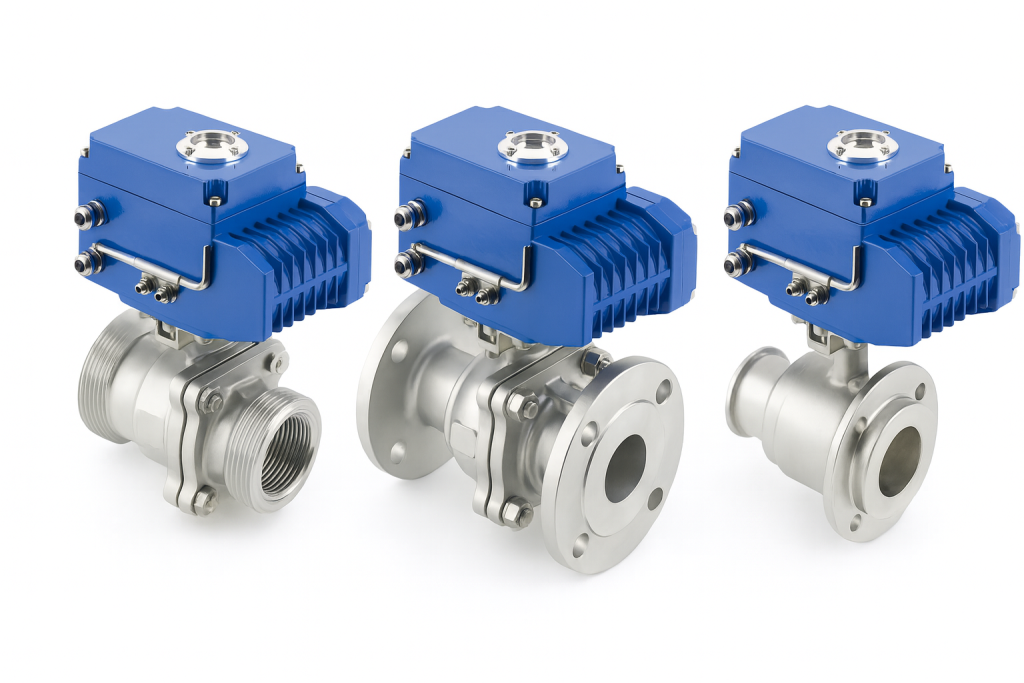
Choosing the right build is critical for the valve’s longevity.
- Valve Body Materials:
- فولاذ مقاوم للصدأ (316L): The go-to for corrosive media, sanitary applications (food, pharma), and marine environments.
- Carbon Steel: A cost-effective and robust choice for general industrial applications like oil and gas.
- Brass: Excellent for water, air, and other non-corrosive utility lines.
- PVC: Used for chemical applications where metal is unsuitable, offering great compatibility at lower pressures and temperatures.
- Seat Materials and Sealing: The soft seats create the “bubble-tight” seal against the ball. RTFE (Reinforced Teflon) is the all-around standard. For higher temperatures or specific chemicals, you might upgrade to فيتون. For water service, EPDM is a common choice.
- Connection Types: Valves can connect to your piping in several ways. NPT threaded connections are common for smaller sizes. ذو حواف connections (ANSI 150/300) are standard for larger industrial pipes. Tri-clamp ends are used in sanitary systems for easy cleaning.
- Port Configurations: أ 2-way valve is the standard on/off valve. A 3-way valve can be used to divert flow from one inlet to two different outlets, or mix flow from two inlets to one outlet. Most industrial applications benefit from a full-port design, which minimizes pressure drop and is ideal for slurries or viscous fluids.
Where Are Electric Ball Valves Used?
Wondering if an electric ball valve is the right fit for your industry? From controlling the temperature in a skyscraper to automating a chemical batching process, these valves are the workhorses behind countless modern systems.
Electric actuated ball valves are used in any application that requires reliable, automated on/off fluid control. Key industries include HVAC, industrial process control, water treatment, energy, and OEM equipment manufacturing, where their precision and remote-control capabilities are essential.
Here are just a few real-world examples of where these valves make a critical difference:
- HVAC and Building Automation: وفقاً ل Universitas Darul ulum study, Electric Ball Valve Actuator are also widely used in building HVAC and district heating systems for zone control and energy management because they support precise modulating control compared with simple on/off valves.
- Industrial Process Control: In a chemical plant, electric valves automate precise batching and dispensing. In a food processing facility, they route ingredients through different stages of production, ensuring consistency and safety.
- Water Treatment and Utilities: Municipal water and wastewater plants use hundreds of these valves to automate flow through filters, chemical dosing systems, and distribution lines, allowing a small crew to manage a massive facility.
- Oil, Gas, and Energy: They are used for pipeline isolation, controlling flow at distribution points, and managing feedwater in power plants, often in remote locations where manual intervention is impractical.
- OEM and Equipment Manufacturing: You’ll find them inside everything from car wash systems that automatically dispense soap and wax to complex medical and laboratory instruments that require precise fluid control. Their compact, self-contained design makes them perfect for integration into other machines.
How Do You Select the Right Electric Ball Valve?
Ready to make a selection but want to ensure you don’t miss a critical detail? Following a structured, step-by-step decision framework guarantees you cover all your bases and choose the perfect valve for the job.
A proper selection process involves five steps: defining your flow requirements, calculating torque, confirming power availability, assessing the environment, and planning for integration. This methodical approach eliminates guesswork and prevents costly specification errors.
Walk through this checklist to engineer your perfect solution:
- Step 1 – Determine Flow Requirements: Start with the basics. What is the media (fluid)? What are its maximum pressure and temperature? Will the valve operate continuously or just a few times a day (duty cycle)?
- Step 2 – Calculate Torque Requirements: Find the torque requirement on the valve’s datasheet. Multiply that number by a safety factor of at least 1.2. Select an actuator with a torque output that is greater than this calculated value.
- Step 3 – Evaluate Voltage and Power: What power is available at the installation site? Is it 24VDC from a control panel or 120VAC from a wall outlet? Ensure the actuator you choose matches this supply.
- Step 4 – Assess Environmental Conditions: Will the valve be indoors or outdoors? Exposed to rain, humidity, or corrosive fumes? For wet or outdoor environments, a NEMA 4X أو IP67 rated enclosure is non-negotiable.
- Step 5 – Confirm Mounting and Integration: Double-check that both the valve and actuator are آيزو 9001 compliant for easy direct mounting. How will you wire it? Does your control system need a simple on/off signal, or a 4-20mA signal for position feedback?
What About Installation, Commissioning, and Maintenance?
You’ve selected the perfect valve, now what? Proper installation and maintenance are essential to ensure you get the 100,000+ cycle lifespan you paid for.
A successful installation hinges on a pre-installation check, following best practices during mounting, and a thorough commissioning test. Routine maintenance is minimal but crucial for maximizing the valve’s operational life and preventing unplanned downtime.
Here’s how to ensure a long and reliable service life. Before you even begin, verify that the valve and actuator specifications on the box match your order. Check for any shipping damage. During installation, always support the valve and pipe properly; the actuator is not a handle. Ensure the manual override is accessible in case of a power failure. Once installed, and before applying system pressure, test the valve electrically and with the manual override to ensure smooth operation. Commissioning involves checking that the open and close limit switches are sending the correct signals back to your control system. For maintenance, a quarterly visual inspection for leaks or corrosion is sufficient. I advise clients to cycle the manual override semi-annually just to keep it from seizing. The sealed motor and gearbox require no internal lubrication, making these units remarkably low-maintenance over their long lifespan.
خاتمة
Electric actuated ball valves are the intelligent choice for modern automation. They offer precise control, superior reliability, and a lower total cost of ownership compared to traditional pneumatic or manual systems.


 English
 Arabic
 Russian
 French
 Spanish