
Butterfly Valve Parts: Body, Disc, Seat, Stem & Actuator Guide
Your project’s success hinges on details. A single component failure can cause costly downtime. Understanding your equipment, especially valve parts, is the key to preventing these issues and ensuring reliability.
The core butterfly valve parts are the body, disc, stem, and seat. The body houses all components. The disc rotates to control flow. The stem connects the disc to the actuator. The seat provides a leak-proof seal when the valve is closed.
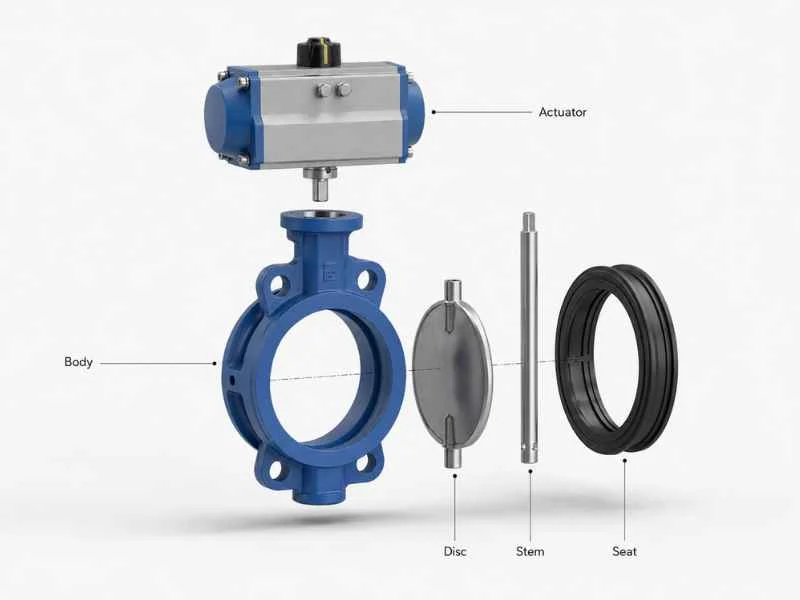
Knowing the names is a good start. But for a chief engineer like you, understanding how these parts work together is what truly matters. Your decisions on materials and design directly impact plant safety and efficiency. Let’s dive deeper into each component, so you can make the most informed choices for your critical projects.
The Body and Disc Form the Butterfly Valve’s Foundation
Choosing the wrong valve body can lead to dangerous leaks or corrosion. This compromises safety and production. Selecting the right body and disc material is your first line of defense.
The valve body is the outer shell that holds everything together and connects to the pipe. The disc is the component inside that opens and closes to control the fluid. The design and material of these two parts are fundamental to the valve’s performance and lifespan.
Body and Disc Design
As a project leader, you know that one size does not fit all. The same is true for valve bodies. The choice between different body types depends entirely on your system’s requirements, especially regarding installation and maintenance.
Valve Body Types
Your connection needs will guide your selection. Each type offers specific advantages for installation and end-of-line service.
| نوع الجسم | الوصف | Best Use Case |
|---|---|---|
| الرقاقة | A simple design that fits between two pipe flanges. | General purpose applications where end-of-line service is not required. |
| Lug | Has threaded lugs around the body for bolting to pipe flanges. | Allows for end-of-line service, meaning one side of the piping can be removed while the valve remains in place. |
| ذو حواف | Features its own flanges that bolt directly to the pipe flanges. | High-pressure and high-temperature systems where a more robust and secure connection is necessary. |
Disc Design and Material
The disc is constantly in contact with the process fluid. Its material must resist corrosion and wear. The disc’s shape is also engineered to improve flow characteristics and reduce pressure drop, which are key concerns for plant efficiency. Common materials include ductile iron for water applications, stainless steel for general corrosive resistance, and special alloys like Hastelloy for highly aggressive chemicals.
The Seat and Stem Ensure a Perfect Seal and Control
A worn-out seat causes constant, slow leaks. This can spoil a batch or create a safety hazard. A weak stem can fail, leaving a valve stuck open or closed during an emergency.
The seat is the soft seal that the disc presses against to create a tight shutoff. The stem is the shaft that connects the actuator to the disc, allowing it to turn. The quality of these parts directly determines the valve’s sealing ability and operational reliability.
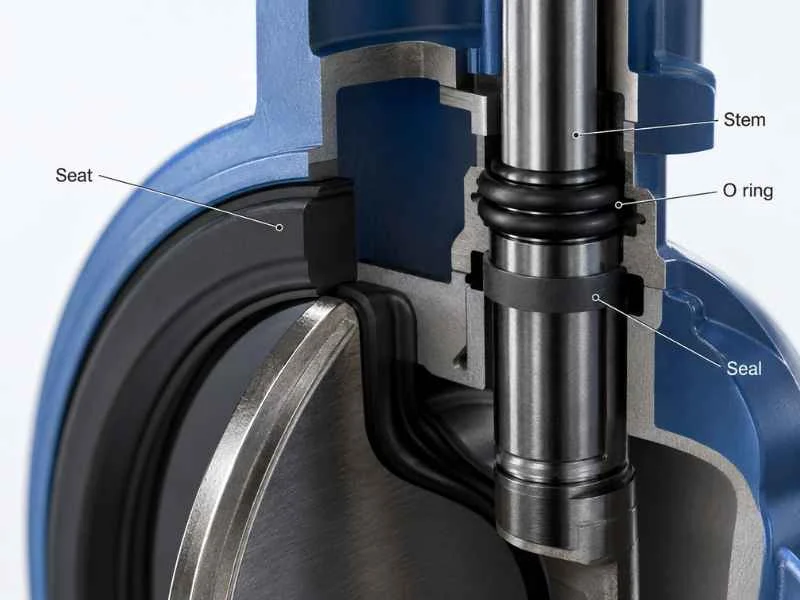
Sealing and Control
For an engineer overseeing complex processes, reliability is everything. The seat and stem are where many potential failures occur. Understanding their materials and design is critical for long-term, trouble-free operation. These components work together to provide both tight sealing and precise control.
Seat Material is Critical for Performance
The seat is often the first part to wear out. Its material must be compatible with the fluid and temperature range of your process. A wrong choice can lead to swelling, hardening, or chemical degradation.
| مادة المقعد | Temperature Range (°C) | الاستخدام الشائع |
|---|---|---|
| EPDM | -40 to 120 | Water, steam, and alcohols. Not suitable for oils. |
| NBR (Buna-N) | -10 to 80 | Oils, fuels, and hydraulic fluids. |
| PTFE (تفلون) | -50 to 200 | Aggressive chemicals and high-temperature applications. |
| Viton (FKM) | -20 to 200 | Wide range of chemicals, oils, and high temperatures. |
Stem Design and Sealing
The stem must be strong enough to handle the torque from the actuator without twisting or breaking. Stems come in two main designs: one-piece, where the stem runs through the entire valve, and two-piece, which can offer better flow characteristics. Just as important is the stem sealing. O-rings or packing are used around the stem to prevent process fluid from leaking out of the valve body, which is a major safety consideration.
The Actuator Drives the Valve’s Operation
In a large refinery or chemical plant, you cannot run around turning valves by hand. You need automated control for efficiency and quick response. Relying on manual operation is not an option.
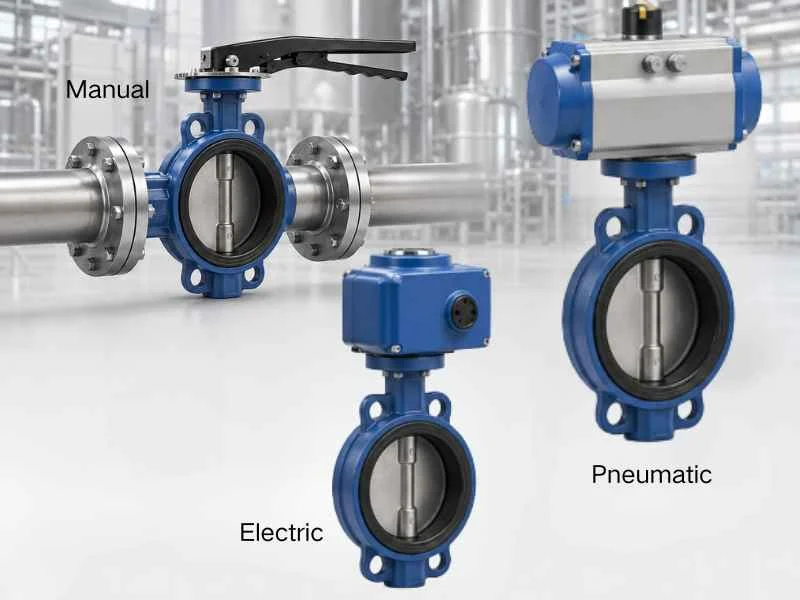
The actuator is the mechanism that opens and closes the valve. It can be a simple hand lever, a gearbox, or a fully automated electric or pneumatic device. Your choice depends on your plant’s control philosophy, power sources, and safety requirements.
Actuation and Other Parts
As the chief engineer, you are responsible for the overall control strategy of the plant. The actuator is the physical link between your control system and the process. Other smaller parts, while often overlooked, are also essential for smooth and safe operation.
Manual vs. Automated Actuation
Manual actuators are simple and reliable for less critical or infrequently used valves. Levers are used for smaller valves, while gearboxes provide mechanical advantage to turn larger valves. For automated systems, you have two main choices:
- المشغلات الكهربائية: Use an electric motor to turn the valve. They are precise, can be integrated with complex control systems like DCS or PLC, and provide feedback on the valve’s position.
- المشغلات الهوائية: Use compressed air to move a piston or diaphragm. They are fast-acting, making them ideal for emergency shutdown (ESD) systems. They are also intrinsically safe for use in explosive environments.
Other Important Butterfly Valve Parts
When I was younger, I saw a major production line stop because of a tiny, failed component. It wasn’t the body or the disc; it was a cheap O-ring that had degraded. This taught me that every part matters. Bushings, for example, are small bearings that support the stem and reduce friction, ensuring smooth rotation. Gaskets and O-rings provide essential seals at joints and connection points. Never underestimate these small butterfly valve parts; their failure can have big consequences.
Material Selection Dictates Valve Lifespan and Safety
Choosing a valve material that is incompatible with your process fluid can lead to catastrophic failure. Imagine an aggressive chemical slowly eating through a valve body until it bursts. Following industry standards is your best protection.
Selecting materials for your butterfly valve parts is not a guess. It is a science based on the process fluid, its concentration, temperature, and pressure. Following established standards like API, ASME, and ISO ensures quality, safety, and interoperability.
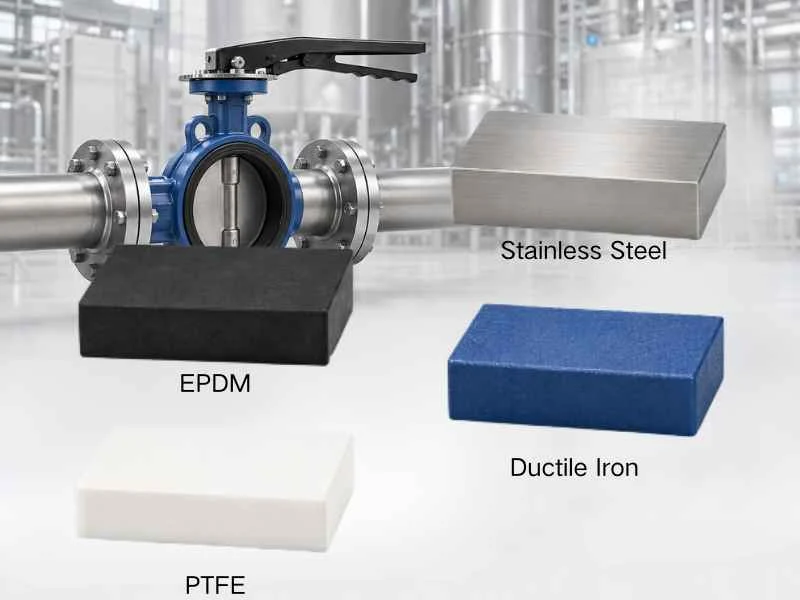
Materials and Standards
Your role requires you to manage risk and ensure compliance. In the world of valves, this means a deep understanding of materials and the standards that govern them. This knowledge is not just about performance; it is about protecting your people, your assets, and the environment.
Matching Materials to Your Medium
The interaction between the valve materials and the process fluid is the most important factor in selection. You must consider every wetted part: the body, disc, and seat.
- الخدمات العامة: For water or air, a cast iron or ductile iron body with an EPDM seat and a stainless steel disc is a cost-effective and reliable choice.
- المعالجة الكيميائية: For acids or bases, you might need a valve with a full PTFE lining to protect all metal parts. The disc and body could be made of stainless steel or more exotic alloys like Hastelloy or Duplex.
- Oil and Gas: In this industry, materials must resist corrosion from sour gas (H2S). Carbon steel bodies with specialized NBR or Viton seats are common. Standards like NACE MR0175 are mandatory for material selection in these sour service environments.
Why Standards Matter
Standards are the collective wisdom of the industry. They provide a common language for engineers, manufacturers, and operators. For butterfly valves, API 609 is a key standard that defines design, materials, face-to-face dimensions, and testing requirements. Adhering to these standards ensures that the valve you specify will perform as expected. It also guarantees that it has undergone critical tests, such as hydrostatic pressure testing and seat leakage tests, providing documented proof of its integrity and safety. For you, this means peace of mind and a compliant, reliable plant.
Frequently Asked Questions (FAQ)
Q1: How do I choose the right materials for my butterfly valve parts?
A1: To choose the right materials, you must consider the process fluid, its temperature, pressure, and concentration. For water, ductile iron and EPDM are common. For chemicals, you may need stainless steel, special alloys, or PTFE-lined parts. Always consult a chemical compatibility chart and relevant industry standards.
Q2: What are the most common failure points in butterfly valve parts?
A2: The most common failure point is the seat. It is a soft part that can wear out, harden, or degrade from chemical attack, leading to leaks. The stem seals (packing or O-rings) are another common point of failure, which can cause external leaks.
Q3: Can I replace individual butterfly valve parts, or do I need a new valve?
A3: Yes, for many high-performance or repairable butterfly valves, you can replace individual parts like the seat, stem, and disc. This is often more cost-effective than replacing the entire valve, especially for larger sizes. These replacement kits are sometimes called “valve repair kits.”
Q4: What standards are important for butterfly valve parts in the oil and gas industry?
A4: In oil and gas, API 609 is the main design standard for butterfly valves. For materials in sour service (containing H2S), NACE MR0175 is critical to prevent sulfide stress cracking. Also, fire-safe design standards like API 607 are often required.
Q5: How does temperature affect the performance of butterfly valve parts?
A5: Temperature dramatically affects performance. High temperatures can cause soft seats like EPDM or NBR to degrade and fail. It can also reduce the pressure rating of the valve body. For high temperatures, you must select metal seats or high-performance polymer seats like PTFE or Viton.
Q6: Why is the seat considered one of the most critical butterfly valve parts?
A6: The seat is critical because it is the part that provides the tight seal. If the seat fails, the valve will leak when closed. This can compromise process control, product quality, and plant safety. Its material must be perfectly matched to the application for reliable, long-term shutoff.
Final Thought
Understanding each component—from the body and disc to the seat and stem—is key to ensuring plant reliability. Choosing the right materials based on industry standards is not just good practice; it’s essential for safety and long-term performance. Our team at اختبار BCST can help you select the right صمامات الفراشة for your project.


 English
 Arabic
 Russian
 French
 Spanish