
When selecting a control valve, most procurement teams focus on the initial purchase price. However, the true cost of a valve isn’t found on the invoice; it’s hidden in the pressure drop across your system and the electricity your pumps consume to overcome it. For high-flow industrial systems, choosing a straight-through globe valve over an angle valve could be costing your facility thousands in “invisible” energy waste every year.
This financial audit compares the Total Cost of Ownership (TCO) between these two designs. We examine the flow coefficient (Cv), calculate the 5-year pumping costs, and analyze how valve geometry impacts piping complexity.
The Efficiency Gap: Comparing Cv and Pressure Drop
ال Cv value (flow coefficient) represents a valve’s efficiency at allowing fluid to pass. A higher Cv indicates less resistance. Because a straight-through globe valve forces fluid into a tortuous “S” shape, it inherently creates more friction than an angle valve, which provides a cleaner 90-degree exit.
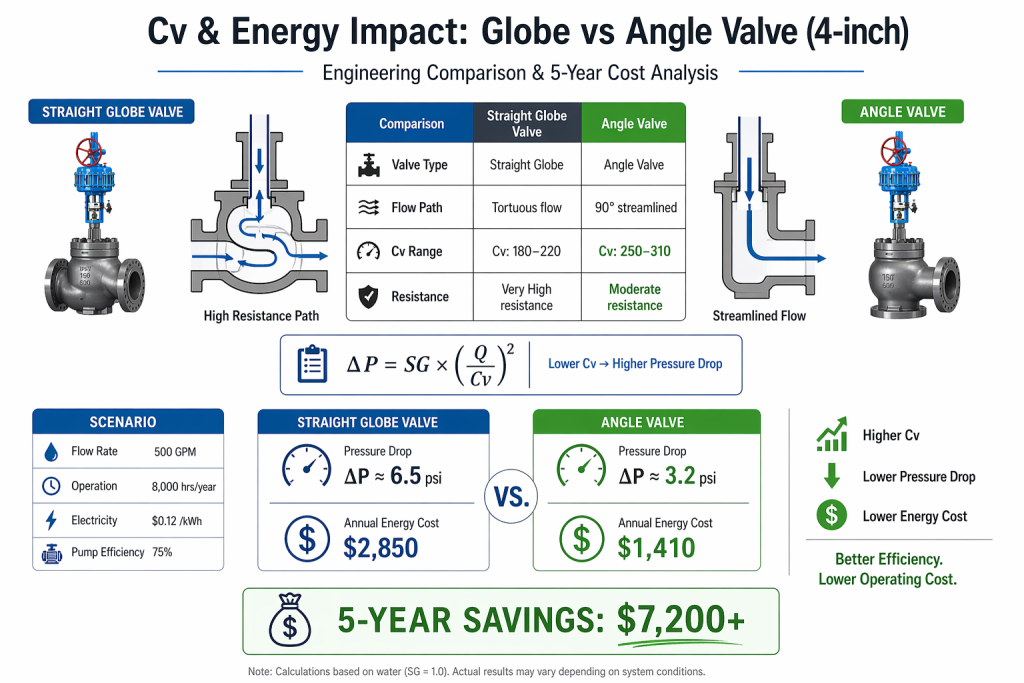
Typical Cv Comparison (4-inch Valve)
| نوع الصمام | Internal Flow Path | Estimated Cv Range | Resistance Level |
|---|---|---|---|
| Straight Globe | Tortuous S-Shape | 180 – 220 | عالية جداً |
| صمام الزاوية | Streamlined 90° Turn | 250 – 310 | معتدل |
Using the standard industry formula ΔP = SG × (Q / Cv)², we can see that for a fixed flow rate (Q), the lower Cv of a straight globe valve results in a significantly higher pressure drop (ΔP).
5-Year Energy Audit: The Cost of Pumping Against Resistance
Every psi lost across a valve requires the pump to work harder. To calculate the financial impact, we estimate the Pumping Cost associated with the valve’s pressure drop.
By selecting an angle valve, you reduce the “tax” paid to the utility company for every gallon moved through the system. For large-scale plants with dozens of valves, these savings scale into the six-figure range.
Beyond Energy: Piping Complexity and Maintenance
The TCO includes more than just energy; it includes the physical footprint and the risk of leaks at joints.
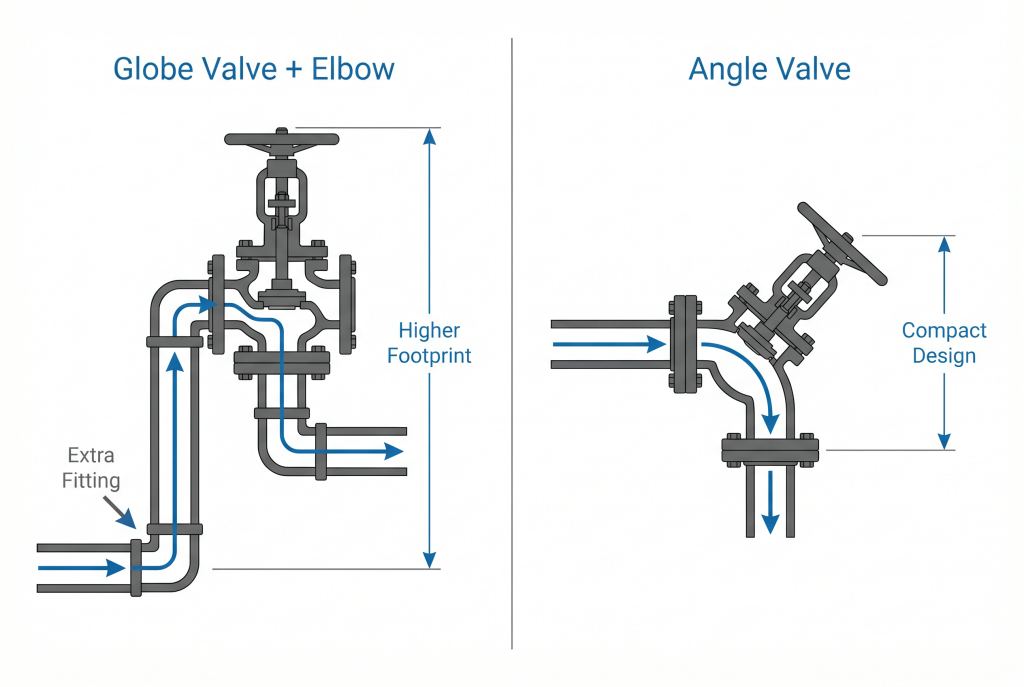
Replacing the 90-Degree Elbow
In many skid designs, a pipe run must turn 90 degrees. Using a straight globe valve requires an additional 90-degree elbow and two extra flanged or welded joints. An angle valve functions as both the control element and the elbow [3].
- Reduced Leak Paths: Eliminating the elbow removes 2 potential leak points, reducing long-term fugitive emissions risks.
- Fewer Components: Lower material spending on pipe fittings and supports.
- Simplified Maintenance: The angle valve’s “bottom-entry” or “side-entry” design often provides easier access to the trim without disturbing the main piping vertical/horizontal runs.
Conclusion: The Audit Result
While a straight globe valve offers familiar linear control, it carries a heavy Total Cost of Ownership due to its restrictive flow path. For facilities focused on industrial valve energy efficiency and lean maintenance, the angle valve is the superior long-term investment.
Request an Energy Audit for Your Valve System
Don’t let inefficient valve designs drain your operational budget. Contact BCST Valve for a detailed Cv vs. Delta P comparison for your specific flow conditions.


 English
 Arabic
 Russian
 French
 Spanish