
Critical Placement: Where to Correctly Install a Venturi Valve on a Pump System
Precision engineering demands precise installation. Get it right for peak pump performance.
In fluid handling systems, the performance of a pump and its associated control valves are intrinsically linked. While the Venturi valve is celebrated for its low-pressure drop and precise control characteristics, its placement within a pump system is a critical design decision that profoundly impacts efficiency, longevity, and overall system reliability. Incorrect installation can negate the benefits of premium valve technology, leading to unexpected pressure losses, pump cavitation, poor control, and even premature system failure. This guide aims to be the definitive resource for process and mechanical engineers, and system designers, offering clear insights into optimal Venturi valve placement.
Key Takeaway for Designers: A Venturi valve’s position relative to a pump—whether on the suction or discharge side—is not trivial. It dictates everything from Net Positive Suction Head (NPSH) requirements to control stability and energy consumption. Correct installation is key to leveraging the unique flow characteristics explained in our Ultimate Guide to Venturi Valves.
At BCST Valve, we understand that valve performance doesn’t end at manufacturing it begins with informed system design. This article provides a comprehensive analysis, complete with clear diagrams, outlining the pros and cons of installing Venturi valves on both the suction and discharge sides of a pump, highlighting their impact on NPSH and overall system dynamics. Remember, improper installation is a primary reason for poor performance and can even lead to a control system shutdown.
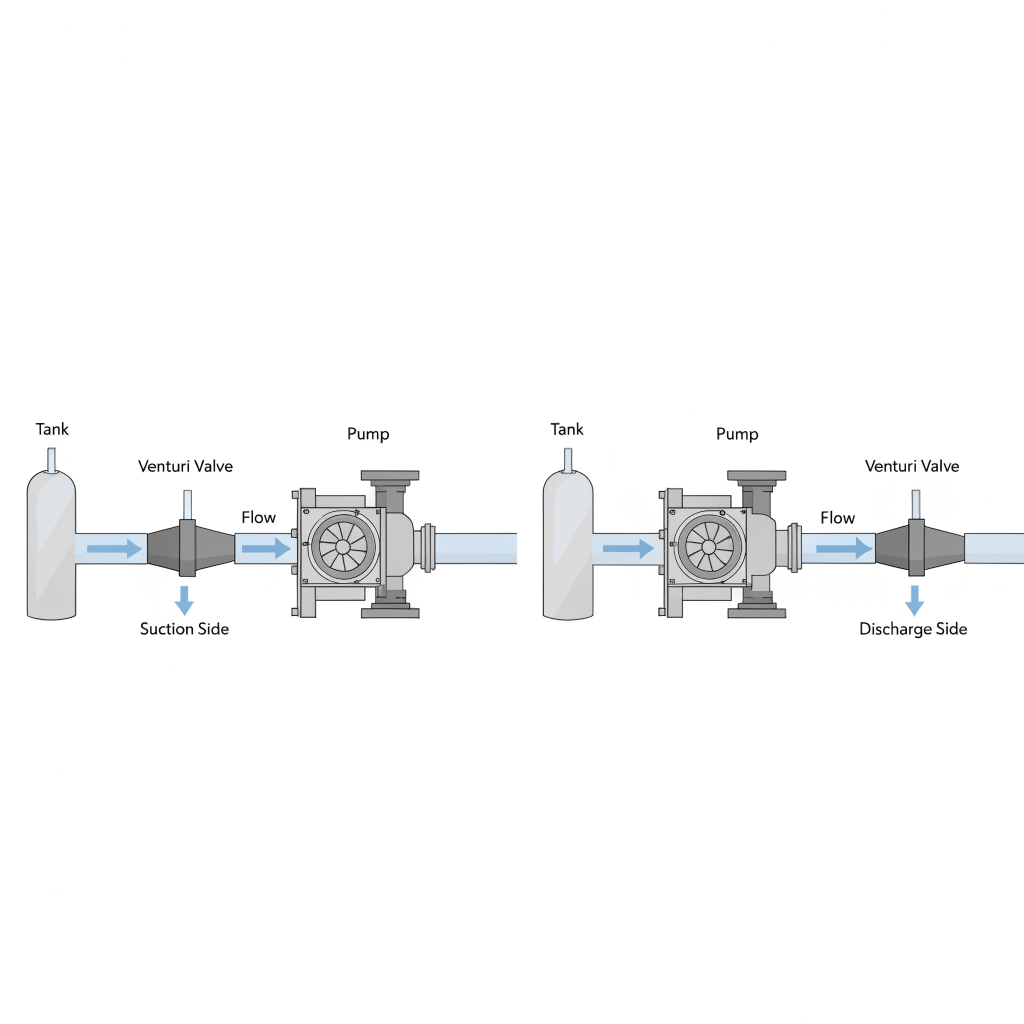
Understanding Net Positive Suction Head (NPSH)
Before discussing placement, it’s crucial to grasp Net Positive Suction Head (NPSH). NPSH is the absolute pressure at the suction side of the pump, minus the vapor pressure of the liquid, expressed in terms of head (meters or feet) of liquid. There are two values: NPSHavailable (NPSHأ), which is a property of the system, and NPSHrequired (NPSHR), which is a property of the pump.
- NPSHأ: This is the head of liquid available at the suction side of the pump to overcome friction losses and provide the necessary pressure to prevent cavitation.
- NPSHR: This is the minimum head required at the suction side of the pump to prevent cavitation within the pump impeller.
For cavitation-free operation, NPSHأ must always be greater than NPSHR, typically with a safety margin of at least 1.1 to 1.3 times NPSHR. Any component (including a valve) on the suction side that introduces pressure drop will reduce NPSHأ.
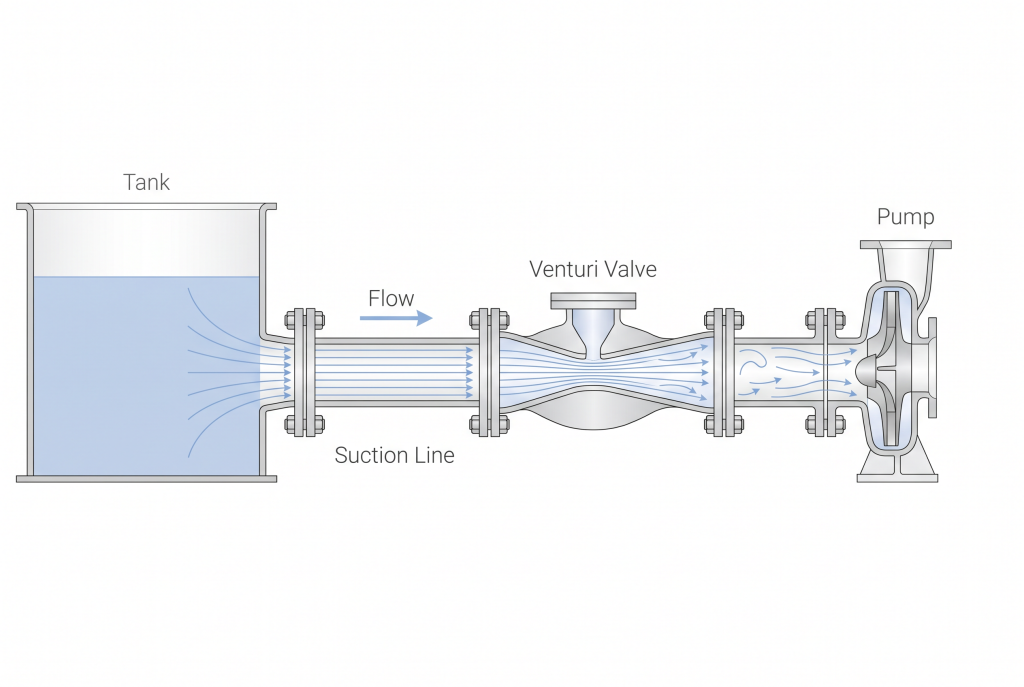
Venturi Valve on the Pump Suction Side: A Careful Balance
Installing a Venturi valve on the suction side of a pump requires meticulous consideration due to its direct impact on NPSHأ.
Pros of Suction Side Placement:
- Cavitation Control (Limited): In specific, highly controlled scenarios, a Venturi valve can sometimes assist in managing pressure at the pump inlet to prevent cavitation for certain pump types or fluid characteristics, by precisely controlling the upstream pressure. This is rare and calls for extensive engineering analysis.
- Space Constraints: If discharge side space is severely limited, suction side might be the only option.
Cons of Suction Side Placement:
- Reduced NPSHأ: Any pressure drop introduced by the valve directly reduces the available NPSH, increasing the risk of pump cavitation. Even the low-pressure drop of a Venturi valve can be critical in tight NPSH margins.
- Increased Risk of Cavitation: If the valve is throttling, the pressure drop across it can cause the fluid pressure to fall below its vapor pressure, leading to cavitation within the valve itself or, more dangerously, at the pump impeller.
- Potential for Suction Line Collapse: If the valve throttles flow too much, it can create a vacuum, potentially collapsing thinner suction lines.
- Flow Disturbances: While Venturi valves create streamlined flow, a throttling valve immediately upstream of a pump can introduce flow patterns that lead to uneven impeller loading. Smooth, laminar flow is crucial for pump suction.
Venturi Valve on the Pump Discharge Side: The Preferred Option
For most applications, installing the Venturi valve on the discharge side of the pump is the overwhelmingly preferred and recommended practice.
Pros of Discharge Side Placement:
- No NPSH Impact: The valve’s pressure drop occurs after the pump, thus having no adverse effect on the pump’s NPSHأ. This is the single most important advantage.
- Optimal Flow Control: Control valves, especially for throttling, are generally intended for use where pressure is high. The valve can easily throttle against the higher discharge pressure to reliably control flow.
- Isolation and Maintenance: Ease of isolation for maintenance or repair of the pump or upstream components without draining large sections of the line.
- System Protection: Can act as a check valve or provide back-pressure protection, depending on its specific function.
Cons of Discharge Side Placement:
- Increased System Pressure: The valve adds pressure drop to the discharge line, which the pump must overcome, potentially leading to slightly higher energy consumption if not properly sized. However, the Venturi valve’s inherently low pressure drop mitigates this significantly compared to other valve types.
- Hot Recirculation (for centrifugal pumps): If flow is severely restricted by the valve, centrifugal pumps can experience increased internal recirculation and heating of the fluid, requiring careful operational considerations or minimum flow bypasses.
Comparative Analysis: Suction vs. Discharge
| مميزة | Suction Side Placement | Discharge Side Placement (Recommended) |
|---|---|---|
| Impact on NPSHأ | Significant reduction, high cavitation risk. | No direct impact on pump NPSHأ. |
| Flow Control Effectiveness | Can be erratic; difficult to maintain stable flow. | Excellent, stable, and precise control. |
| Pump Efficiency | Potentially reduced due to cavitation or disturbed flow. | Optimized, as valve pressure drop is after impellers. |
| Maintenance Access | Can be challenging if it means pump isolation. | Generally easier and safer for the pump. |
| General Recommendation | Avoid whenever possible; only with extreme caution and analysis. | Always preferred; standard engineering practice. |
Best Practices for Installation regardless of location
- Straight Pipe Runs: Ensure adequate straight pipe runs upstream and downstream of the Venturi valve to allow fluid flow to fully develop, especially critical if there are elbows or reducers nearby. Industry standards recommend 5-10 pipe diameters upstream and 2-5 downstream.
- Vibration Dampening: Ensure valve and adjacent piping is properly supported to mitigate vibration, especially crucial for accurate control.
- إمكانية الوصول: Plan for easy access for routine maintenance, calibration, or potential troubleshooting.
- Flange Alignment: Ensure perfect flange alignment to prevent pipe stress on the valve body.
Conclusion: Discharge Side – The Optimal Choice for Performance & Longevity
The decision of where to install a Venturi valve in a pump system is a cornerstone of effective fluid engineering. While careful analysis might suggest a suction-side placement for highly specialized cases, the overwhelming evidence and industry best practices strongly advocate for discharge-side installation. This approach safeguards the pump from cavitation risks, enhances control stability, and ensures the entire system operates with maximum efficiency and reliability.
At BCST Valve, we don’t just manufacture superior Venturi valves; we partner with you to ensure their optimal integration into your systems. Our application engineers are available to review your specific requirements, helping you achieve peak performance from your pump and control valve setup.
Designing a new pump system or optimizing an existing one?


 English
 Arabic
 Russian
 French
 Spanish