
Choosing the wrong bolt length for a поворотный клапан installation can compromise the integrity of your entire piping system. It is a small detail with significant safety implications.
To determine the correct butterfly valve bolt length, you must sum the thicknesses of the two mating flanges, the valve body face-to-face dimension, and any gaskets. Finally, add the height of one nut and a small projection allowance of 2-3 threads.
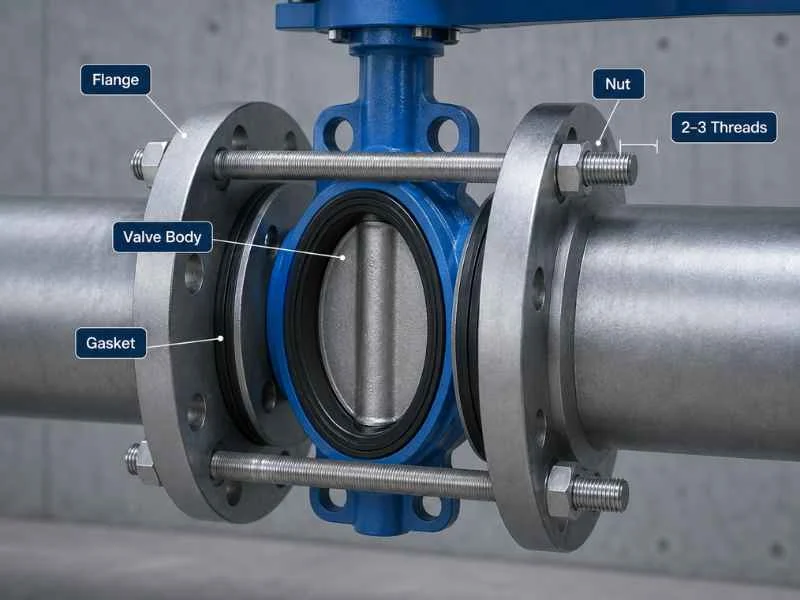
This calculation seems simple, but several critical factors can influence the final measurement. This guide will walk you through the precise formula, key variables you must consider, and common mistakes to avoid, ensuring a safe and leak-free installation for your project.
Calculating the Basic Butterfly Valve Bolt Length
A secure, leak-proof flanged connection depends on applying the correct clamping force, which starts with using bolts of the proper length. An incorrect length prevents proper tensioning.
The fundamental formula for calculating the required stud bolt length for a wafer-style butterfly valve is straightforward. You must add the thickness of all components being clamped together and include an allowance for the nut and necessary thread projection.
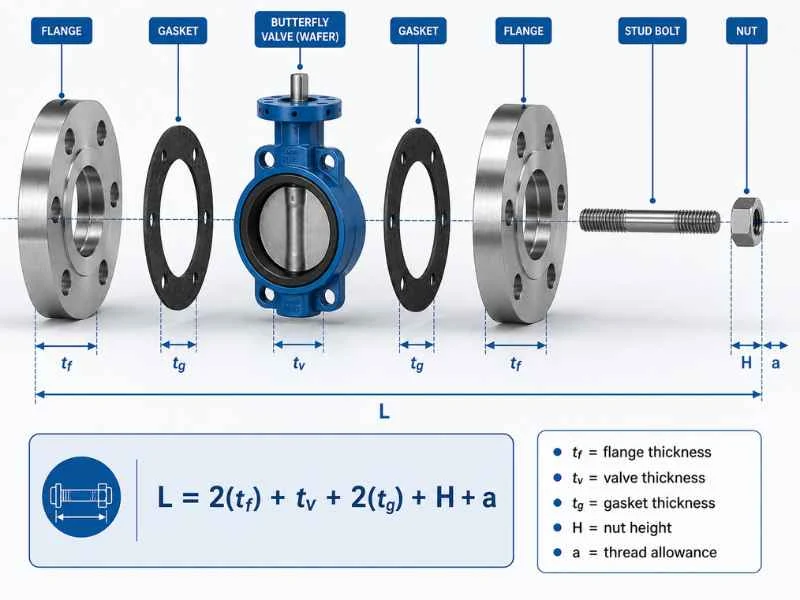
The calculation is most easily represented by the following formula:
L = 2(t_f) + t_v + 2(t_g) + H + a
Where the components are:
| Переменная | Описание |
|---|---|
| L | Total required stud bolt length. |
| t_f | Thickness of one pipe flange. |
| t_v | Face-to-face thickness of the butterfly valve body. |
| t_g | Thickness of one compressed gasket. |
| H | Height of one heavy hex nut. |
| a | Additional allowance for projection (2 to 3 threads past the nut). |
The flange thickness (t_f) is determined by the pipe schedule and pressure class, found in standards like ASME B16.5. The valve body thickness (t_v) is specified by the manufacturer and often conforms to standards like API 609 or ISO 5752. Remember to use the compressed thickness for gaskets, not their uncompressed state. For the allowance (a), a good rule of thumb is to add a length equal to one-quarter of the bolt diameter. This ensures sufficient thread engagement and accounts for any minor variations. Understanding the different types of butterfly valves is crucial, as this calculation primarily applies to wafer-style valves that are clamped between flanges by long stud bolts. Lug-style valves use two separate sets of shorter bolts.
Key Factors Influencing Bolt Selection and Length
Beyond the basic formula, several engineering factors directly impact your bolt length calculation and overall joint integrity. Overlooking these can lead to installation failures.
Your choice of flange standard, pressure rating, gasket material, and valve style all influence the dimensions used in the bolt length formula. These factors are not optional considerations; they are essential for safety and reliability.
The primary factors you must account for are the governing flange standard and its pressure class. For example, an ASME B16.5 Class 300 flange is significantly thicker than a Class 150 flange of the same nominal pipe size. This increased thickness directly requires a longer bolt to achieve a proper connection. Similarly, a DIN or EN 1092-1 PN40 flange will have different dimensions than its ASME counterpart. Always verify the flange dimensions applicable to your specific project.
Gasket Type and Thickness
The type of gasket used is a critical variable. A simple compressed non-asbestos fiber gasket has a different installed thickness than a spiral wound gasket. Spiral wound gaskets compress to a controlled thickness determined by their metal guide ring. You must use this specific compressed thickness value in your calculation. In some applications, such as with a rubber-lined butterfly valve, the resilient seat can form a seal directly with the flange face, eliminating the need for separate gaskets. If gaskets are not used, you must set the gasket thickness (t_g) to zero in your formula. This simplifies the calculation but requires confirmation that the valve design permits it.
Bolt and Nut Material and Grade
While the material grade (e.g., ASTM A193 B7 studs with A194 2H nuts) does not change the length calculation, it is critical for ensuring the joint can handle the service pressure and temperature. The dimensions of the nuts, however, do matter. A standard heavy hex nut (ASME B18.2.2) has a specific height (H) that you must include. Using a different type of nut would require you to substitute the correct height value to ensure accuracy. The working principle of a butterfly valve relies on the body being held securely in place, and using the correct bolting hardware is fundamental to its proper function.
Common Mistakes to Avoid When Sizing Butterfly Valve Bolts
Even a small error in your bolt length calculation can lead to significant problems during installation or operation. Being aware of common pitfalls helps prevent costly rework.
Frequent mistakes include using bolts that are too short, using bolts that are excessively long, and mismatching component standards. Each of these errors introduces a potential point of failure.
The most dangerous mistake is using bolts that are too short. If a bolt is too short, the nut will not have full thread engagement. This means only a few threads are carrying the entire load. Under pressure and thermal cycling, these few threads can easily strip, leading to a loss of clamping force and a sudden, catastrophic leak. As a rule, the end of the bolt must be at least flush with the face of the nut after tightening, with the ideal projection being 2-3 full threads visible. This visual check confirms sufficient engagement.
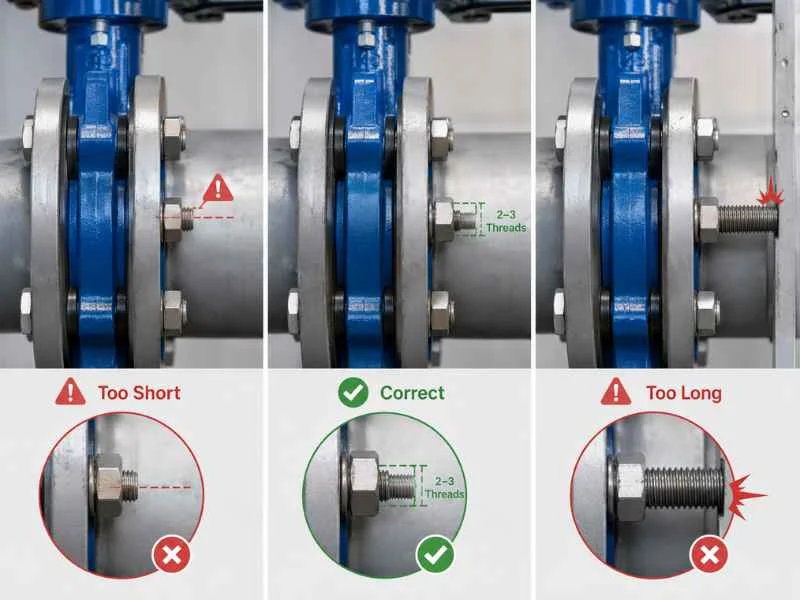
Using Excessively Long Bolts
Conversely, using bolts that are too long also creates problems. Excessively long bolts can be a snagging hazard for personnel moving around the equipment. They can interfere with adjacent piping, insulation, or equipment supports, making installation and future maintenance difficult. In some cases, the extra length may prevent the use of standard torque wrenches or tensioning equipment, leading to improper bolt loading. While it may seem safer to choose a longer bolt, it often creates a new set of practical and safety issues. Stick to the calculated length with the recommended projection.
Mismatching Standards and Components
Another common error is failing to verify that all components conform to the same standard. For instance, you might have a valve built to an API standard being installed between flanges specified by an EN standard. While the nominal sizes may seem compatible, the face-to-face dimension of the valve and the thickness of the flanges can differ. This mismatch will render your calculation inaccurate. Always confirm that the valve, gaskets, flanges, and bolts all reference compatible standards for your project. When sourcing a complete package, you can refer to a trusted manufacturer’s catalog, like the BCST butterfly valve range, where compatible components are clearly specified.
Часто задаваемые вопросы
1. How do you calculate the butterfly valve bolt length for a wafer type?
For a wafer butterfly valve, calculate the bolt length by adding the thickness of both flanges, the valve’s face-to-face dimension, and the compressed thickness of two gaskets. Then, add the height of one heavy hex nut and an allowance for 2-3 threads to project past the nut for safety. The formula is L = 2(t_f) + t_v + 2(t_g) + H + a. Always verify dimensions with project specifications.
2. What happens if the butterfly valve bolt length is too short?
If the butterfly valve bolt length is too short, the nut will not achieve full thread engagement. This severely weakens the connection. Under operational pressure and vibration, the few engaged threads can strip, causing the joint to lose its clamping force. This can lead to a dangerous leak or a complete blowout of the valve, posing a significant risk to plant safety and personnel.
3. Does pressure rating affect the butterfly valve bolt length?
Yes, the pressure rating directly affects the required butterfly valve bolt length. Flanges with higher pressure ratings (e.g., ASME Class 600 vs. Class 150) are thicker to withstand higher pressures. This increased flange thickness means you need longer bolts to connect the joint properly. The bolt diameter and material grade are also determined by the pressure class to ensure sufficient strength.
4. Which standard helps determine butterfly valve bolt length?
Several standards are involved. ASME B16.5 or EN 1092-1 define flange thicknesses. API 609 or ISO 5752 specify valve face-to-face dimensions. ASME B18.2.1 and B18.2.2 provide dimensions for bolts and nuts. The final butterfly valve bolt length is not found in a single chart but is calculated using dimensional data from these relevant standards based on your project’s specific size and pressure class.
5. Is there a chart for butterfly valve bolt length?
While manufacturers often provide bolting charts for their specific valves, there is no universal chart for butterfly valve bolt length. The length depends on the combination of the specific valve model, flange standard (ASME, EN), pressure class, and gasket type used in your application. The most reliable method is to perform the calculation based on the actual dimensions of the components for your project.
6. Do lug-style valves change the butterfly valve bolt length calculation?
Yes, lug-style butterfly valves completely change the bolting requirements. Instead of one set of long stud bolts clamping the valve between flanges, a lug valve uses two separate sets of shorter cap screws (bolts). Each flange is bolted independently to the threaded “lugs” on the valve body. Therefore, the butterfly valve bolt length calculation is different and simpler: it depends only on the flange thickness, gasket, and required thread engagement into the valve body’s lug.
Final Thought
Accurately determining the butterfly valve bolt length is a fundamental step for ensuring plant safety and operational reliability. It protects against leaks and premature joint failure. BCST provides detailed technical datasheets for all our valves to help you get your calculations right.
Contact our team of experts today to ensure your next project’s success.


 English
 Arabic
 Russian
 French
 Spanish