

Are you constantly worried about a DCS failure shutting down your entire operation? The financial losses are huge. The safety risks are even bigger. You need a system that is completely reliable.
The most frequent Distributed Control System (DCS) issues in the oil and gas sector stem from hardware failures, software bugs, network communication errors, and human mistakes. You can reduce these risks with proactive maintenance, strong cybersecurity measures, and continuous training for your operators. This ensures plant safety and efficiency.

You know that a small glitch in the control system can quickly become a major incident. The pressure to maintain uptime and safety is immense. As a chief engineer, you are responsible for the entire technical strategy, from design to daily operations. A deep understanding of potential DCS failure points is not just helpful; it is essential for your role. We need to look closely at these challenges to build a truly resilient system. Let’s break down the most common problems you will face, starting with the physical components of your system.
Preventing Critical DCS Hardware Failures
A single controller card failure can shut down a whole unit. You face immediate downtime and intense pressure to get the plant back online. Every minute of delay costs money. A proactive approach is your best defense against these hardware emergencies.
You can prevent most DCS hardware failures with a strict preventive maintenance schedule. Regularly inspect and clean key components like controllers, I/O modules, and power supplies. You must maintain a detailed inventory of critical spare parts and manage the environment in control rooms to extend hardware life.

As a chief engineer, the physical health of your DCS is your foundation. I have seen projects delayed for weeks because of a single, hard-to-find obsolete part. Your role involves planning for the long term, and that means confronting the reality of aging hardware head-on.
The Challenge of Aging Infrastructure
Many refineries and chemical plants operate with DCS hardware that is over 15 or 20 years old. This equipment has served well, but it presents a growing risk. Manufacturers stop producing older modules, which makes finding spare parts very difficult and expensive. You might have to rely on third-party resellers, and the quality of these parts is not always guaranteed. A failure in an obsolete component can lead to prolonged shutdowns while your team scrambles to find a replacement. As the technical leader, you must make a strong case for phased migration and system upgrades. You need to present clear data to management about the financial and operational risks of relying on outdated technology. This is about securing the plant’s future production capabilities.
Environmental Factors Are Silent Killers
The environments in oil and gas facilities are harsh. Control rooms and field enclosures are often exposed to heat, humidity, and corrosive elements. These conditions accelerate the degradation of electronic components. I remember a client at a coastal LNG terminal who faced constant I/O card failures. The cause was salt in the air leading to micro-corrosion on the circuit boards. Simple issues like failed cooling fans or clogged air filters can cause components to overheat, leading to intermittent faults that are incredibly hard to diagnose. You must ensure that environmental control systems for your DCS equipment rooms are part of your critical maintenance plan. This is a simple step that prevents many complex problems.
A Proactive Maintenance Strategy
A reactive approach to hardware is a recipe for disaster. You must champion a proactive strategy. This involves more than just calendar-based checks. It requires a comprehensive plan that includes regular diagnostics, thermal imaging of cabinets to spot overheating components, and a well-managed spare parts inventory. Your team needs to know exactly where every critical spare is located and how to install it quickly. Having a clear plan reduces panic and minimizes downtime during an actual failure.
Here is a simple table to structure your hardware maintenance checklist:
| Component | Weekly Check | Monthly Check | Annual Check |
|---|---|---|---|
| Controllers | Check Status LEDs | Run System Diagnostics | Full Backup and Firmware Review |
| Power Supplies | Verify Output Voltages | Clean Fans and Vents | Test Redundancy and Failover |
| I/O Modules | Check for Fault Indicators | Visually Inspect for Corrosion/Damage | Calibrate Analog Inputs/Outputs |
| Network Switches | Check Port Status LEDs | Review Error Logs | Update Firmware and Backup Configuration |
| Server/Workstations | Monitor CPU/Memory Usage | Clean Dust Filters | Apply Security Patches and System Updates |
By implementing and enforcing such a structured approach, you turn maintenance from a cost center into a strategic tool for ensuring plant reliability and safety, which is your core responsibility.
Managing Complex DCS Software and Cybersecurity Risks
A software bug can be just as disruptive as a hardware failure. Unexpected system reboots or incorrect logic execution can cause process upsets. The growing threat of cyberattacks adds another layer of risk that you must manage carefully.
To manage these risks, you need a strict software management protocol. This includes regular patching, full system backups, and controlled access to the engineering station. You must also implement a defense-in-depth cybersecurity strategy with firewalls, network segmentation, and continuous monitoring to protect your critical infrastructure.

In your position, you are the final authority on technical solutions, and this now includes the digital integrity of the plant. A software glitch is not just an IT problem; it is a process safety problem. The lines between process control and cybersecurity have disappeared, and you must lead the effort to secure your operations from these invisible threats.
The Hidden Dangers of Software Glitches
DCS software is incredibly complex. Even with rigorous testing by the vendor, bugs can exist. These can remain dormant for years until a specific set of conditions triggers them. I worked with a chemical plant where a minor software update caused a memory leak. Over several days, the system slowed down until a critical controller crashed, forcing a unit shutdown. The root cause was hard to find because it was not a direct command failure. Your responsibility is to ensure that any software changes, from a minor patch to a major upgrade, are tested thoroughly in a development or simulation environment before they are deployed on the live system. You must have a clear rollback plan in case something goes wrong. Rushing a software update to save time can cost you much more in the long run.
Cybersecurity: The New Frontier of Plant Safety
Historically, DCS networks were isolated from business networks, creating an "air gap" for protection. This is no longer the case. The need for real-time production data and remote monitoring has connected these systems, creating new vulnerabilities. A cyberattack on your DCS is a direct threat to physical safety and environmental compliance. A malicious actor could manipulate valve positions, disable safety alarms, or shut down entire processes, leading to catastrophic consequences. As the chief engineer, you must work closely with IT and cybersecurity specialists to implement a robust security framework. This is not just about installing a firewall. It involves a multi-layered approach.
Here is how you can structure your defense:
- Network Segmentation: You should isolate the process control network from the corporate network. Use firewalls and demilitarized zones (DMZs) to strictly control any traffic that passes between them. This prevents a compromise on the business side from directly impacting plant operations.
- Access Control: You need to enforce the principle of least privilege. Engineers, operators, and maintenance staff should only have access to the systems and functions they absolutely need to do their jobs. Use strong passwords, two-factor authentication, and maintain a clear log of all system access.
- System Hardening: You must disable all unnecessary ports, services, and software on DCS components. Every open door is a potential entry point for an attack. You should also have a strict policy for using removable media like USB drives, as they are a common vector for malware infection.
Your leadership is critical in building a culture of security awareness. Every person who interacts with the DCS, from the control room operator to third-party vendors, must understand their role in protecting the system.
Ensuring Robust DCS Network and Communication Integrity
Your DCS is a distributed system. Its reliability depends entirely on the communication network that links everything together. A network failure can isolate controllers and leave your operators blind, instantly creating a dangerous situation.
To ensure network integrity, you must design for redundancy. Use redundant fiber optic rings, redundant network switches, and diverse cable paths. Regularly monitor network traffic and health. You should also conduct periodic testing of the failover systems to ensure they work as expected.
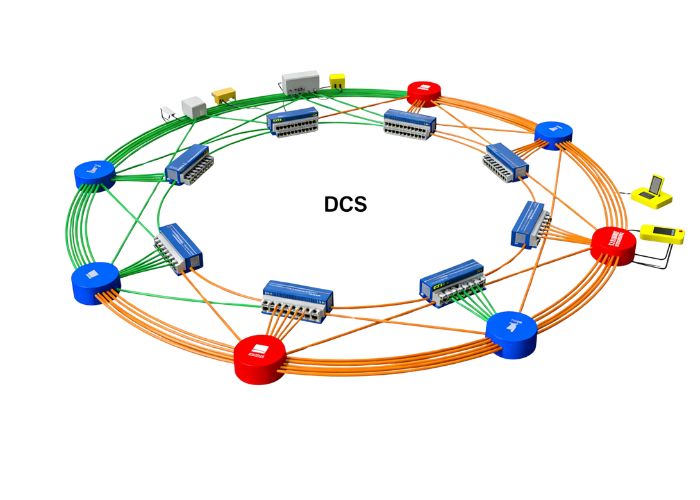
When you design a new plant or an expansion, the network architecture is one of the most critical decisions you will make. It is the central nervous system of the entire operation. My father always told me a valve is only as good as the pipe it is connected to. In the same way, a controller is only as good as the network that serves it. A failure here can have a wider impact than a single hardware fault.
The Critical Role of Redundancy
In the oil and gas industry, there is no room for single points of failure. This principle is especially true for your DCS network. A standard network design might be acceptable for an office, but it is not sufficient for process control. You must insist on fully redundant network topologies. A ring topology using redundant fiber optic cables is a common and effective solution. If one cable is cut or a switch fails, data is automatically rerouted in the other direction with minimal interruption. This failover should be seamless and automatic. However, you cannot just assume it works. As part of your commissioning and regular maintenance plans, you must schedule tests to simulate a failure. Disconnect a cable or power down a switch to verify that the system responds correctly. Finding out your redundancy does not work during a real emergency is too late.
Diagnosing Intermittent Communication Faults
Some of the most frustrating problems to solve are intermittent communication errors. An operator might report that a value on their screen froze for a few seconds or that a command was slow to respond. These "ghosts in the machine" can be caused by many things: a failing network card, a loose connection, or electromagnetic interference (EMI) from nearby equipment like large motors or variable frequency drives (VFDs). The first step is to check the network diagnostics and error logs on your switches and controllers. These often provide clues about where the problem is located. You should also ensure that all network cabling, especially in the field, is properly shielded and grounded according to industry standards. In my experience helping clients specify control valves, I have seen issues where the electrical noise from a VFD’s power cable interfered with the 4-20mA signal from a valve positioner because the cables were run in the same conduit. The same principle applies to your network cables. Proper installation is key.
Managing Network Load and Performance
As you add more devices and data to your system, you can start to experience network performance issues. If the network becomes overloaded, data packets can be delayed or dropped. This can affect the performance of your control loops and the responsiveness of the operator interface. As the chief engineer overseeing the design, you must plan for future capacity. Choose switches with enough bandwidth to handle not just the current load, but also the expected load after future expansions. You can use network monitoring tools to track bandwidth utilization and identify any bottlenecks. This allows you to address potential performance problems before they impact plant operations. It is about designing a system that is not just reliable today, but also scalable for the future.
Conclusion
Mastering your DCS requires a complete strategy for hardware, software, and networking. Proactive maintenance and strong security are your keys to a safe and profitable operation.


 English
 Arabic
 Russian
 French
 Spanish