
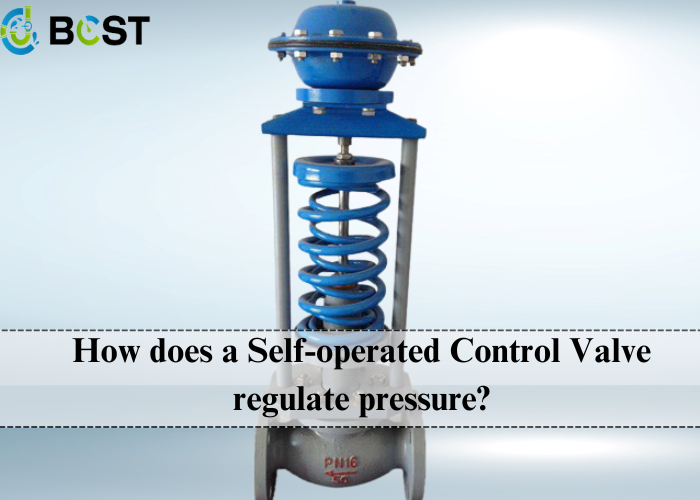
Self-operated control valve as a widely used in industrial automation control equipment, because it does not need an external power source to drive and so named. Its uniqueness lies in the use of the controlled medium’s own energy to adjust the valve opening, thus realizing the automatic control of medium pressure, flow, temperature and other parameters. In this article, we will discuss in depth how the self-regulating valve regulates the principle of pressure, application scenarios, as well as the use of precautions.
Ⅰ. The basic principle of self-regulating valve
Self-operated control valve is mainly composed of valve body, actuator, feedback mechanism and regulator. Its working principle is based on the idea of feedback control system, that is, through the real-time feedback on the controlled variable, automatically adjust the valve opening, so as to maintain the system at the set pressure value.
Specifically, the process of regulating the pressure of the self-regulating valve is as follows:
1.**Sensing pressure**: When the medium passes through the valve, part of the medium will be guided to the sensing parts (such as bellows, spring or diaphragm). The sensing part will produce the corresponding mechanical displacement according to the pressure change of the medium.
2. **Feedback Adjustment**: The displacement of the sensing part is transmitted to the actuator, which automatically adjusts the valve opening according to the difference between the set pressure value and the actual pressure value. When the actual pressure is higher than the set value, the actuator will close the valve, thus reducing the flow rate and lowering the pressure; on the contrary, it will open the valve, increase the flow rate and raise the pressure.
3. **Dynamic Balance**: Throughout the process, the regulating valve is constantly fine-tuned to stabilize the system pressure near the set value. This self-balancing feature makes the self-regulating valve in the absence of external energy, but still be able to accurately regulate and maintain a stable system pressure.
Ⅱ. The type and application of self-regulating valve
According to the different ways of regulating pressure, self-operated control valves can be divided into the following types:
1. **Self-operated pressure regulating valve**: used to maintain a constant pressure downstream or upstream. This type of valve is usually used for pressure control of media such as steam, air, gas and liquid. Depending on the installation location, they are categorized into pressure-reducing type and back-pressure type.
2. **Self-operated differential pressure regulating valve**: used to control differential pressure in the system. Typical applications include hot water circulation in HVAC systems, differential pressure control in steam delivery systems, etc.
3. **Self-operated Temperature Control Valve**: Although it is mainly used for temperature control, it can also indirectly affect the system pressure through the relationship between temperature and pressure.
4. **Self-operated flow control valve **: used to keep the flow constant, but to a certain extent can also control the pressure, because there is an interdependent relationship between flow and pressure.
Ⅲ. The specific application scenarios of self-operated control valve
1. **Pressure Reduction Control in Steam Systems**: In steam heating systems, self-operated pressure regulating valves are commonly used to control steam pressure reduction. By keeping the outlet pressure constant, it ensures the stability and safety of steam heating.
2. **Pressure control in industrial gas transportation**: In industrial production, the transportation of gases often requires the maintenance of specific pressure values. Self-operated control valves can accurately control the pressure of the gas to avoid the impact of pressure fluctuations on the production process.
3. **Differential pressure control in the petrochemical industry**: In the petrochemical process, many reaction processes have strict requirements for differential pressure. Self-operated differential pressure control valve can realize stable differential pressure control to ensure the normal operation of the production process.
4. **Pressure regulation in the water treatment system**: in the municipal or industrial water treatment system, self-operated control valves are often used to maintain a constant pressure in the water system to ensure the stability of the water supply.
Ⅳ. The self-regulating valve selection and installation considerations
- **Determination of the pressure range**: In the selection, first of all, the working pressure range of the system should be clear. Select the appropriate pressure regulating valve, both to take into account the adjustment accuracy, but also to ensure that the valve’s pressure resistance.
- **Medium Characteristics Considerations**: Different media have different requirements for valve materials. Corrosive media, viscous media, high temperature media, etc., need to choose the appropriate valve material and sealing form.
- ** flow characteristics of the matching **: flow and pressure are closely related. In the selection, to ensure that the flow characteristics of the control valve to meet the actual needs of the system, to avoid insufficient or excessive flow resulting in abnormal system pressure.
- **Selection of installation position**: The installation position of the self-operated control valve has an important impact on its performance. It should be installed in the straight section of the system as far as possible, avoiding installation in the elbow, branch or vibration position to reduce the impact on the regulation accuracy.
**Periodic maintenance and calibration**: In order to ensure the long-term stable operation of the self-operated control valve, it needs to be maintained and calibrated regularly. In particular, the wear and tear of the sensing parts and actuators need to be checked and replaced regularly.
V. Summary
As a kind of automatic control equipment without external power, self-operated control valve plays an important role in industrial production. By utilizing the energy of the medium itself for regulation, the valve not only saves energy costs, but also simplifies the system structure and improves the reliability of the system. Mastering the working principle, selection methods and installation and maintenance considerations of self-operated control valves can help engineers better apply this equipment to ensure the safe and stable operation of industrial systems.
With the development of industrial automation technology, self-operated control valves will continue to play its unique advantages in the future and be widely used in more applications. Whether it is a new project or the transformation of the old system, the rational selection and use of self-operated control valve will bring significant economic and social benefits for the enterprise.

 English
 Arabic
 Russian
 French
 Spanish