
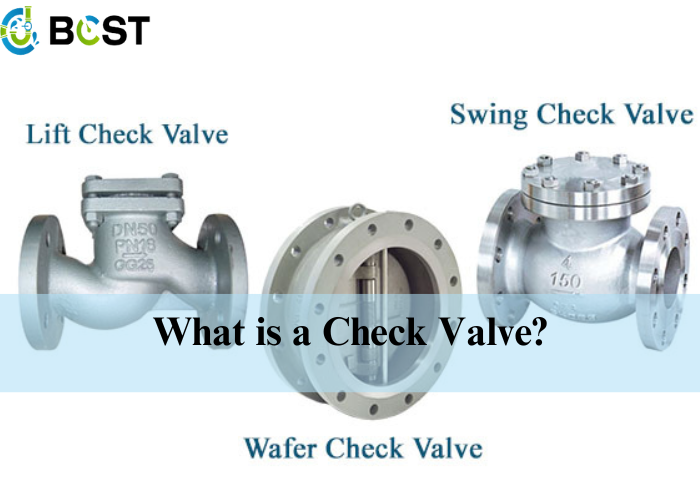
Check valves play a vital role as a key component in fluid control systems. As a specialized manufacturer, we understand the importance of check valves in securing the unidirectional flow of fluids and preventing the back flow of media. In this article, we will analyze this indispensable fluid control component from the definition of check valve, principle of operation, structural standards, types, application areas and innovation trends.
Ⅰ. The definition of check valve.
Check valve, as the name suggests, is a kind of valve that can automatically stop the reverse flow of fluid. Its working principle is based on the fluid pressure changes, when the fluid is flowing in the right direction, the valve automatically opens, allowing the fluid to pass; and when the fluid pressure is reduced or reverse flow, the valve is automatically closed, effectively preventing the fluid from flowing backwards. This feature makes the check valve is widely used in a variety of fluid systems, such as water treatment, heating, refrigeration and industrial piping and other fields.
Ⅱ. The working principle of the check valve.
The working principle of the check valve can be simply summarized as the use of the valve flap automatically open and close to control the one-way flow of fluid. Valve as the core component of the check valve, usually designed as a movable disk or sphere, able to move freely in the valve body. When the fluid pressure exceeds the opening pressure of the valve, the valve flap is pushed open, the fluid can pass through smoothly; and when the fluid pressure is lower than the closing pressure of the valve or when the direction is changed, the valve flap is automatically closed under the action of the spring or other reset mechanism, so as to prevent the back flow of fluid.
Specifically, the working process of the check valve can be divided into the following stages:
Open stage: when the fluid is flowing and the pressure reaches or exceeds the opening pressure of the valve, the fluid pressure pushes the valve flap to leave the valve seat, the formation of a pathway, allowing the fluid to pass.
Flow stage: in the fluid continues to flow positively in the process, the valve stays open, the fluid passes through the valve smoothly.
Closing stage: when the fluid pressure is reduced to below the closing pressure of the valve or the fluid direction changes, the valve flap in the spring or the fluid reverse pressure automatically closes to prevent the fluid back flow.
Ⅲ. The standard structure of the check valve .
Check valve structure standards mainly cover the valve body, valve cover, valve flap, spring and other key components of the design and manufacturing requirements. These standards ensure the reliability and durability of check valves in different working conditions. The following are some common types of check valves and their structural characteristics:
1. Lift check valve
Structural components: usually composed of valve body, valve cover, valve flap, lifting lever and spring and other components.
Working principle: the valve flap moves up and down along the lifting stem under the pressure of the fluid to realize the opening and closing of the valve.
Application Scenario: suitable for large diameter, high flow rate fluid system.
2. Rotary check valve:
Structural components: composed of valve body, valve cover, valve flap and rotary shaft and other components.
Working principle: the valve flap realizes opening and closing by rotating, usually relying on the fluid pressure to drive the rotating shaft rotation.
Application Scenario: It is suitable for the occasions that need fast response and frequent opening and closing.
3. Pair-clamped check valve:
Structural features: the valve body is a butt-clamp structure, easy to install, without flange connection.
Working principle: similar to lift or rotary check valve, but more compact structure.
Application Scenario: suitable for occasions where space is limited or quick installation is required.
Ⅳ. Types of check valves.
According to different classification standards, check valves can be divided into various types. The following are some common ways of classification and corresponding types:
- Classification according to structural form:
Lift check valve
Rotary check valve
Wafer-type check valve
Butterfly check valve
Spherical check valve
- Categorized by material:
Metal check valve (such as stainless steel, carbon steel, etc.)
Non-metallic check valve (such as plastic, rubber, etc.)
- Classified by connection:
Flange connection check valve
Clamp connection check valve
Threaded connection check valve
Welded connection check valve
4. Classified by function:
Ordinary check valve
Silent check valve (through a special design to reduce the noise of the fluid through)
Slow-closing check valve (buffer effect in the closing process, reduce water hammer phenomenon)
Ⅴ. The application of check valves.
As an important element in the fluid control system, check valve is widely used in various industrial fields. The following aspects are some application areas:
Water treatment industry: in the water treatment system, check valves are used to prevent sewage from flowing back to the clean water pipeline and to guarantee the safety of water quality.
Heating and cooling system: In heating and cooling pipelines, check valves are used to prevent back flow of hot water or refrigerant and ensure normal operation of the system.
Petrochemical industry: In the petrochemical production process, check valves are used to control the one-way flow of various chemical media, prevent the media from contaminating each other, and ensure the continuity and safety of the production process.
Thermal power generation and nuclear power plants: In these large-scale energy facilities, check valves are installed in various piping systems to stop the back flow of high-temperature and high-pressure steam or coolant, to protect critical equipment from damage, and to ensure the stability and safety of the power generation process.
Food & Beverage Industry: In food and beverage processing and packaging, check valves are used to ensure a pure and sterile product flow line, preventing cross-contamination and ensuring the quality and safety of the final product.
Pharmaceutical Industry: In pharmaceutical production lines, check valves not only control the flow direction of various medicinal fluids and solvents, but also meet strict hygiene and cleanliness standards to ensure compliance and quality consistency in drug production.
Marine Engineering and Ship: In marine engineering and ship systems, check valves are widely used to prevent the back flow of seawater, fresh water or fuel oil, and to safeguard the normal operation of the ship’s power system, cooling system and water supply system.
Agricultural Irrigation Systems: In agricultural irrigation networks, check valves help prevent water flow reversal, protect pumps and pipelines from damage caused by back flow, and improve irrigation efficiency.
Fire fighting system: In fire fighting piping systems, check valves ensure a one-way supply of water, preventing fire fighting water from being contaminated by back flow after fire fighting and guaranteeing the reliability of fire fighting systems.
Ⅵ. The innovative trend of check valve
With the continuous progress of industrial technology and the increasingly diversified application needs, check valves are also constantly undergoing innovation and development. The following are some current and future innovation trends:
Intelligent and remote monitoring: By integrating sensors, actuators and intelligent control systems into check valves, remote monitoring, fault diagnosis and automatic adjustment are realized to improve the intelligent level and operation and maintenance efficiency of the system.
Application of high-performance materials: High-performance materials that are more resistant to corrosion, high temperature and abrasion are used to manufacture check valves to cope with more severe working conditions and extend the service life of the equipment.
Energy-saving and emission reduction design: Optimize the flow path design of check valves to reduce the resistance and energy consumption when the fluid passes through, and at the same time reduce noise and vibration to achieve green environmental protection.
Modularization and standardization: Promote the modular design and standardized production of check valves to simplify the installation and replacement process, improve maintenance convenience and reduce operating costs.
Customized solutions: Provide customized check valve solutions according to users’ specific needs and application scenarios, including special materials, special structures, special functions, etc., in order to meet diversified market demands.
Ⅶ. Conclusion
As an indispensable and important component in the fluid control system, check valves play a vital role in guaranteeing one-way flow of fluids and preventing back flow of media. With the continuous development of industrial technology and the continuous growth of application demand, check valves are also constantly innovating and improving. As a professional manufacturer, we will continue to be committed to the research and development and application of check valve technology, to provide customers with more efficient, reliable and intelligent fluid control solutions, to help the booming development of various industries.


 English
 Arabic
 Russian
 French
 Spanish