
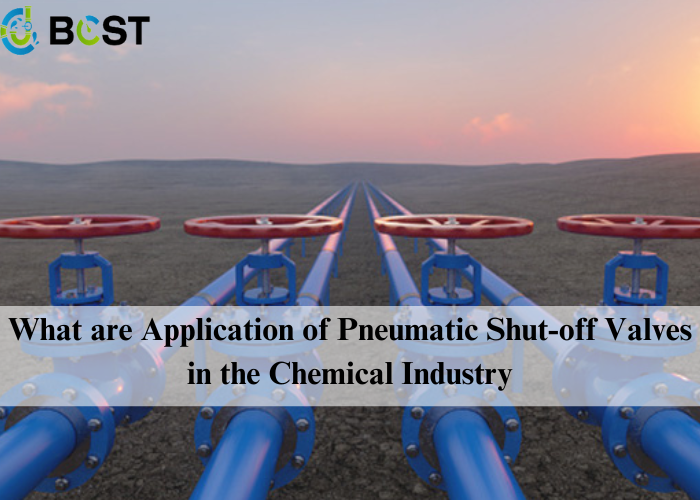
Пневматический запорные клапаны are critical control components widely used in various fluid control processes within the chemical industry. Their efficiency, reliability, and safety make them central to many process flows. This article will detail the working principle of pneumatic запорные клапаны, process requirements, valve materials, actuator and accessory configurations, and their ease of installation and maintenance.
I. Working Principle of Pneumatic Shut-off Valves
A pneumatic запорный клапан operates by using compressed air as a power source to drive the valve to open or close. Its main working principle includes:
1.Air Supply: Compressed air is regulated to the appropriate pressure through air filters and pressure regulators before being delivered to the pneumatic actuator.
2. Pneumatic Actuator: The actuator receives signals from the control system and uses compressed air to drive the internal piston or diaphragm, thus moving the valve stem and valve core to open or close the valve.
3. Feedback System: The valve position feedback system sends the actual valve position signal back to the control system for closed-loop control and monitoring.
II. Process Requirements of Pneumatic Shut-off Valves
In the chemical industry, pneumatic запорные клапаны need to meet the following process requirements:
1.High Reliability: Many chemical production processes have strict safety and continuity requirements. Pneumatic shut-off valves must have high reliability to ensure they can quickly and accurately cut off fluid in emergencies.
2.Corrosion Resistance: Given the corrosive nature of many chemical media, the valve material must withstand corrosion to extend service life.
3.High Temperature and High Pressure Resistance: Some chemical processes involve high temperature and high pressure operations, requiring the pneumatic shut-off valve to endure these harsh conditions.
4.Quick Response: In certain processes, the valve needs to respond quickly to open or close fluid channels promptly to prevent accidents.
5.Excellent Sealing Performance: The valve must have superior sealing performance to prevent media leakage, ensuring production safety and environmental protection.
III. Valve Materials of Pneumatic Shut-off Valves
Selecting the right valve material is crucial based on different process requirements. Common materials include:
1. Stainless Steel: Suitable for most corrosive media with good corrosion resistance and mechanical properties.
2.Carbon Steel: Suitable for non-corrosive media with high strength and toughness.
3.Lined Fluorine Material: Ideal for highly corrosive media like acids and alkalis, offering excellent corrosion resistance.
4.Alloy Materials: Such as Hastelloy and Monel, suitable for extremely corrosive media and high-temperature, high-pressure environments.
IV. Actuator and Accessory Configurations of Pneumatic Shut-off Valves
The actuator of a pneumatic shut-off valve is its core component, typically including the following types:
1.Single-Acting Actuator: Has only one air chamber, utilizing spring force for return, suitable for applications requiring automatic reset.
2.Double-Acting Actuator: Has two air chambers, using air source control for opening and closing actions, suitable for bidirectional control.
3.Diaphragm Actuator: Drives the valve stem by the deformation of the diaphragm, simple structure, suitable for medium and low-pressure applications.
4.Piston Actuator: Uses the linear motion of the piston to drive the valve stem, suitable for high-pressure applications with large thrust.
To enhance the performance and functionality of pneumatic shut-off valves, the following accessories are commonly equipped:
1.Positioner: Adjusts the valve position according to control signals, ensuring precise valve action.
2.Limit Switch: Monitors the valve’s open and close status, providing position signals.
3.Solenoid Valve: Controls the on-off of the air source for remote control of the valve.
4.Filter Regulator: Filters and regulates air source pressure, ensuring normal operation of the actuator.
5.Manual Override: Allows manual operation to open or close the valve in case of air source failure or emergencies.
V. Ease of Installation and Maintenance of Pneumatic Shut-off Valves
The ease of installation and maintenance of pneumatic shut-off valves is crucial for the stable operation of chemical production. Key points include:
Ease of Installation:
1.Installation Position Selection: Choose a location that is convenient for operation and maintenance, avoiding high or narrow spaces.
2.Pipe Connection: Select the appropriate pipe connection method (flange, thread, etc.) based on the valve interface type, ensuring sealing performance.
3.Air Source Connection: The air supply line should be securely installed to avoid bending or damage.
4.Electrical Connection: Ensure correct wiring for electrical components like solenoid valves and limit switches according to electrical codes.
Простота в обслуживании:
1.Regular Inspection: Periodically check all components of the pneumatic shut-off valve, including the air source system, actuator, and valve body, to ensure they are in good condition.
2.Lubrication Maintenance: Regularly lubricate parts that require it to reduce wear and extend service life.
3.Troubleshooting: Quickly address issues in the air source, electrical, or mechanical aspects when the valve malfunctions.
4.Spare Parts: Keep common spare parts such as seals and springs readily available for quick replacement and repair.
VI.Conclusion
Пневматический запорные клапаны play a crucial role in the chemical industry. Their working principle, process requirements, valve materials, actuator and accessory configurations, and ease of installation and maintenance directly affect the safety and efficiency of chemical production. By selecting and configuring pneumatic shut-off valves appropriately, along with regular maintenance, the stability and safety of chemical production can be significantly enhanced, ensuring smooth process flows.

 English
 Arabic
 Russian
 French
 Spanish