
Replacement Ball Valve LOTO: Ensuring Absolute Safety During Valve Change-Outs
Replacing an industrial valve, particularly a critical one like a шаровой клапан, involves breaking the integrity of a pressurized system. This inherently creates high-risk situations, from unexpected fluid discharge to accidental system re-energization, all of which can lead to severe injuries or catastrophic failures. This is precisely why Lockout/Tagout (LOTO) procedures are not just recommended, but legally mandated, and become especially critical when performing a replacement ball valve LOTO operation.
Implementing robust replacement ball valve LOTO protocols ensures that industrial pipelines and equipment are completely de-energized, depressurized, and isolated before any work begins. This article will provide an in-depth look at the distinct requirements for LOTO during the replacement of a ball valve, covering planning, execution, and verification to maintain a safe working environment.
Mastering replacement ball valve LOTO is essential for maintenance teams, safety professionals, and plant operators to protect human life, preserve equipment, and conform to stringent safety regulations like OSHA.
Why is LOTO Crucial for Ball Valve Replacement?
While general LOTO prevents accidental operation of a valve, replacement ball valve LOTO requires an even higher level of diligence. The primary goal is to ensure that the system is not only shut off but also completely safe to physically disassemble and reassemble.
- Breaching Containment: Unlike simply closing a valve, replacement involves unbolting flanges, directly exposing personnel to internal pipe contents. If not properly de-energized, this can lead to explosions, chemical burns, or suffocation.
- Hidden Energy: Even if a ball valve is closed, trapped pressure or residual fluids in the line section between isolation points can exist. This “hidden energy” must be released and verified before the valve can be unbolted.
- Accidental Re-energization: Without proper LOTO, others might mistakenly or unknowingly attempt to re-energize the system, resulting in a dangerous surge of energy into an open pipeline.
- Regulatory Mandate: OSHA and similar global standards explicitly require LOTO for any servicing or maintenance where the unexpected energization or startup of machinery or equipment, or the release of stored energy, could cause injury. This absolutely applies to replacement ball valve LOTO.
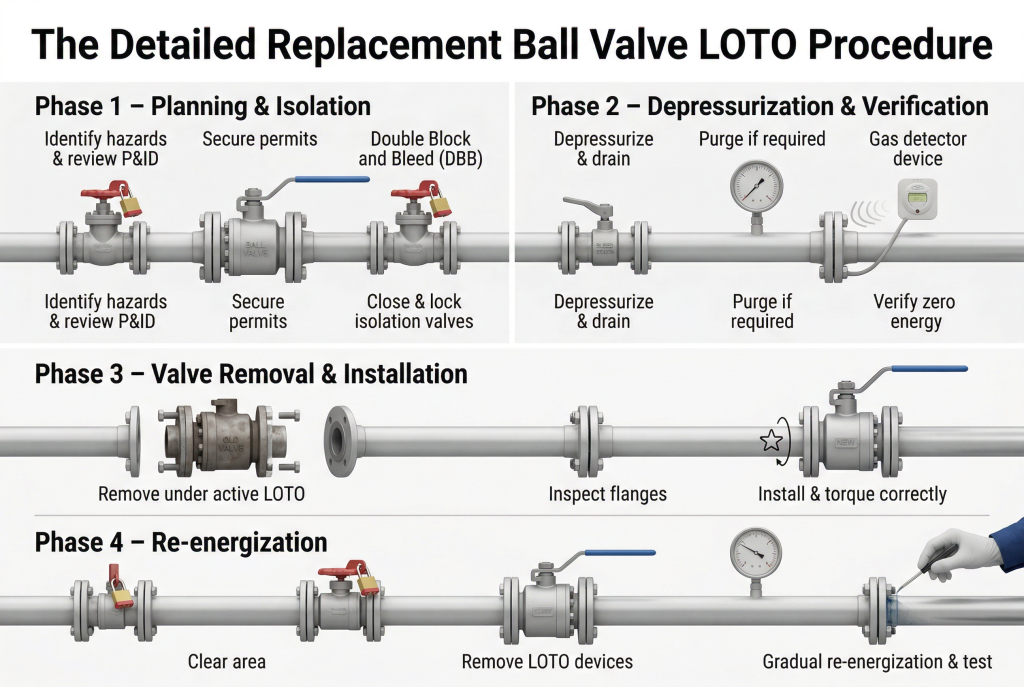
The Detailed Replacement Ball Valve LOTO Procedure
A successful replacement ball valve LOTO strategy involves careful planning and execution. The following steps expand on general LOTO to address the unique challenges of valve removal and installation:

Phase 1: Pre-Replacement Planning & Isolation
- Identify and Understand Hazards: Prior to any work, identify the fluid type (flammable, corrosive, toxic), its temperature, pressure, and any other energy sources (e.g., electrical actuators). Review P&ID diagrams.
- Permit-to-Work System: Secure all necessary permits (e.g., LOTO permit, Confined Space permit, Hot Work permit) as dictated by facility policy.
- Notify Affected Personnel: Inform all operators, supervisors, and adjacent teams about the upcoming shutdown and replacement ball valve LOTO procedure.
- Locate All Isolation Points: Identify all upstream and downstream valves (including drain points, vent points) that require isolation to create a safe work zone around the ball valve being replaced. For absolute isolation, consider upstream Double Block and Bleed (DBB) ball valves.
- Controlled Shutdown: Safely shut down the process linked to the valve, ensuring continuity of operations is not jeopardized elsewhere.
- Close and Lock Isolation Valves: Close all identified upstream and downstream isolation valves. Apply appropriate lockout devices and individual padlocks by each authorized worker, along with clear tagout warnings.
Phase 2: Depressurization, Draining, and Verification
- Release Stored Energy / Depressurize: Slowly open bleed valves or drain points within the isolated section to release residual pressure and drain fluid. Ensure adequate containment for drained liquids.
- Purge/Flush (If Necessary): For hazardous or flammable fluids, consider purging the isolated section with an inert gas (like nitrogen) or flushing with a compatible non-hazardous fluid to remove traces of the dangerous media.
- Verification of Zero Energy: This is the most critical step in replacement ball valve LOTO.
- Attempt Operation: Attempt to operate the locked-out isolation valves to confirm they cannot be moved.
- Pressure/Temperature Check: Confirm zero pressure using dedicated gauges. If applicable, check for safe temperatures.
- Atmospheric Monitoring: Use gas detectors to confirm the absence of hazardous gases or vapors in the work area, especially before breaking flange connections.
- Визуальный осмотр: Open vent/drain points to visually confirm no flow or pressure releases.
Phase 3: Valve Removal & Installation Under LOTO
- Remove Old Ball Valve: With LOTO fully in place and verified, carefully unbolt and remove the old ball valve. Be prepared for any residual drips or spills.
- Inspect Flanges: Clean and inspect mating pipe flanges for damage or debris.
- Install New Ball Valve: Position the new ball valve, ensuring proper alignment. Install new gaskets (refer to gasket best practices). Fasten bolts in a star pattern to the manufacturer’s specified torque. LOTO remains active throughout this installation.
Phase 4: Post-Replacement and Re-energization
- Final Checks: Ensure all tools, equipment, and personnel are clear from the work area. Confirm the new ball valve is in the closed position.
- Notify for LOTO Removal: Inform all previously notified personnel that LOTO devices will be removed.
- Remove LOTO Devices: Each authorized employee removes their own padlock, followed by the lockout devices and tags.
- Gradual Re-energization: Slowly reintroduce pressure/fluid to the system, carefully checking for leaks at the newly installed ball valve. Monitor gauges and temperatures closely.
- Functional Test: Operate the new ball valve to confirm correct functionality.
Specialized Devices for Safe Ball Valve Replacement
Beyond standard ball valve LOTO devices, specific tools and techniques further enhance safety during a replacement ball valve LOTO sequence:
- Pipe Blanking or Blinding: For highly hazardous services, after isolation and draining, physical blanking plates or spades may be inserted between flanges upstream and downstream of the work area to provide a positive, unbreachable barrier.
- Flange Protectors: To contain any minor residual drips once a flange is broken.
- Portable Bleed/Drain Connections: Temporary connections to safely drain small volumes or relieve minimal pressure.
- Multi-Lock Hasps: Essential when multiple workers are involved in the replacement ball valve LOTO, allowing each person to apply their individual lock.
- Valve-Specific Lockouts: Devices designed to encapsulate the ball valve handle or prevent actuator movement to ensure it remains in the isolated position.
Common Pitfalls in Replacement Ball Valve LOTO
Awareness of these common errors can significantly mitigate risks during replacement ball valve LOTO:
- Incomplete Isolation: Failing to identify or lock out all energy sources (e.g., neglecting a bypass line, not considering thermal energy).
- Insufficient Depressurization/Draining: Assuming a closed valve means zero pressure or liquid, leading to unexpected releases when flanges are loosened.
- Poor Communication: Lack of clear handovers during shift changes or amongst multiple teams involved in the same LOTO.
- Skipping Verification: Not physically testing or measuring to confirm the absence of hazardous energy. Visual checks alone are not sufficient.
- Unauthorized Personnel: Allowing individuals who have not applied their personal locks to work on the system.
- Rushing the Process: Pressure to meet deadlines often leads to shortcuts, which is a leading cause of LOTO-related incidents.
Заключение
The integrity of an industrial system is only as strong as its weakest link, and when that link is a valve needing replacement, the safety protocols must be impeccably robust. Replacement ball valve LOTO is more than just a procedure; it’s a critical safety strategy that empowers workers to perform their duties without fear of unexpected hazards. By meticulously following each step, utilizing appropriate safety devices, and fostering a culture of unwavering adherence to LOTO, industries can ensure zero incidents during valve maintenance.
BCST Valve is committed to promoting the highest safety standards in fluid control. Our extensive range of high-quality industrial valves, engineered for reliability and long service life, are designed to integrate seamlessly into your rigorous LOTO programs. Trust BCST for valves that support your safety mandates, from isolation to replacement ball valve LOTO.
For reliable ball valves that integrate with your LOTO safety programs, contact us today.


 English
 Arabic
 Russian
 French
 Spanish