
Watching pressure gauges climb is stressful. An overpressure event can damage equipment, ruin products, and endanger lives. You need an automatic, reliable guard for your system.
A Предохранительный клапан (PSV) works as a simple, automatic fail-safe. It’s a valve that remains closed during normal operation but automatically opens when system pressure exceeds a safe, predetermined limit. This releases the excess pressure and then closes again once conditions are safe.
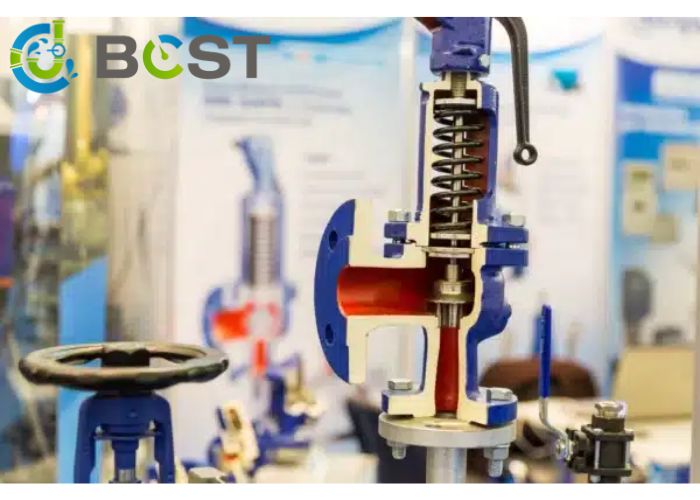
What Is a Pressure Safety Valve Really Doing Inside?
The internals of a valve can look complex and confusing. It’s hard to trust a device if you don’t understand how it works. Let’s simplify it down to the basic forces at play.
A pressure safety valve operates on a simple balance of forces. A powerful spring pushes a disc down, keeping the valve sealed. The system’s pressure pushes up on that same disc. When the upward push from the pressure becomes stronger than the downward push from the spring, the valve opens.
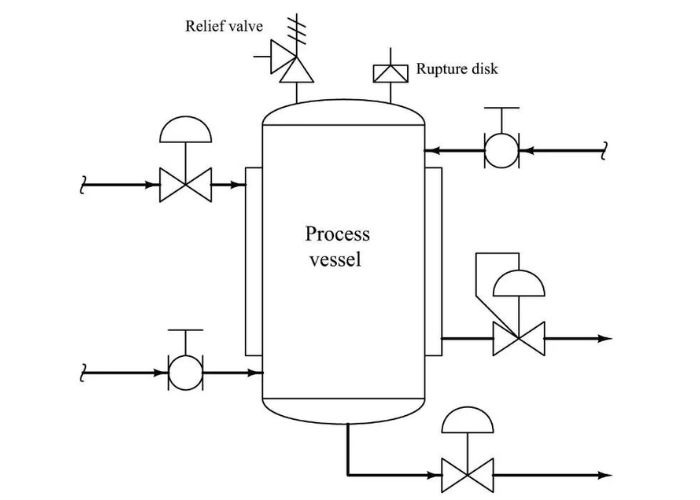
At its core, a PSV is a battle between two forces. This principle of force balance is what makes the valve so brilliantly simple and reliable. There are no complex electronics or external power sources needed. It’s pure physics. Let’s look at the key players in this battle.
Core Components and Their Roles
The design is built around three fundamental parts that work together to manage the pressure.
- The Spring: This is the heart of the клапанs control mechanism. It’s a heavy-duty, precisely calibrated spring. Before the valve is installed, the spring’s compression is adjusted using a screw. This adjustment determines the “set pressure.” The amount of force the spring exerts downwards is the benchmark for safety.
- The Disc and Seat: Think of the disc as the gate and the seat as the gate frame. The seat is the opening (or nozzle) through which the pressure would escape. The disc is a carefully machined plug that sits perfectly on top of the seat. The spring’s force presses the disc down onto the seat, creating a tight seal that prevents any fluid from leaking out during normal operations.
- The Body and Bonnet: The body is the main housing that contains the fluid path, including the inlet and outlet. The bonnet is the part of the housing that covers the spring and disc assembly, protecting them from the outside environment.
The Concept of Set Pressure
Сайт Set Pressure is the most important term related to a PSV. It is the specific pressure at which the valve is designed to begin opening. This is not a random number. Engineers like Hassan, when designing a refinery, will calculate the maximum pressure a vessel or pipe can safely handle (known as the MAWP – Maximum Allowable Working Pressure). The set pressure of the PSV is typically set at or just below this MAWP. This ensures that the system is never allowed to exceed its safety limits. The valve acts as the absolute last line of defense against a pressure surge.
| Компонент | Функция | The Role It Plays in the “Battle” |
|---|---|---|
| Весна | Provides a calibrated, downward force. | Represents the “safe pressure limit.” |
| Диск | Seals the opening under normal pressure. | This is the “gate” that the two forces fight over. |
| Место | Forms the seal with the disc. | The frame of the gate, ensuring a tight seal. |
| System Fluid | Exerts an upward force based on pressure. | Represents the “current system pressure.” |
How Does the Valve Actually Open and Close During an Emergency?
You know the parts, but what does the sequence look like in action? An overpressure event happens in seconds. The valve’s response must be instantaneous and automatic to be effective.
The valve opens when system pressure overcomes the spring force, lifting the disc and releasing pressure. It then automatically snaps shut once the pressure drops back to a safe level. This simple, reliable cycle provides continuous, automatic protection against dangerous overpressure situations.
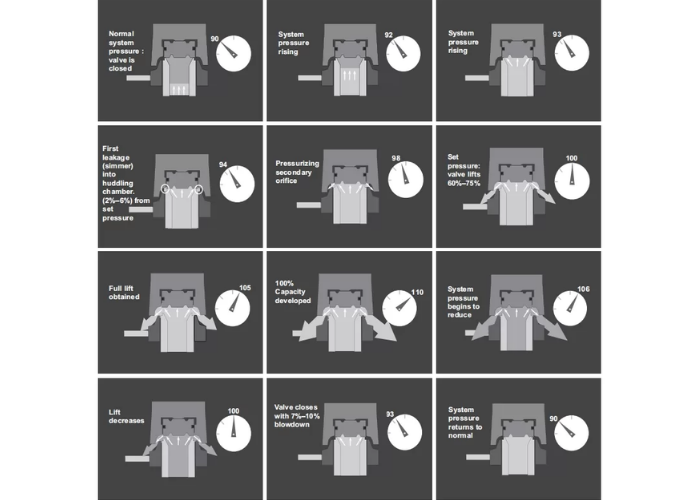
Let’s walk through the life of a pressure safety valve during a single overpressure event. This whole sequence can happen in just a few seconds, but it’s a beautifully engineered dance of physics that prevents disaster.
Step 1: Normal Operation (The Watchful Wait)
Most of the time, a PSV does absolutely nothing. The pressure in the system—be it a boiler, pressure vessel, or pipeline—is below the valve’s set pressure. During this time, the downward force of the powerful spring is much stronger than the upward force of the system pressure acting on the disc. The disc is held firmly against the seat, creating a tight seal. The valve is simply waiting, acting as a silent guardian for the system.
Step 2: The Lift (Pressure Exceeds the Set Point)
Now, an issue occurs. Maybe a downstream valve is accidentally closed, or a chemical reaction runs out of control. The pressure inside the system starts to rise. As it climbs, the upward force on the disc gets stronger and stronger. When the system pressure reaches the valve’s set pressure, the upward force becomes equal to the downward spring force. As the pressure continues to rise even slightly above the set point, the balance is broken. The upward force wins. The disc begins to lift off the seat. In many designs, the disc is shaped to use the initial rush of fluid to “pop” open quickly to its full lift, ensuring a large path for the excess pressure to escape.
Step 3: Discharge (Releasing the Pressure)
With the клапан now open, a large volume of the excess fluid (gas, steam, or liquid) is vented out of the valve’s outlet port. This port is connected to a safe disposal system, like a flare stack in a refinery or a blowdown tank. The valve will stay open as long as the system pressure is high enough to keep the disc lifted against the spring’s force. This rapid discharge quickly reduces the pressure in the main system, bringing it back down from the danger zone.
Step 4: Reseating (Returning to Normal)
As the pressure is vented, the pressure inside the system begins to drop. As it drops, the upward force on the disc weakens. Eventually, the pressure will fall to a point where the downward force from the spring is once again stronger. This pressure point is called the “reseating pressure” and is always lower than the set pressure. Once this point is reached, the spring pushes the disc back down onto the seat, snapping the valve shut and resealing the system. The cycle is complete, and the valve is now back in its normal, watchful state, ready for the next time it’s needed.
Are All Pressure Safety Valves the Same?
Is one simple spring-loaded valve good for every situation? Picking the wrong type can lead to poor performance, valve chatter, or even failure to open in a critical moment.
No, there are several types. The most common is the direct spring-loaded клапан. For more precise control and larger applications, a pilot-operated valve is used. There are also specialized designs, like balanced bellows valves, for systems with high backpressure.

I often get questions from clients about which PSV is right for their system. There is no single “best” answer; the best valve is the one that is perfectly matched to the application’s specific needs. My father taught me to always ask about the system first before ever recommending a product. Let’s look at the three main families of PSVs.
Direct Spring-Loaded Safety Valves
This is the classic, most widely used design we’ve been discussing. Its popularity comes from its simplicity, reliability, and relatively low cost. It’s completely self-contained and relies on the simple balance between a spring and the system pressure. They are versatile and can be used for gas, steam, and liquid service. They are the workhorse of the industry and are found in everything from small air compressors to large industrial boilers. Their main limitation can be sensitivity to backpressure (pressure at the valve’s outlet), which can interfere with their opening characteristics.
Pilot-Operated Safety Valves
For larger pipes, higher pressures, or situations where you need extremely precise operation, the pilot-operated valve is a more advanced solution. This design uses a two-part system: a small, conventional spring-loaded “pilot” valve and a much larger main valve. The pilot valve senses the system pressure. When the set pressure is reached, the small pilot valve opens. Instead of venting the entire system’s pressure, it just vents a small amount of pressure from a chamber above the main valve’s piston. This pressure change causes the large main piston to lift, opening the main valve and allowing the full system pressure to be released. These valves can operate much closer to the set pressure without leaking and are not as affected by backpressure, making them ideal for complex systems like those Hassan designs for oil and gas terminals.
Specialized Variants (e.g., Balanced Bellows)
Sometimes, the operating environment poses unique challenges. A common problem is backpressure, where pressure builds up at the outlet of the PSV. In a standard spring-loaded valve, this backpressure pushes up on the disc, effectively helping the spring and changing the pressure at which the valve will open. To solve this, engineers created the balanced bellows safety valve. This design incorporates a flexible metal bellows around the disc. This bellows has the same surface area as the disc, and it’s vented to the atmosphere. This design cancels out the effect of any backpressure, ensuring the valve will always open at its correct set pressure, regardless of what’s happening downstream.
| Тип клапана | Принцип работы | Ключевое преимущество | Best Use Case |
|---|---|---|---|
| Пружинный механизм | A direct balance between a spring and system pressure. | Simple, reliable, cost-effective. | General purpose applications (boilers, vessels). |
| Пилотируемый | A small pilot valve controls the opening of a larger main valve. | Very accurate, handles high pressure, can operate closer to setpoint. | Large pipelines, high-pressure storage, transmission stations. |
| Balanced Bellows | A bellows assembly isolates the disc from backpressure. | Reliable opening even with high or variable backpressure. | Systems with complex vent piping or multiple valves. |
Заключение
В итоге, a pressure safety valve is your system’s ultimate insurance policy. Its reliability hinges on proper selection to match the system, correct installation, and a diligent maintenance schedule.


 English
 Arabic
 Russian
 French
 Spanish