
Grooved Ball Valves: The Secret to Faster, Safer Pipe Installation
You’re faced with a tight project schedule, but traditional pipe joining methods are slow. Welding requires hot work permits and specialized labor. Flanged connections mean painstakingly aligning gaskets and tightening dozens of bolts in the correct sequence. Ball valves (including grooved-end types) are primarily on/off devices; studies show they have limited accuracy as control valves and are used for throttling mainly in emergencies rather than as precise regulators.
Grooved ball valves solve this problem by using a mechanical coupling that replaces flanges or welds. This system allows you to install a valve in minutes, not hours, with just two bolts and a simple hand tool, drastically reducing labor costs and project timelines.

How Does a Grooved Coupling Actually Work?
You see the simple two-bolt coupling, and it seems too easy. How can something that simple create a seal as reliable and strong as a heavy, multi-bolt flange?
The system is a clever combination of three parts: the grooved ends of the valve and pipe, a pressure-responsive gasket, and the bolted coupling housing. The housing mechanically locks the pipes together, while the gasket creates the seal. Line pressure itself reinforces this seal, making it even stronger under operation.

The Three Components of a Perfect Seal
To an engineer like Hassan, who is ultimately responsible for system integrity, understanding the mechanics of the seal is essential. The elegance of the grooved system lies in how these three simple components work together to create a secure and reliable joint.
- The Groove: This is the foundation of the system. A groove is formed near the end of the pipe and on the valve ends by “roll grooving” or “cut grooving.” This groove provides the channel where the coupling housing will lock in, providing a strong mechanical connection.
- The Gasket: This is the heart of the seal. Unlike a flange gasket which is just compressed, a grooved coupling gasket is “pressure-responsive.” As pressure is introduced, it pushes against the lips of the gasket, forcing it more tightly against the pipe and valve surfaces. The higher the pressure, the tighter the seal becomes.
- The Coupling Housing: This is the muscle. It consists of two ductile iron halves that surround the gasket and engage with the grooves. When the two bolts are tightened, they draw the housing segments together, firmly securing the pipe ends and locking them in place.
Here is how it compares to traditional methods:
| Характеристика | Grooved Coupling | Flanged Joint | Welded Joint |
|---|---|---|---|
| Installation Speed | Very Fast (Minutes) | Slow (Hours) | Very Slow (Hours + inspection) |
| Required Skills | Basic hand tools | Wrench/Torque Wrench | Certified Welder |
| Безопасность | No flame, no hot work | Minimal risk | High risk (flame, fumes, sparks) |
| Гибкость | Allows for movement | Rigid | Completely Rigid |
| Техническое обслуживание | Easy (2 bolts) | Difficult (many bolts) | Very Difficult (cut out) |
What Are the Main Advantages of a Grooved System?
You’re planning a new project and need to control the budget and stick to a tight schedule. Traditional pipe joining methods are labor-intensive and slow, representing a major risk to both your finances and your timeline.
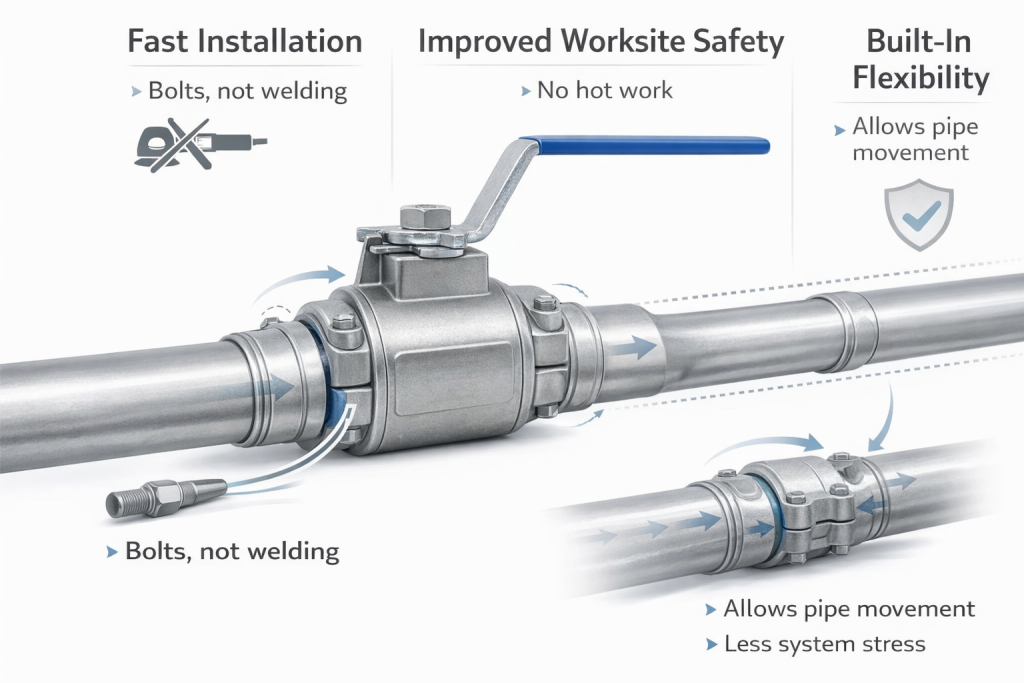
Grooved systems deliver huge advantages across the board. They offer unmatched installation speed, which directly cuts labor costs, and enhance worksite safety by completely eliminating welding. They also provide built-in flexibility to accommodate pipe movement, reducing stress on the entire system.
The True Value Proposition
While the speed of installation is what first catches everyone’s attention, the long-term operational benefits are what make grooved systems a brilliant choice for many applications. Engineers appreciate systems that are not only quick to build but also safe, reliable, and easy to maintain over decades of service.
Dramatic Speed and Cost Savings
The labor savings from grooved systems are substantial. Consider installing a 6-inch valve:
- Grooved: One technician can install a grooved joint in about 15 minutes.
- Flanged: A technician might take over an hour to properly align the gasket, insert all 8 bolts, and torque them in a star pattern.
- Welded: A certified welder could take 2-4 hours, plus additional time for setup, cooling, and weld inspection (NDT).
This time difference, multiplied across a project, translates into a massive reduction in labor costs.
Enhanced Worksite Safety
- No Hot Work: Grooved systems are a cold-formed joint. There are no sparks, open flames, or hazardous fumes. This eliminates the need for hot work permits and a dedicated fire watch.
- Reduced Injury Risk: The couplings are lighter and easier to handle than a comparable heavy flange, reducing the risk of strains, burns, and other common worksite injuries.
Built-in System Flexibility
- Movement Accommodation: The coupling design allows for controlled linear and angular movement, accommodating thermal expansion, contraction, and seismic events. It acts as a shock absorber for the system.
- Vibration Damping: The gasket helps to absorb vibrations from equipment like pumps, leading to a quieter and more durable system.
Unmatched Ease of Maintenance
- Simple Access: To remove a grooved ball valve, a technician simply needs to loosen two bolts. The coupling comes apart, and the component can be lifted out.
- Fast Reassembly: This drastically reduces downtime for routine maintenance or emergency repairs, saving a facility a fortune in lost production.
Заключение
Grooved ball valves are more than just a component; they are part of a system that accelerates projects, improves safety, and adds long-term flexibility, making them a superior choice for a wide range of applications.
Ready to Streamline Your Next Project?
Explore our range of grooved ball valves and couplings to see how you can save time and money on your installation.


 English
 Arabic
 Russian
 French
 Spanish