
Why even “Closed” Gate Valve Can Still Pass 10 Liters a Minute?
You’ve installed a new задвижка for critical isolation. You close it, expecting a complete shutdown. Yet, product is still migrating downstream, contaminating another line or creating a hidden safety risk. How is this possible?
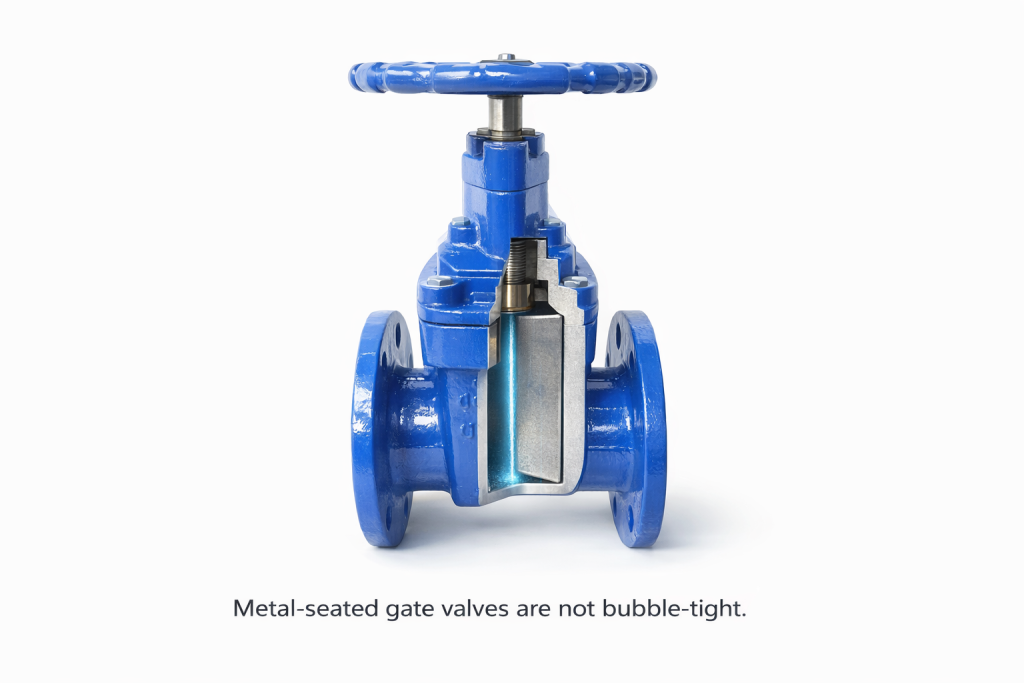
The hard truth is that a “closed” metal-seated gate valve is rarely 100% leak-tight. The industry standard that governs its testing, API 598, actually permits a certain amount of leakage. For a large valve, this “acceptable” rate can be surprisingly high.
What is API 598 and Why Does It Permit Leakage?
You trust that a gate valve provides a tight shutoff, but “tight” is a relative term. API 598, the “Valve Inspection and Testing” standard, allows for some leakage in metal-seated valves because achieving a perfect, bubble-tight seal between two large, rigid metal surfaces is extremely difficult and often unnecessary for the intended service.
The Numbers Don’t Lie: Allowable Leakage Rates
The standard sets different criteria for resilient-seated vs. metal-seated valves:
- Resilient-Seated Valves (Soft Seats): Zero leakage требуется.
- Metal-Seated Valves (e.g., Gate Valves): Leakage is permitted.
| NPS (Inches) | Drops/min | mL/min |
|---|---|---|
| ≤ 2 | 4 | 0.2 |
| 2 ½ – 6 | 12 | 0.6 |
| 8 – 12 | 20 | 1.0 |
| ≥ 14 | 2 per inch | 0.1 per inch |
The “10 Liters a Minute” figure is a very real possibility for a very large gate valve in liquid service that is simply meeting its design standard after some service life, combining the allowable rates with real-world operating conditions.
So, If a Gate Valve By Design Leaks, Why Use One?
Now that you know this—and may also know that gate valves have specific leakage causes—you might wonder why they are so common. The key is using the right tool for the right job. A standard gate valve is ideal for full-bore isolation where a small amount of seat leakage is acceptable.

The Right Tool for the Right Job
Сайт gate valve’s structure gives it advantages for specific applications:
Where to Use a Gate Valve
- Transport Pipelines: Low pressure drop is critical.
- General Isolation: Isolating equipment where lines can be drained.
- Tank Farms: Isolating large storage tanks.
Where NOT to Use a Standard Gate Valve
- Critical (Zero-Leak) Shutoff: For toxic media or live maintenance.
- Cross-Contamination Prevention: Where product purity is essential.
- Дросселирование: This will destroy the valve’s seats.
For applications requiring true zero-leakage, you must specify a different valve, such as a resilient-seated ball valve or a Double Block and Bleed valve system.
Conclusion: Match the Valve to the Application
A standard gate valve is a workhorse of industry, but it is not a perfect seal. Understanding that API 598 allows for leakage is the first step toward better system design, improved safety, and preventing costly process mistakes. Always match the valve’s capability to the application’s true requirements.


 English
 Arabic
 Russian
 French
 Spanish