
The Complete Guide to Zone Control Valves for HVAC Systems
In today’s pursuit of optimized comfort and energy efficiency, the ability to fine-tune environmental conditions in specific areas of a building is no longer a luxury—it’s a necessity. This is precisely the role of zone control valves in modern hydronic (water-based) heating and cooling systems. Often overlooked but always critical, these devices allow for unparalleled customization of indoor climates, ensuring that energy is directed exactly where and when it’s needed.
This comprehensive guide from BCST Valve will serve as your definitive starting point for understanding zone control valves. Whether you’re an HVAC technician, a mechanical engineer, a building maintenance supervisor, or a hydronic system designer, this article will equip you with the foundational knowledge to effectively integrate and manage these essential components in any multi-zone system. We’ll define what a zone valve is, explain its fundamental role, introduce its core components, and provide a roadmap to deeper technical insights within our cluster articles.
What is a Zone Control Valve?
At its core, a zone control valve is an electro-mechanical device used in hydronic heating and cooling systems to regulate the flow of conditioned water or steam to specific areas, or “zones,” within a building. Instead of conditioning an entire building uniformly, zone valves empower HVAC systems to deliver heating or cooling only to the areas that need it, based on individual thermostat demands.

Imagine a large office building where some offices are occupied on a cold Saturday morning, while others are empty. Without zone control, the entire building’s heating system would likely turn on, wasting significant energy. A zone valve allows only the occupied offices to receive heat, significantly reducing energy consumption and providing customized comfort.
Role in Multi-Zone Hydronic Systems
In a multi-zone hydronic system, a central boiler or chiller produces hot or cold water, which is then circulated through a network of pipes. Instead of a single large circulating pump serving the entire system, or multiple pumps for each zone (which can be costly), zone valves serve as the gatekeepers for each individual zone.
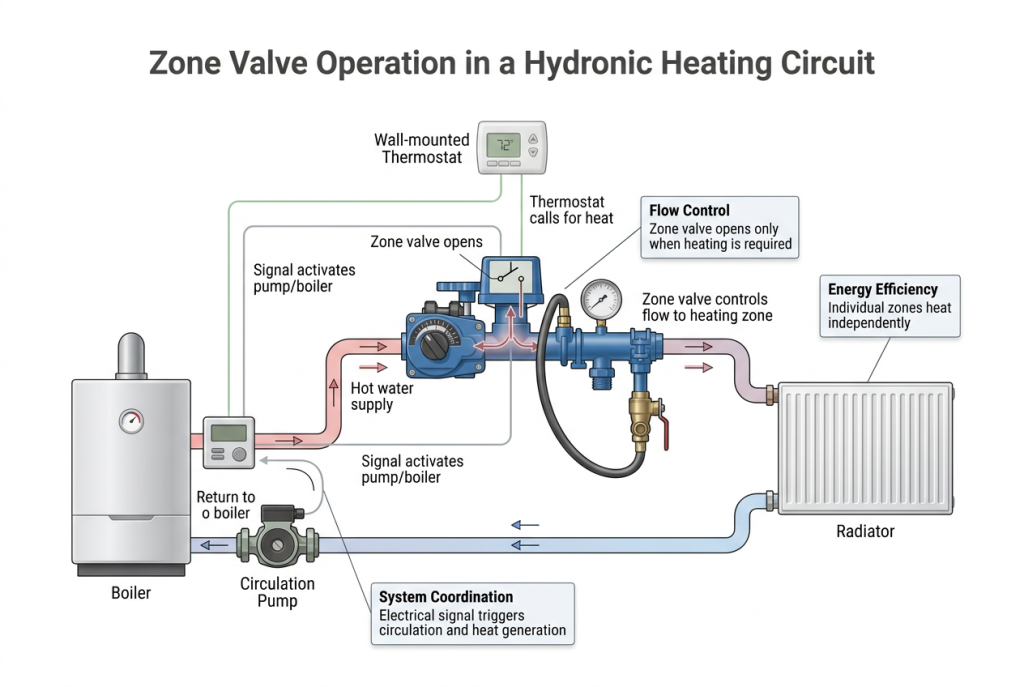
When a thermostat in a particular zone calls for heating or cooling, it sends a signal to its corresponding zone valve. The valve then opens, allowing conditioned water to flow through the heat emitters (like baseboard heaters, radiant floors, or fan coils) in that specific zone. This precise control results in:
- Enhanced Comfort: Different occupants can set their preferred temperatures without affecting other areas.
- Significant Energy Savings: Preventing energy waste in unoccupied or less critical zones.
- Повышенная гибкость системы: Adapting to varying occupancy schedules and building uses.
Core Components of a Zone Valve
While appearing as a single unit, a zone control valve assembly typically comprises three key interdependent components:
1. The Valve Body (Hydraulic Section)
This is the actual mechanical valve that controls the flow of water. Within the body, a port and seat mechanism (often a ball or globe design) is responsible for opening and closing the passageway for water. The most fundamental choice in system design is whether you need to simply stop flow or divert it. This choice is explored in our technical comparison: 2-Way vs. 3-Way Zone Valves: A Critical Design Choice.
- 2-Way Valve: Acts like a simple on/off switch, allowing or stopping flow through a single pipe.
- 3-Way Valve: Can either mix fluids from two inlets to a single outlet or divert fluid from a single inlet to one of two outlets, commonly used in mixing or diverting applications.
2. The Actuator (Electro-Mechanical Driver)
Mounted directly on top of the valve body, the actuator is the brain and muscle of the zone valve. It’s an electric motor or thermal expansion device that responds to electrical signals from the thermostat. Upon receiving a signal, the actuator moves the valve mechanism (e.g., rotating a ball or lifting a stem) to open or close the flow path.
3. The End Switch (Electrical Feedback)
Integrated within the actuator assembly, the end switch is a crucial electrical contact that closes once the valve has fully opened (or sometimes fully closed, depending on the design). The closing of this switch signals to the main system (e.g., the boiler or circulating pump) that flow has been established in that zone. This prevents the boiler from firing or the pump from running unnecessarily if the valve isn’t fully open yet, ensuring efficient operation.
The magic of a zone valve lies in how the actuator and end switch work together to control flow. We provide a detailed mechanical and electrical breakdown in our guide: How a Zone Valve Works: Actuators, End Switches, and Schematics.
How Zone Valves Work: A Simplified Overview
Here’s a basic sequence of how a zone valve operates in a typical hydronic heating system:
- Thermostat Call: The thermostat in a specific zone senses the temperature is below its setpoint and sends a low-voltage electrical signal to its associated zone valve actuator.
- Actuator Action: The actuator receives this signal and begins to move the valve mechanism (e.g., opening a port). This process usually takes several seconds to a minute.
- End Switch Engagement: Once the valve is fully open, the end switch inside the actuator closes.
- System Activation: The closed end switch sends a signal to the boiler and/or circulating pump control panel, indicating that flow is ready. The boiler then fires, and the pump circulates hot water to that zone.
- Temperature Achieved: When the thermostat reaches its setpoint, it stops sending the signal to the valve actuator, which then closes the valve, and the end switch opens, signaling the boiler/pump to shut down for that zone.
Correctly wiring the valve to the thermostat, transformer, and circulator is critical for proper operation. We provide clear, step-by-step diagrams in How to Wire a Zone Control Valve: A Technician’s Guide.

Benefits of Employing Zone Control Valves
Integrating zone control valves into an HVAC system offers a multitude of advantages, translating into tangible benefits for building owners and occupants alike:
- Personalized Comfort: Allows individual rooms or areas to maintain distinct temperatures suitable for their specific use or occupancy.
- Significant Energy Savings: By only heating or cooling inhabited spaces, zone valves prevent conditioned air from being wasted in unoccupied areas, leading to lower utility bills.
- Уменьшение износа: Prevents the central heating/cooling unit from constantly running at full capacity, potentially extending its lifespan.
- Адаптивность: Easily accommodates changes in building usage, remodeling, or tenant preferences without a complete system overhaul.
- Elimination of Overheating/Overcooling: Addresses common comfort complaints by delivering precise temperature management.
Common Issues and Troubleshooting
Like any electro-mechanical component subjected to continuous use, zone control valves can eventually encounter issues. Common problems include actuators failing (either not opening or closing), valve bodies sticking, or end switches malfunctioning. When a zone isn’t heating or cooling correctly, the valve is a primary suspect. Learn how to diagnose the issue with our dedicated guide: Field Guide to Troubleshooting Zone Control Valve Failures.
Conclusion: Precision Control for Modern Comfort
Zone control valves are indispensable components in any efficient and comfortable hydronic HVAC system. They represent a smart investment for optimizing energy use, extending equipment life, and providing tailored thermal comfort throughout a building. By understanding their function, components, and integration, you’re better equipped to design, install, and maintain these sophisticated systems.
At BCST Valve, we specialize in high-quality, reliable zone control valves designed to meet the rigorous demands of residential, commercial, and industrial HVAC applications. Partner with us to achieve precision climate control in your next project.
Ready to elevate your HVAC system with advanced zone control?


 English
 Arabic
 Russian
 French
 Spanish