
Pipeline Valve Integrity: Flanged vs. Welded End Connections
The integrity of any pipeline system hinges not just on the quality of its pipes and valves, but crucially, on how these components are joined together. The end connection type of a valve determines its structural robustness, ease of maintenance, potential for leakage, and suitability for various operating conditions. For pipeline engineers, the decision between flanged and welded end connections is a fundamental one, impacting project costs, operational safety, and long-term system reliability.
At BCST Valve, we recognize that the interface between a valve and the pipeline is a critical point of engineering. This guide will provide a comprehensive comparison of flanged and welded end connections, detailing their respective advantages, disadvantages, and optimal applications. This is a vital consideration within a broader understanding of pipeline valve engineering, as explored in The Engineer’s Guide to Ball Valves in Pipeline Applications.
Understanding Flanged End Connections
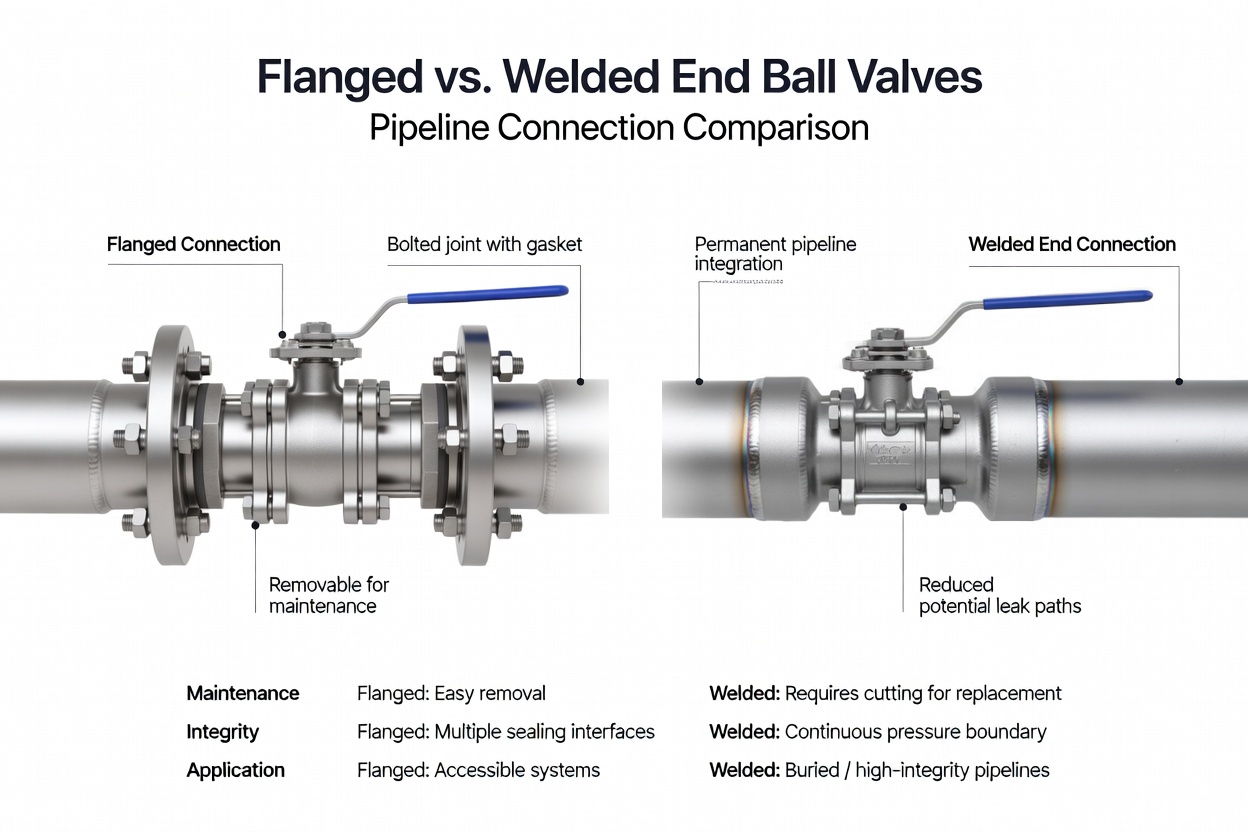
Flanged connections are characterized by circular plates (flanges) at the ends of the valve body, which are bolted to corresponding flanges on the pipeline using gaskets to create a seal. This method adheres to standards like ASME B16.5 (for pipes up to 24 inches) and B16.47 (for larger pipes).
Advantages of Flanged Connections:
- Ease of Installation & Removal: Valves can be quickly installed, inspected, repaired, or replaced without cutting the pipeline, minimizing downtime.
- Гибкость: Allows for easier alignment during installation, accommodating minor misalignments.
- Совместимость материалов: Can be used to join different materials of construction effectively.
- Modifications: Facilitates future system modifications or additions.
Disadvantages of Flanged Connections:
- Potential Leak Paths: Gaskets and bolted joints represent potential points of leakage, which can degrade over time due to vibration, thermal cycling, or chemical attack.
- Increased Weight & Space: Flanges add significant weight and require more radial space compared to welded connections.
- Higher Cost (Initially): Flanged valves and accompanying hardware (gaskets, bolts) can sometimes have higher initial acquisition costs and require more skilled labor for assembly.
- Corrosion Risk: Bolting and flange faces can be susceptible to external corrosion, especially in harsh offshore or underground environments.
Understanding Welded End Connections
Welded end connections involve directly welding the valve (typically its body ends) to the pipeline. This method creates a seamless, homogenous connection, eliminating potential leak paths associated with bolted joints.
Advantages of Welded Connections:
- Ultimate Integrity: Eliminates flange gaskets and bolts, creating a truly monolithic, leak-proof connection with the pipeline. Ideal for critical, hazardous, or high-pressure/temperature applications.
- Reduced Weight & Space: Offers a more compact design and significantly reduces weight compared to flanged valves.
- Cost-Effective (Long-term): While initial welding can be expensive, the elimination of gaskets, bolts, and reduced maintenance for leak detection can lead to lower long-term operating costs.
- Устойчивость к коррозии: A welded joint offers superior external corrosion resistance compared to exposed flanges and bolts, especially in buried or submerged conditions.
- Fire Safety: Welded connections are inherently more fire-safe as they are less prone to leakage during a fire event.
Disadvantages of Welded Connections:
- Difficult Maintenance: Repair or replacement requires cutting the valve out of the line, which can be time-consuming and costly, especially in remote locations or with specialized welding procedures.
- Skilled Labor: Requires highly skilled and certified welders, specialized equipment, and non-destructive testing (NDT) to ensure weld quality.
- Alignment Challenges: Precise alignment of the valve with the pipeline is critical before welding.
- Heat-Affected Zone (HAZ): Welding can create a HAZ, potentially altering the material properties of the pipe and valve, requiring careful material selection and post-weld heat treatment (PWHT).
Flanged vs. Welded: A Direct Comparison
| Характеристика | Flanged End | Welded End |
|---|---|---|
| Leak Integrity | Good, but potential for gasket/bolt leaks | Excellent, monolithic seal |
| Простота обслуживания | High (easy removal/replacement) | Low (requires cutting/re-welding) |
| Installation Cost | Lower labor, higher hardware. | Higher labor (welding), lower hardware. |
| Space/Weight | More space, heavier | Compact, lighter |
| Thermal Cycling | Can affect gasket life | Highly resistant |
| Corrosion Risk | Higher external for bolts/flange faces | Lower (seamless construction) |
Key Engineering Considerations for Selection
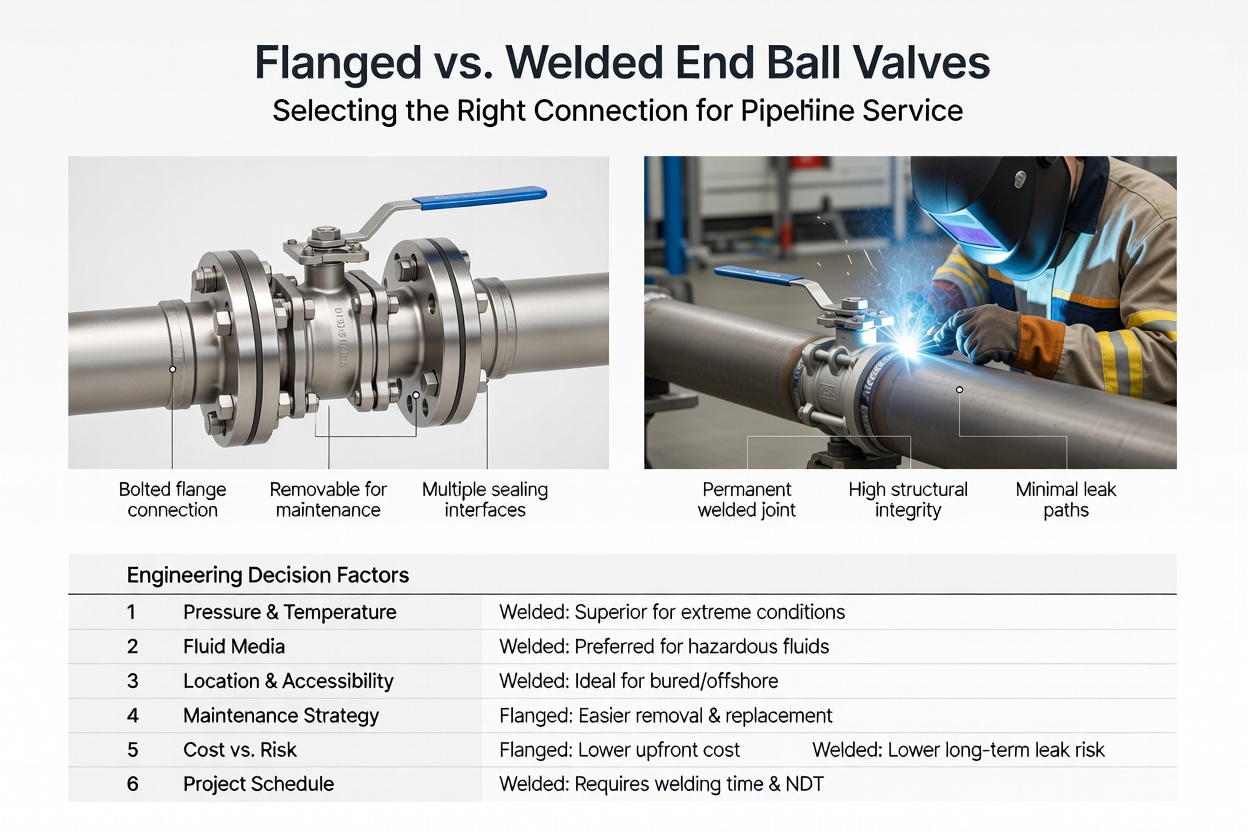
The optimal choice between flanged and welded connections depends heavily on the specific application parameters:
- Pressure & Temperature: For extremely high pressures or temperatures, welded connections offer superior sealing and structural integrity.
- Жидкие среды: Highly corrosive, toxic, or flammable fluids often mandate welded connections to minimize leak potential.
- Location & Accessibility: For buried pipelines, offshore platforms, or inaccessible areas where maintenance is difficult and leaks are unacceptable, welded connections are preferred.
- Maintenance Philosophy: If frequent inspection, repair, or replacement of valves is anticipated, flanged connections offer logistical advantages.
- Cost vs. Risk: Initial cost savings from flanged connections must be weighed against the potential long-term costs of leakage, environmental impact, and prolonged downtime for welded repairs.
- Project Schedule: Welding processes can be time-consuming, especially with NDT requirements, impacting project timelines if not planned properly.
Заключение
The choice between flanged and welded end connections for pipeline valves is a pivotal engineering decision that demands careful consideration of operating conditions, safety requirements, maintenance strategies, and economic factors. While flanged connections offer valuable flexibility and ease of maintenance, welded connections provide superior integrity, particularly in critical, high-risk, or inaccessible pipeline applications.
At BCST Valve, we supply both flanged and welded end ball valves, manufactured to the highest industry standards (like API 6D), ensuring optimal performance and integrity for your specific pipeline needs. Consult with our experts to make the most informed decision for your project.
Ready to optimize your pipeline connections?


 English
 Arabic
 Russian
 French
 Spanish