
You need to control fluid flow, but the wrong valve choice can cause damage and poor performance. This leads to unexpected downtime and increased maintenance costs in your plant.
Yes, butterfly valves can be used for throttling, but their effectiveness is limited to a specific range. They perform best when the disc is between 30 and 70 degrees open. Outside this range, they offer poor control and risk damage from cavitation and erosion.
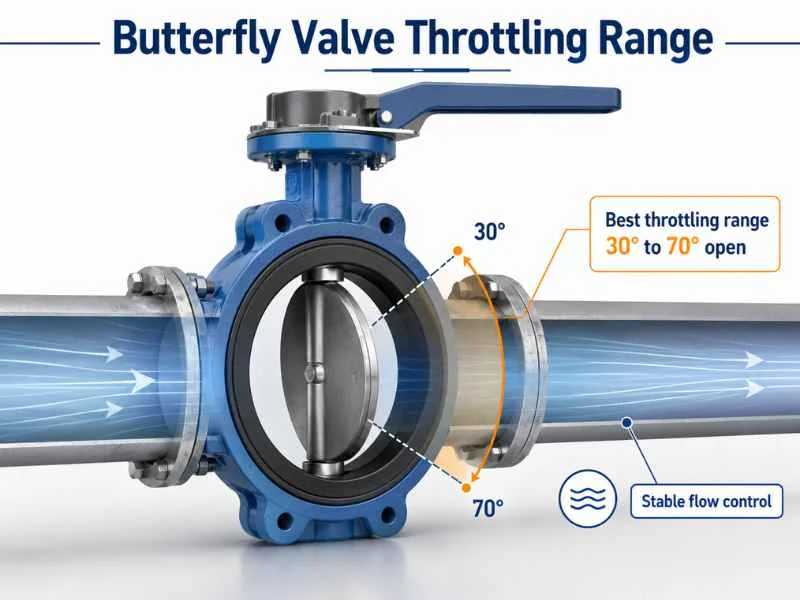
Using a butterfly valve for throttling, which means regulating the flow or pressure of a fluid, requires careful consideration. While they are an economical choice for on/off service, their suitability for flow control depends on the application specifics and valve design. This guide will explore their capabilities, risks, and how to select the right valve for your throttling needs.
Understanding Butterfly Valve Throttling Capabilities
Using a butterfly valve for flow modulation requires understanding its inherent flow characteristics. Your control precision depends entirely on the disc’s position within the flow stream.
A butterfly valve provides its most effective throttling performance in the mid-range of its rotation, typically from 30 to 70 degrees open. In this zone, the change in flow rate is more proportional to the disc’s movement, allowing for reasonable control over the process.
This control characteristic is often described as “modified equal percentage.” In the optimal range, a certain degree of disc rotation produces a consistent percentage change in the flow. However, this relationship breaks down at the extremes of its operation.
The Problem with Low Opening Angles (0-30 Degrees)
When a butterfly valve is nearly closed, from fully shut to about 30 degrees open, it offers very poor control. Small movements of the disc cause large, non-linear changes in the flow rate. This makes precise adjustments nearly impossible. Furthermore, the narrow opening creates a high-velocity jet of fluid. This jet can quickly erode the edge of the disc and the adjacent seat material, especially in abrasive or high-pressure services. This concentrated wear significantly shortens the valve’s service life. You can learn more about the basic components in our guide on what is a butterfly valve.
The Issue at High Opening Angles (70-90 Degrees)
Conversely, when the valve is nearly fully open, from 70 to 90 degrees, control also diminishes. In this range, moving the disc results in very little change to the flow rate. The disc is almost parallel to the flow, and the valve is essentially acting as a fully open pipe. Attempting to throttle here is ineffective. The unstable flow dynamics can also cause the disc to “flutter” or vibrate, which puts stress on the stem, seals, and actuator.
The table below summarizes the effectiveness of throttling at different disc positions.
| Disc Opening | Flow Control Precision | Risk of Damage | Recommended for Throttling? |
|---|---|---|---|
| 0° – 30° | Poor, non-linear | High (Erosion) | Нет |
| 30° – 70° | Good, more linear | Умеренный | Yes, with correct valve type |
| 70° – 90° | Poor, minimal change | Moderate (Vibration) | Нет |
For your projects, this means you should design systems to operate the butterfly valve within its ideal 30-70 degree throttling window for stable and reliable flow control.
Key Risks of Throttling with Butterfly Valves
Improperly applying a butterfly valve in throttling service can lead to premature failure and serious safety hazards. Understanding these risks is essential for ensuring plant reliability and personnel safety.
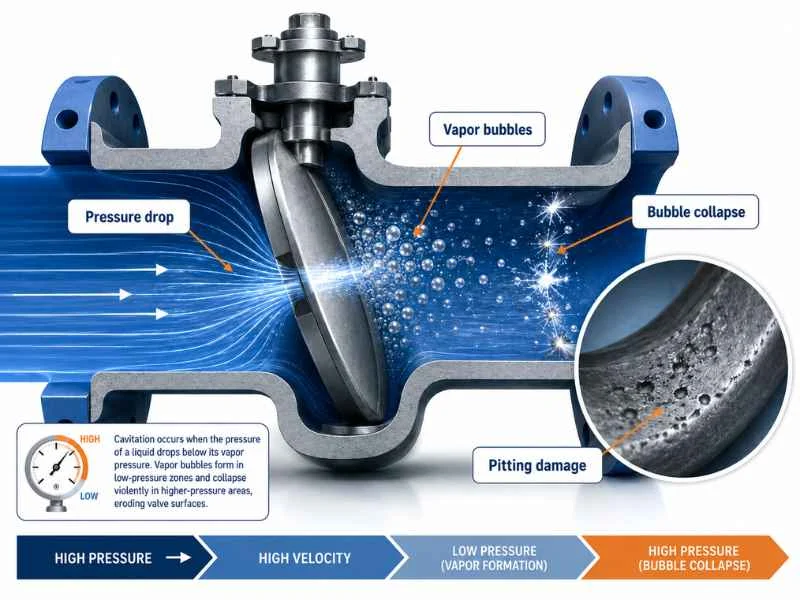
The primary risks of throttling include severe erosion from high fluid velocity, damaging vibration from turbulence, and destructive cavitation in liquid services. These phenomena can drastically reduce the valve’s lifespan and compromise the integrity of your entire piping system.
Cavitation Damage
Cavitation is a major threat in liquid throttling applications. It occurs when the fluid velocity increases as it passes the partially open disc, causing its pressure to drop below the vapor pressure. This pressure drop creates small vapor bubbles. As the fluid moves past the disc, the pressure recovers, and these bubbles violently collapse or implode.
These implosions act like tiny hammer blows on the valve’s internal surfaces. They can create significant noise and vibration. More importantly, they cause pitting and erosion on the disc and valve body downstream. Over time, this damage can lead to leakage, loss of control, and ultimately, catastrophic valve failure. For this reason, you must carefully calculate the pressure drop across the valve to avoid conditions that induce cavitation.
Erosion from High Velocity and Solids
When you throttle a fluid, its velocity increases as it squeezes through the restricted opening. If the fluid contains abrasive particles like sand, scale, or catalyst fines, this high-velocity stream acts like a sandblaster. It will wear away the seating surfaces of the disc and the liner or seat ring. Even clean fluids at very high pressure drops can cause erosion damage over time. This erosion prevents the valve from achieving a tight seal when closed and degrades its ability to control flow accurately.
Disc Flutter and Vibration
Turbulent flow around a partially open disc can create unsteady pressure forces. These forces can cause the disc to vibrate or “flutter” rapidly. This vibration is transmitted through the stem to the actuator. It can lead to premature wear of the stem bearings, packing seals, and actuator gears. In severe cases, the vibration can cause the stem to fatigue and fail. This is why a robust stem design and proper actuator sizing are critical for throttling valves, which you can understand better by reviewing the butterfly valve working principle.
Selecting the Right Butterfly Valve for Flow Control
Not all butterfly valves are suitable for demanding throttling services. Selecting the correct design and materials is crucial for ensuring long-term performance and reliability in flow control applications.
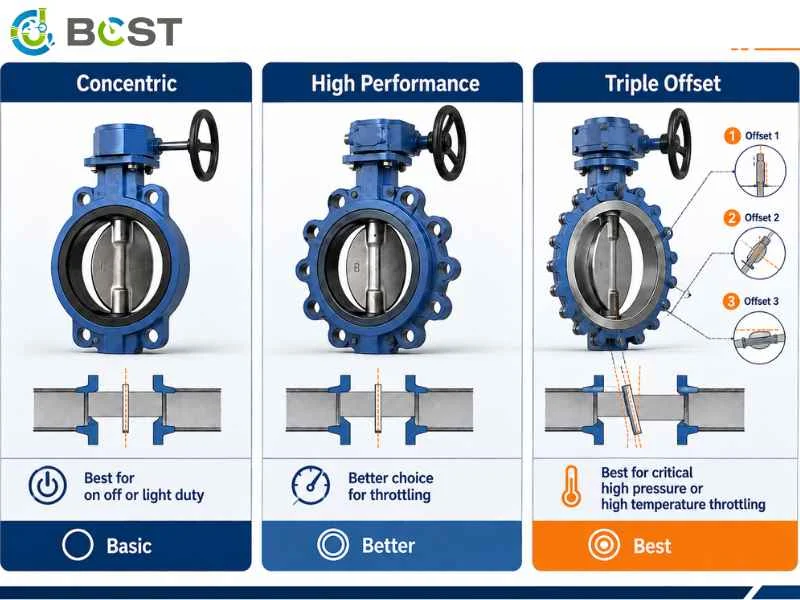
For throttling, you should prioritize high-performance or triple-offset butterfly valves over standard resilient-seated designs. Their advanced construction features robust metal seats and a more rigid disc and stem assembly, which better withstand the stresses of continuous flow modulation.
Valve Type: Concentric vs. Offset Designs
The choice between a concentric (resilient-seated) valve and an offset valve is the most important factor.
- Concentric Butterfly Valves: These are the simplest design, where the stem is centered in the disc, and the disc is centered in the pipe. The seat is typically made of a soft material like EPDM or PTFE. While cost-effective, they are not ideal for throttling. The constant friction between the disc and the soft seat during modulation causes rapid wear, leading to leakage. They are best used for simple on/off applications or very low-pressure-drop throttling.
- High-Performance Butterfly Valves (Double Offset): These valves have two offsets. The disc is offset from the valve centerline and the stem centerline. This geometry lifts the disc off the seat as it opens, minimizing friction and wear. They often feature more robust seats (like RTFE or metal) and are designed for higher pressures and temperatures. Their rigidity makes them a much better choice for frequent throttling.
- Triple Offset Butterfly Valves (TOVs): TOVs add a third offset in the seat cone angle. This completely eliminates friction between the disc and the metal seat during operation. They provide a bubble-tight, zero-leakage seal. With their all-metal construction, they are the best choice for critical throttling applications involving high pressure, high temperature, or abrasive media.
Materials and Actuation
Beyond the valve type, consider the materials. For erosive or corrosive services, discs and bodies made from Stainless Steel, Duplex, or other high-grade alloys are necessary. A hardened disc edge can further improve resistance to wear.
Finally, the actuator must be sized correctly. Throttling creates dynamic torque from the flowing fluid, which can be much higher than the simple seating and unseating torque. The actuator must be powerful enough to hold the disc steady at the desired position against these forces. Using a digital positioner with the actuator is highly recommended for achieving precise and repeatable flow control. You can explore a range of suitable options in our поворотный клапан product lineup.
Q&A: Your Questions on Throttling with Butterfly Valves
1. Why are butterfly valves good for throttling in some cases?
Butterfly valves are good for throttling when cost-effectiveness and moderate control are required. In the 30-70 degree open range, they offer a reasonable response. High-performance and triple-offset designs, in particular, handle the stress of throttling well. Their simple, lightweight design also makes them easier and cheaper to install compared to globe valves, making them a practical choice for many large-pipe-size applications where perfect precision is not the primary goal.
2. For which applications are butterfly valves good for throttling?
Butterfly valves are good for throttling in applications like cooling water systems, large air handling units (HVAC), and low-pressure process lines where precise control is not critical. They are suitable for managing large volumes of fluids or gases. However, for applications with high-pressure drops, abrasive slurries, or where cavitation is a high risk, more robust valve types like globe valves or specialized severe-service butterfly valves are recommended.
3. Are butterfly valves good for throttling high-pressure liquids?
Generally, standard butterfly valves are not good for throttling high-pressure liquids due to the risk of cavitation and erosion. The high pressure drop across the partially open disc can cause severe damage. However, triple-offset butterfly valves (TOVs) with metal seats and robust construction are specifically designed for high-pressure and high-temperature services. They can handle throttling duties in these conditions far more effectively than concentric or resilient-seated designs.
4. How does disc position affect if butterfly valves are good for throttling?
Disc position is critical. Butterfly valves are only good for throttling in their mid-range, typically between 30 and 70 degrees open. In this range, flow control is relatively stable and predictable. Below 30 degrees, control is poor, and erosion risk is high. Above 70 degrees, the valve offers very little flow change, making control ineffective. Operating outside the optimal range negates any benefits of using a butterfly valve for throttling.
Final Thought
В то время как поворотные затворы can be effective for throttling, success depends on using the right type within its optimal control range. For demanding applications, always lean towards high-performance or triple-offset designs to ensure reliability and a long service life.
For expert assistance in selecting the ideal throttling butterfly valve for your project, contact the BCST team today.


 English
 Arabic
 Russian
 French
 Spanish