
The 30-Second Maintenance Task That Ends in an LTI: A Guide to Hidden Pressure Traps in Bleeder Valves
Why overlooking a “simple” bleeder valve can lead to critical failures and lost time injuries.
A routine maintenance task. A quick drain. A technician assumes the line is depressurized, opens a bleeder valve, and within a terrifying 30 seconds, a stored energy burst results in a severe injury, or worse. This isn’t a hypothetical safety briefing; it’s a tragic reality in industrial environments where the inconspicuous bleeder valve, often treated as a commodity, can harbor **hidden pressure traps**. These unseen dangers—caused by design flaws, material degradation, or procedural errors—can turn a seemingly safe operation into an LTI (Lost Time Injury) event, impacting lives, productivity, and profitability.
Key Takeaway: A bleeder valve, despite its small size, is a safety-critical component. Ensuring its integrity and understanding potential failure modes is paramount to preventing catastrophic workplace accidents arising from trapped pressure.
For decades, our team has partnered with industries navigating these complex challenges, developing solutions that inherently detect and mitigate these risks. This guide will expose the most common hidden pressure traps associated with bleeder valves and provide actionable insights for robust risk management, transforming maintenance from a gamble into a predictable, safe operation.
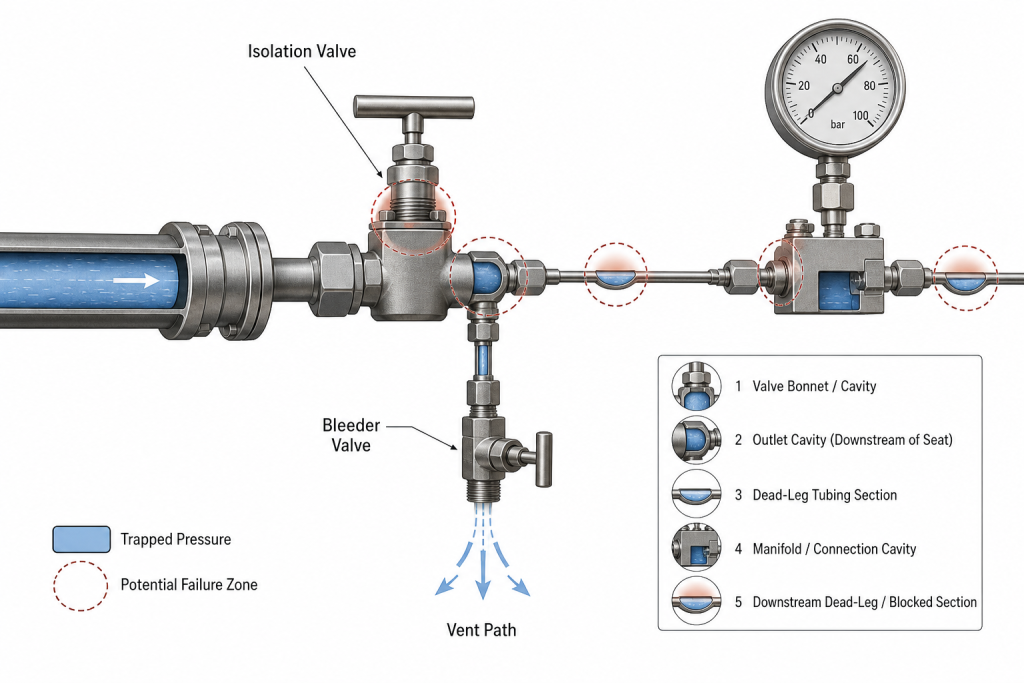
Understanding the “Hidden Pressure Trap” Phenomenon
A hidden pressure trap occurs when a seemingly isolated system retains residual pressure or process fluid, often due to an unforeseen blockage, a faulty component, or an incorrect sequence of operation during depressurization. Bleeder valves, designed to relieve this very pressure, can ironically become the source of the danger if compromised.
The Three Pillars of Bleeder Valve Risk: Design, Material, and Process
The potential for a bleeder valve to create a hazardous situation can typically be traced back to one of three core areas:
- Inadequate Design for Service: A valve not engineered for specific conditions (e.g., high-pressure gas service) can fail catastrophically. One of the most terrifying scenarios is when the valve stem itself fails. This is a direct result of using the wrong design for the application, creating The ‘Human Projectile’ Risk in high-pressure gas service.
- Несовместимость материалов: The valve’s construction material may succumb to the process media or environmental factors, leading to structural integrity loss. The integrity of the valve’s material is paramount. In sour gas environments, a common procurement error leads to The ‘NACE’ Oversight, which can turn a valve into shrapnel.
- Procedural and Operational Errors: Even with a perfectly designed and manufactured valve, improper operation or maintenance can generate new risks. If a valve is seized, attempting to force it can cause a different kind of failure. Before applying a wrench, consult The ‘Seized Valve’ Checklist to avoid snapping the stem.
Beyond the immediate safety concerns, a compromised bleeder valve can silently erode operational efficiency. We detail how even a minor weep can compromise your entire plant accounting in Don’t Blame the Transmitter: How a Leaky Bleed Valve Wrecks Mass Balance.
Common Scenarios Leading to Bleeder Valve LTIs
Understanding the context surrounding these incidents is crucial for prevention. Here are prevalent scenarios where hidden pressure traps manifest:
- Plugged Orifice/Valve Component: Accumulation of process residue (solids, scale, hydrates) can partially or fully block the bleeder’s internal passage, preventing complete depressurization. A technician, unaware of the blockage, assumes isolation and opens the system.
- Valve Seat Leakage: Internal erosion or wear on the valve seat can allow upstream pressure to bypass the main block valve and accumulate behind the closed bleeder, creating a pressurized pocket.
- Incorrect Isolation Procedure: Failure to follow strict LOTO (Lockout/Tagout) procedures, or misunderstanding the system’s fluid dynamics, can lead to residual pressure being overlooked.
- Деградация материала: Over time, corrosion or embrittlement (e.g., from sour gas) weakens the valve body or stem, leading to sudden failure under pressure.
Mitigating the Risk: A Multi-Layered Approach
Preventing LTIs from hidden pressure traps requires a holistic strategy that addresses design, material specification, operational procedures, and regular maintenance.
1. Design for Safety: Beyond Basic Bleeders
The choice of bleeder valve should always consider the worst-case scenario. This includes:
- Anti-Blowout Stem Designs: Essential for high-pressure gas service to prevent stem ejection, addressing the core of The ‘Human Projectile’ Risk.
- Robust, Non-Rotating Stems: Reduces galling and seizure, critical for ensuring reliable operation and avoiding force-induced failures, as detailed in The ‘Seized Valve’ Checklist.
- Self-Ventilating Designs: Some specialized designs actively prevent media accumulation in critical areas.
2. Material Specification: The Hidden Strength
Materials must withstand both the process media and environmental conditions throughout the valve’s lifecycle.
- NACE Compliance: Mandatory for sour gas (H2S) environments to prevent Sulfide Stress Cracking, a factor highlighted in The ‘NACE’ Oversight.
- Устойчивость к коррозии: Selecting alloys appropriate for corrosive chemicals, high temperatures, and cyclical stresses.
- Прослеживаемость: Ensuring all materials are traceable to their MTRs (Material Test Reports) for verification.
3. Rigorous Procedures and Training
Even the best equipment fails without proper human interaction. Implementing and enforcing:
- Verified Lockout/Tagout (LOTO): Strict adherence to procedures that ensure positive isolation and energy dissipation before work begins.
- Pressure Verification: Using pressure gauges or dedicated bleed points to physically confirm zero pressure before any disassembly. Double-checking is non-negotiable.
- Training & Competency: Regular, hands-on training for all personnel involved in operations, maintenance, and isolation verification to avoid contributing to silent financial issues and, more critically, physical harm.
- Inspection Protocols: Scheduled inspections of bleeder valves for signs of clogging, corrosion, or difficult operation.
Conclusion: Elevating Bleeder Valves from Commodity to Critical Safety Device
The narrative around bleeder valves must shift. They are not merely small fittings; they are critical safety components that, when compromised, pose severe risks of LTI, environmental damage, and significant financial loss. By proactively addressing design inadequacies, ensuring material compatibility, and instituting rigorous operational procedures, you can eliminate the threat of hidden pressure traps.
Our dedication to engineering precision ensures that our bleeder valves are built precisely to prevent these “30-second tragedies.” We invite you to explore our advanced solutions designed with safety, reliability, and precision in mind.
Ready to enhance the safety of your process systems?


 English
 Arabic
 Russian
 French
 Spanish