
The Comprehensive Industrial Selection Guide for 3-way Ball Valve
Key Insights: Choosing Your Industrial 3-Way Ball Valve
- Space & Cost Savings: Replaces multiple 2-way valves, reducing footprint and potential leak points.
- Flow Patterns: Crucially differentiate between L-Port (diverting) and T-Port (mixing/bypassing).
- Actuation Modes: Manual for simple tasks; electric 3 way ball valve for automation and remote control.
- Material of Choice: 3 way stainless steel ball valve (316L often preferred) for corrosion and pressure resistance.
- Приложения: Essential for fuel manifold distribution, recirculation loops, and blending.
For engineers and project managers operating in demanding sectors like fuel processing, chemical manufacturing, or power generation, optimizing fluid control systems is a constant challenge. The 3-ходовой шаровой кран stands out as a versatile solution to this challenge. It brilliantly bridges an efficiency gap by allowing multiple flow paths to be managed with a single component, rather than an array of individual 2-way valves. This “multi-port” concept not only significantly reduces piping complexity and installation space but, crucially for industries handling volatile media, it dramatically cuts down the number of potential leak points, enhancing overall system safety and uptime.
This article serves as your comprehensive, high-level guide to selecting the right 3-way ball valve for various industrial applications. We’ll cover everything from their fundamental anatomy and the critical distinctions between L-Port and T-Port flow patterns, to the benefits of manual versus automated actuation, material considerations, and key selection criteria to ensure you specify the perfect valve for your industrial needs.
What is a 3-Way Ball Valve? (Anatomy & Function)
At its core, a 3-way ball valve is a quarter-turn valve featuring a spherical ball with specially drilled bores that allow it to direct, mix, or divert flow between three ports. This innovative design offers operational flexibility that far exceeds that of a standard 2-way valve.

Understanding the Multi-Port Design: The Three-Port Body and the Bored Ball
The distinguishing feature of a 3-way ball valve is its multi-port valve body, which incorporates three distinct pipeline connections. Inside, a rotating ball (typically controlled by a lever or actuator) contains one or more bores. The configuration of these internal bores determines how fluid is directed when the ball rotates, enabling various flow paths without needing to cascade multiple valves.
Common Port vs. Side Ports: Defining the “Inlet” Hub
In most 3-way valve applications, one port is designated as the common port, often viewed as the primary inlet or outlet through which flow is either received or discharged. The other two connections are typically referred to as side ports. Understanding which port is common is fundamental for correct installation and predictable flow management.
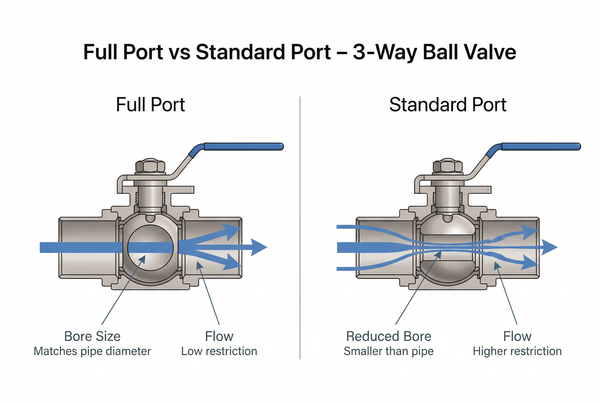
Full Port vs. Standard Port: How Bore Size Affects Flow Coefficient (Cv) in Fuel Lines
When it comes to measure flow coefficient in fuel lines, like 2-way ball valves, 3-way variants come in either full port или standard port designs. A full port valve has an internal bore diameter equal to the connecting pipe, minimizing pressure drop and maximizing flow (high Flow Coefficient ($C_v$)). This is often preferred in fuel lines where maintaining high flow rates and reducing energy losses are crucial. A standard port (or reduced port) valve has a smaller bore than the pipe, increasing pressure drop but potentially allowing for a more compact valve body.
L-Port vs. T-Port: Choosing Your Flow Path
The internal configuration of the ball’s bore defines whether a 3-way valve functions as an L-Port or a T-Port, which are the two primary 3-way ball valve port configurations. This distinction is paramount as it dictates the possible flow paths within your system.
The Diverter (L-Port) vs. The Mixer (T-Port): A Summary
An L-Port valve is primarily a diverter, directing flow from a single inlet to one of two possible outlets. A T-Port valve, on the other hand, is more versatile, capable of mixing two inlets to one outlet, diverting flow, or even acting as a bypass for a straight-through flow. Selecting the wrong internal bore can lead to system backpressure, inefficient operations, or even dangerous conditions.
For a full breakdown of flow sequences, intricate diagrams, and detailed application scenarios, read our dedicated guide: L-Port vs. T-Port 3-Way Ball Valve: Understanding Flow Patterns.
Manual vs. Electric 3-Way Ball Valves
The method by which a 3-way ball valve is operated—manually or automatically—is a critical design choice influencing system control, user intervention, and overall operational efficiency.
The Need for Automation: Why Manual Valves are Being Replaced by “Smart” Instrumentation
While manual 3-way ball valves are simple, robust, and cost-effective for static or infrequently adjusted systems, modern industrial demands often necessitate “smart” instrumentation. Automated valves, particularly electric 3 way ball valve units, allow for precise control without direct human intervention. This is crucial for optimizing complex processes, ensuring consistent operation, and enhancing safety in hazardous environments.
Remote Monitoring in the Fuel Industry: Using Electric Actuators for SCADA Feedback
In the fuel industry, where large-scale operations and remote locations are common, the ability to monitor and control valves from a central location is invaluable. Electric actuators facilitate integration with SCADA (Supervisory Control and Data Acquisition) systems, providing real-time feedback on valve position, operational status, and even fault detection. This capability is essential for managing critical processes, rapid emergency shutdowns, and maintaining continuous uptime.
Automation requires precise calibration of 90° vs. 180° turns and selecting the right power source. Learn how to match your actuator to your valve for seamless integration in our comprehensive guide: Manual vs. Electric 3-Way Ball Valves: A Guide to Industrial Automation.
Material Selection: Why Stainless Steel is Standard
The choice of material for a 3-way ball valve determines its suitability for specific media, pressure, and temperature conditions, directly impacting its lifespan and reliability.
Corrosion Resistance in Harsh Media: Comparing 316 vs. 304 Stainless Steel for Fuel Oils and Gases
For industrial applications involving fuel oils, various gases, and aggressive chemicals, corrosion resistance is non-negotiable. This is why a 3 way stainless steel ball valve is often the default choice. While 304 stainless steel offers good general corrosion resistance, 316 stainless steel (and its low-carbon variant, 316L) contains molybdenum, which dramatically improves its resistance to pitting and crevice corrosion, especially in chloride-rich or acidic environments. For critical fuel system components, 316/316L is typically specified for its superior durability.
High-Pressure and Temperature Limits: Understanding the Pressure-Temperature Curve
Beyond corrosion, industrial valves must withstand high operational pressures and temperatures. Stainless steel alloys provide excellent mechanical strength across a wide range of conditions. Manufacturers provide pressure-temperature (P-T) curves for their valves, illustrating the maximum allowable working pressure at specific temperatures. Adhering to these curves is vital to prevent material failure and ensure safe operation.
Seal Compatibility: Using Viton (FKM) or PTFE for Chemical and Fuel Resistance
The integrity of a ball valve relies heavily on its sealing components, usually PTFE seats (Polytetrafluoroethylene) and O-rings. For aggressive chemicals and fuel oils, PTFE offers excellent chemical inertness and a broad temperature range. For applications requiring higher temperature resistance or specific chemical compatibility, alternatives like Viton (FKM) provide superior performance. Always cross-reference seal materials with the specific media for long-term reliability.
Industrial Applications for 3-Way Valves
The versatility of 3-way ball valves makes them indispensable in numerous industrial processes.
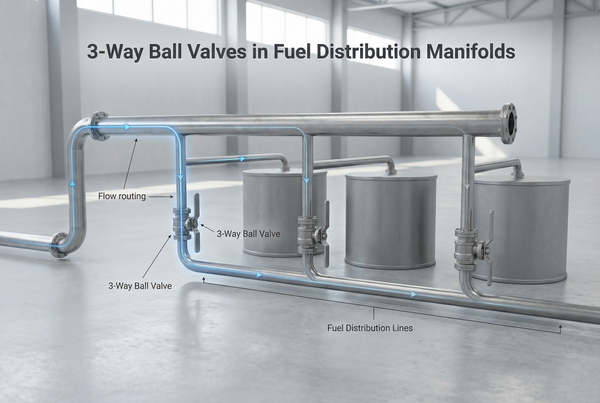
Fuel Manifold Distribution: Switching Between Storage Tanks
In fuel storage and distribution, 3-way valves are commonly used in manifolds to efficiently switch the supply from one storage tank to another, or to divert fuel to different processing units. This minimizes the need for complex piping arrays and ensures a seamless transition between sources without interrupting flow.
Recirculation and Bypass Loops: Maintaining Constant Pump Pressure
T-Port 3-way valves are excellent for creating recirculation and bypass loops. They can divert a portion of the flow back to the pump inlet, helping to maintain a consistent pump pressure or prevent deadheading. This is crucial for protecting pumps and ensuring stable flow rates in processes requiring continuous circulation.
Mixing and Temperature Control: Blending Fuel Additives or Maintaining Viscosity
For applications where two fluid streams need to be blended, a T-Port valve can combine them into a single output. For example, in the production of lubricants or specialized fuels, they can precisely mix additives. They are also vital in heat exchanger circuits to control blending of hot and cold fluids for maintaining specific process temperatures or fuel viscosity.
Key Selection Criteria for Industrial Owners
Making the correct 3-way ball valve selection requires evaluating several critical factors relevant to your specific industrial setup.
End Connection Types: Threaded (NPT) vs. Flanged vs. True Union
The method of connecting the valve to your piping system is crucial for ease of installation and maintenance.
- Threaded (NPT/BSP): Common for smaller diameter lines, offering compact connections.
- Flanged: Standard for larger diameters and higher pressure applications, allowing for easy removal and reinstallation.
- True Union: Provides ultimate ease of inline maintenance, as the valve body can be removed without disturbing the pipe connections.
Mounting Pads (ISO 5211): Ensuring the Valve is “Actuator-Ready”
For systems that will eventually be automated, look for valves with an ISO 5211 mounting pad. This international standard ensures direct and easy mounting of a wide range of actuators (electric or pneumatic) without the need for additional brackets or adapters, meaning the valve is “actuator-ready” from day one.
Pressure Ratings and Certifications: (API, CE, ATEX for Hazardous Areas)
Always verify the valve’s pressure rating (e.g., Class 150, Class 300, PN16, PN40) matches or exceeds your system’s maximum operating and surge pressures. Additionally, ensure the valve holds relevant industry certifications. For the fuel industry, this often means compliance with API (American Petroleum Institute) standards for performance, as well as CE marking for European markets and ATEX for equipment intended for use in potentially explosive atmospheres.
Frequently Asked Questions About 3-Way Ball Valves
Q: Can a 3-way ball valve be used as a shut-off valve?
Yes, an L-Port 3-way ball valve can be used as a shut-off valve, as it can typically be rotated to a position where all three ports are closed (sometimes referred to as “dead-end” service). However, a standard T-Port 3-way ball valve typically *cannot* fully shut off all flow, as it will always connect at least two ports. If absolute isolation is needed for all three ports, ensure you specify an L-Port valve or incorporate additional shut-off valves.
Q: What is a “Double-L” or “X-Port” 4-way valve?
A “Double-L” or “X-Port” valve is a more complex multi-port valve, typically a 4-way or even 5-way design. Instead of three ports, they have four (or more). An X-Port connects two opposite ports and can also connect the other two opposite ports, allowing for flow reversal or more intricate manifold control than a 3-way valve. These are used in specialized applications requiring simultaneous, alternative flow paths or complete flow reversal.
Q: Why is my 3-way valve leaking between ports?
Leakage between ports, known as cross-port seepage or internal leakage, is usually caused by worn or damaged internal seals (like the PTFE seats). Over time, constant use, abrasion from particulates in the fluid, chemical degradation, or over-pressurization can deform or damage the seats, preventing a tight seal. Misalignment of the ball due to incorrect actuator calibration can also lead to this issue. Regular maintenance and proper material selection are key to preventing this.
Q: Can I install a 3-way valve in a vertical position?
Generally, yes, most 3-way ball valves can be installed in a vertical position without negatively impacting their core function. Unlike some other valve types (e.g., certain check valves that rely on gravity), ball valves operate purely through the rotation of their internal ball and sealing elements. However, practical considerations like ease of access for manual operation or maintenance, and ensuring actuators are protected from environmental factors, should always be taken into account for vertical installations.
Заключение
Сайт 3-ходовой шаровой кран truly provides an efficiency advantage, serving as a space-saving, cost-reducing powerhouse in countless industrial applications. Its ability to manage multiple flow paths with a single component makes it indispensable for streamlined operations and reduced leak potential. However, its effectiveness hinges on keen attention to detail: matching the right L-port vs T-port flow patterns to your needs, considering the benefits of electric 3-way ball valve automation, and selecting robust materials like a stainless steel 3-way valve for durability.
For industrial owners, project managers, and engineers, making an informed choice in valve selection is not just about immediate system functionality; it’s a critical investment in long-term operational costs, safety, and reliability. Quality instrumentation reduces future headaches and ensures continuous uptime.
Still unsure which configuration fits your manifold or complex system?


 English
 Arabic
 Russian
 French
 Spanish