
The Myth of the ‘Foolproof’ Quarter-Turn Ball Valve: 3 Failure Modes You Can’t Ignore
It’s just a quarter turn ball valve. A ball, a body, a handle. Turn it 90 degrees, and it works. What could possibly go wrong? This mindset is a dangerous trap. Reliability studies define failure not just as breakage, but when leakage or torque exceeds limits.
The simple design of a quarter turn ball valve hides complex failure modes. These include seat erosion from incorrect use, stem leaks creating environmental hazards, and catastrophic body cracking that can cause explosive failures.

1. How Can a “Simple” Seat Erode and Leak?
You close a critical isolation valve, but the flow doesn’t stop completely. That “passing” valve is now useless. The cause is often seat erosion, where the smooth, soft seats inside the quarter turn ball valve have been physically damaged by the process fluid, creating a leak path.
Dive Deeper: The Seat Killers – Abrasion and Throttling
The heart of a quarter turn ball valve is the perfect seal between the polished ball and smooth seats. This is how that perfection is compromised:
- Abrasion: Hard particles in the fluid (sand, rust, scale) act like sandpaper. When the valve closes, particles get trapped and embed into the soft seat, creating a rough surface that cannot seal.
- Throttling: This is the most common mistake. A quarter turn ball valve is for ON/OFF service only. Using it to control flow (partially open) creates a high-velocity jet that cuts a groove into the seat, a phenomenon known as the “Venturi effect.”
| Seat Type | Abrasion Resistance | Throttling Resistance |
|---|---|---|
| Standard PTFE (Soft Seat) | Poor | Very Poor |
| Metal Seat (Hard Seat) | Excellent | Good to Excellent |
2. Why Is It Leaking From the Top?
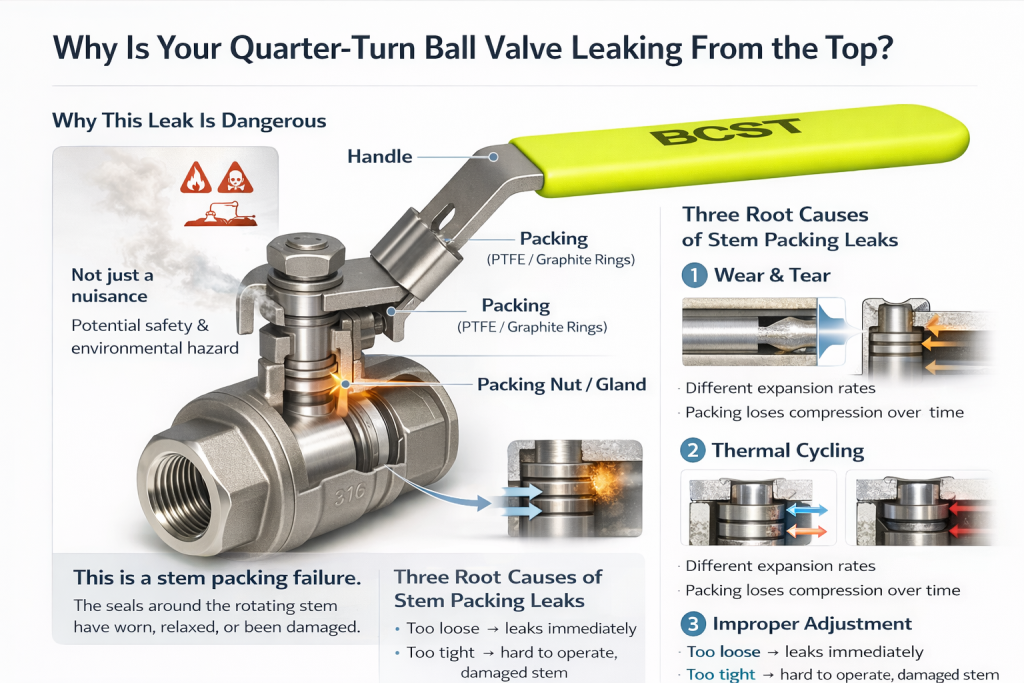
A small drip or wisp of vapor from under the handle is not a minor annoyance; it’s a stem packing failure. If the fluid is flammable or toxic, this is a serious safety hazard. The seals meant to prevent fluid from escaping along the rotating stem have failed.
Dive Deeper: The Unseen Seal That Matters Most
The “packing” is a set of rings (PTFE or Graphite) compressed between the valve body and stem to create a seal. Here’s why it fails:
- Wear and Tear: Each valve operation causes microscopic wear. Over thousands of cycles, a leak path forms.
- Thermal Cycling: As processes heat up and cool down, metal parts and packing expand/contract at different rates. This can cause the packing to lose compression and leak. A quality quarter turn ball valve will have features like live-loading to mitigate this.
- Improper Adjustment: If the packing nut is too loose, it leaks. If overtightened to stop a leak, it can damage the stem and make the valve hard to turn.
| Packing Material | Common Use | Key Limitation |
|---|---|---|
| PTFE | General purpose, chemicals | Limited temperature range (~450°F / 232°C). |
| Graphite | High temperatures, steam | Needs proper installation for fine gases. |
3. Can a Quarter Turn Ball Valve Actually Explode?
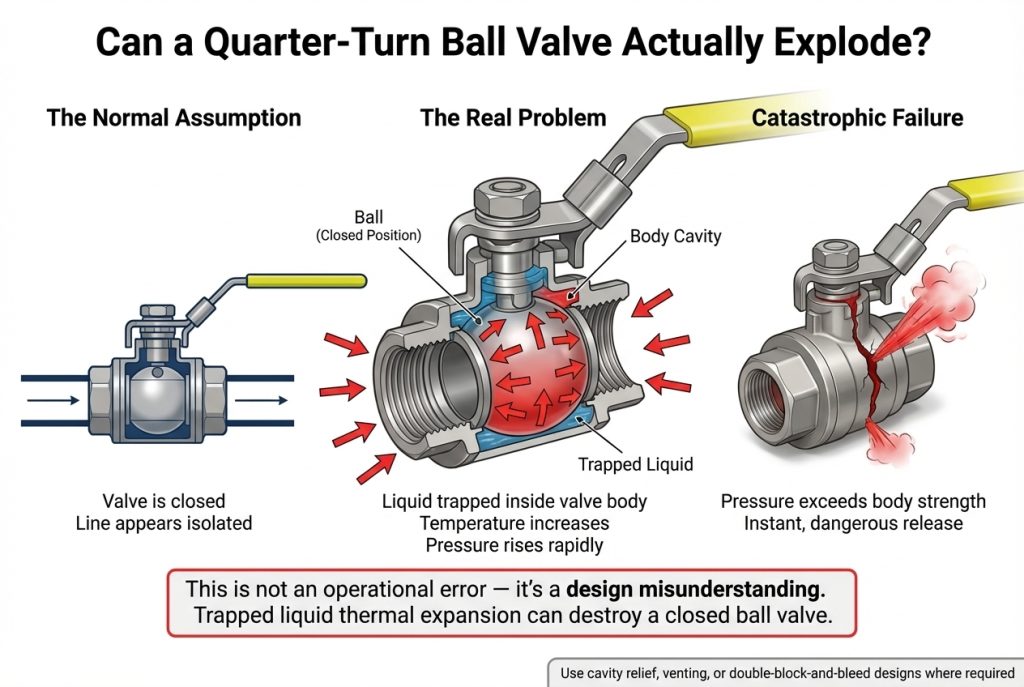
Yes. It sounds unbelievable, but a quarter turn ball valve can fail catastrophically, cracking its body and releasing its contents instantly. This dangerous failure is almost always caused by the thermal expansion of liquid trapped inside the valve’s body cavity when it’s closed.
Dive Deeper: The Danger of the Trapped Cavity
When a quarter turn ball valve is closed, it seals on both sides, trapping fluid in the body cavity. If that trapped liquid is heated (by sunlight, ambient heat, etc.), pressure builds exponentially because liquid is incompressible. The pressure can easily exceed the valve body’s limits, causing it to crack.
| Application | Risk of Rupture | Prevention Method |
|---|---|---|
| Gases (Air, Nitrogen) | Very Low (Gas is compressible) | Standard quarter turn ball valve is safe. |
| Liquids (Water, Chemicals) | High (If heating can occur) | Use a vented quarter turn ball valve to relieve cavity pressure upstream. |
Conclusion: Respect the Complexity
The “simple” quarter turn ball valve is an amazing and reliable tool, but only when selected and operated with an understanding of its limits. By respecting these real-world failure modes—seat erosion, stem leakage, and cavity over-pressurization—you can avoid costly downtime, ensure safety, and build a truly foolproof system.


 English
 Arabic
 Russian
 French
 Spanish