
Pneumatic vs. Electric: What Type of Ball Valve Actuator Fits Your Application?
Choosing the wrong ball valve actuator can lock you into years of high operating costs, inadequate safety, and poor performance. It’s a decision with long-term consequences that goes far beyond the initial purchase.
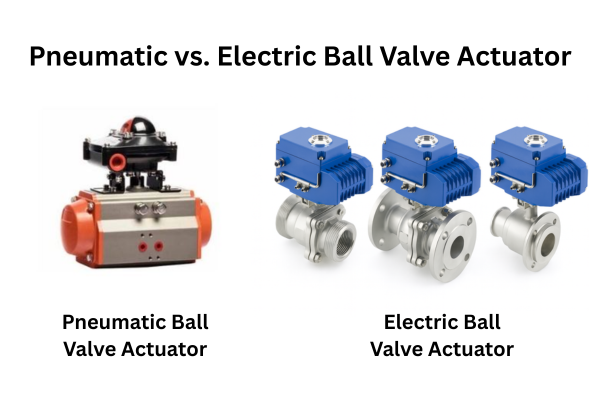
The ideal ball valve actuator depends entirely on your specific application’s needs. Pneumatic actuators excel in speed and simple, robust failsafe action, while electric actuators offer precision control and are ideal for remote locations without compressed air infrastructure.
1. When Do You Need Raw Speed and Mechanical Simplicity?
In your plant, certain valves must close in a fraction of a second to prevent a major incident. When a delayed shutdown is not an option, the simple, mechanical force of a pneumatic ball valve actuator is often the superior choice for guaranteed return to a safe position during a power outage.
Dive Deeper: The Physics of Speed and Failsafe
- Stroking Speed: A pneumatic ball valve actuator operates by rapidly venting a large volume of compressed air, allowing for extremely fast operation (often under one second). Electric actuators are limited by motor and gear speed, which is almost always slower.
- The Failsafe Mechanism: A pneumatic spring-return actuator uses a large mechanical spring. If air is lost, the spring’s mechanical energy instantly drives the valve to its safe position—a purely mechanical action. Electric actuators rely on a battery backup, introducing complexity and potential points of failure such as charged batteries and functional circuitry. The reliability and precision of an electric ball valve actuator depend heavily on its control electronics, which is why selecting high-quality PCB fabrication is fundamental for long-term performance in demanding environments. For electric ball valve actuators that demand consistent performance under power fluctuations and temperature extremes, sourcing your control boards from a trusted supplier of FR-4 PCBs ensures both signal integrity and long-term reliability.
| Feature | Pneumatic Spring-Return | Electric Failsafe |
|---|---|---|
| Failsafe Power | Mechanical Spring Energy | Battery or Capacitor |
| Speed | Very Fast (Sub-second common) | Moderate to Slow |
| Best For | Emergency Shutdown (ESD), High-Cycling | General Purpose On/Off |
2. Which Actuator is Best for Hazardous Locations?
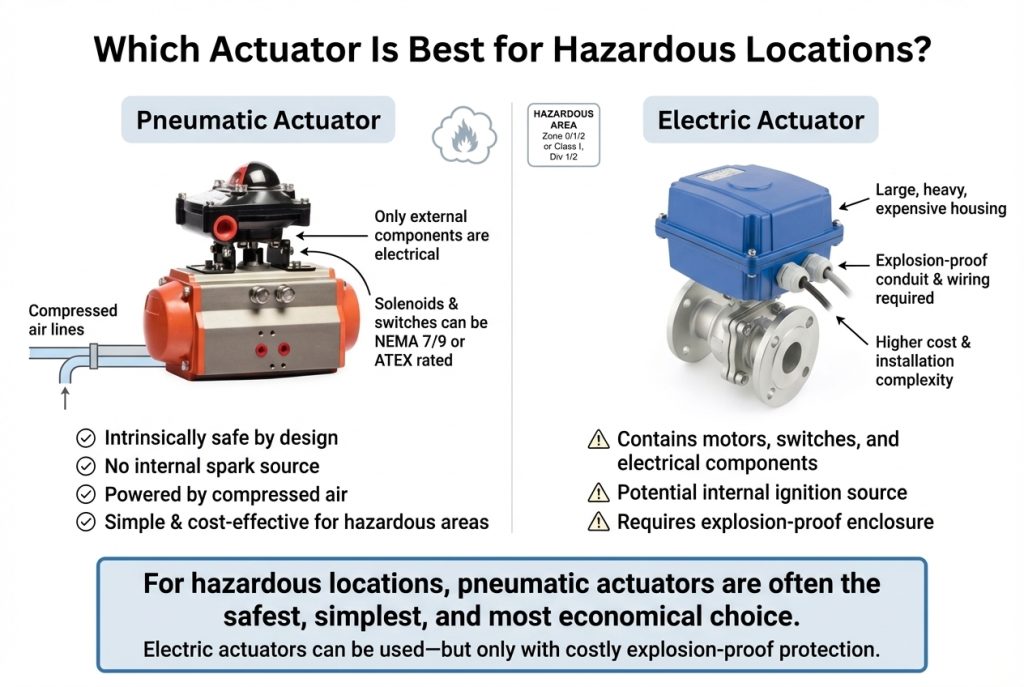
Choosing an actuator for a Class I, Division 1 area is a critical safety decision. The inherent safety of a pneumatic ball valve actuator, which has no internal spark source, often makes it the simplest and most cost-effective solution. As studies show, pneumatic actuators are preferred where instrument air is available because they are intrinsically safe.
Dive Deeper: Intrinsic Safety vs. Explosion-Proofing
- Pneumatics – Intrinsically Safe: A standard pneumatic ball valve actuator is a “dumb” mechanical device with no internal spark source. Only the small, external electrical components (solenoid, switches) need a hazardous area rating, making the package simple and low-cost.
- Electrics – Explosion-Proofing Cost: An electric ball valve actuator in a hazardous area must be housed in a certified explosion-proof enclosure. These are large, heavy, and expensive, designed to contain an internal explosion. This adds substantial cost, weight, and complexity.
| Actuator Type | Approach to Hazardous Areas | Relative Cost & Complexity |
|---|---|---|
| Pneumatic | Inherently safe actuator; only external solenoid needs rating. | Low cost, low complexity. |
| Electric | Requires heavy, certified explosion-proof enclosure for the entire actuator. | High cost, high complexity. |
3. What is the True Total Cost of Ownership?
To find the true cost, you must look beyond the initial hardware price. The Total Cost of Ownership (TCO) includes the infrastructure for the power source (compressed air vs. electricity) and long-term energy consumption.
Dive Deeper: Capex vs. Opex
A project manager must balance Capital Expenditures (CapEx – upfront cost) with Operating Expenditures (OpEx – running costs).
- The Case for Electric (Lower Infrastructure Cost): For a few valves in remote locations, an electric ball valve actuator is the CapEx winner.Electricity is readily available, whereas you must generate compressed air on-site.
- The Case for Pneumatic (Lower Unit Cost): If air infrastructure exists or you need many valves in one area, pneumatic is more economical. The individual actuators are simpler and less expensive.
- The Hidden Cost of Compressed Air (OpEx): Generating compressed air is very energy-intensive and systems often leak. An electric actuator only uses power when operating. A pneumatic system consumes energy constantly to maintain pressure, making its long-term OpEx potentially much higher.
| Scenario | Lower CapEx | Lower OpEx | Best Choice |
|---|---|---|---|
| 2-3 valves in a remote tank farm | Electric | Electric | Electric ball valve actuator |
| 50+ valves on a new process skid | Pneumatic | Varies | Pneumatic ball valve actuator |
| Energy-efficiency focused plant | Varies | Electric | Electric ball valve actuator |
Conclusion: Make an Informed Choice
The best ball valve actuator is the one that fits your specific needs for safety, speed, and cost. By using a framework that weighs these critical factors, you can make an informed decision that ensures reliability and optimizes your plant’s performance for years to come.


 English
 Arabic
 Russian
 French
 Spanish