
Ways to Prevent Your Ball Valve Passing
You’ve just completed a costly installation and a new valve is in the line. But during the first pressure test, you find it’s already leaking. A failed ball valve shut off on a brand-new component is infuriating. Study shows, In liquid–solid two-phase service, one study found the erosion-wear rate rises sharply when the ball closes from 20% to 10% opening, meaning most sealing-surface damage happens at very small openings.
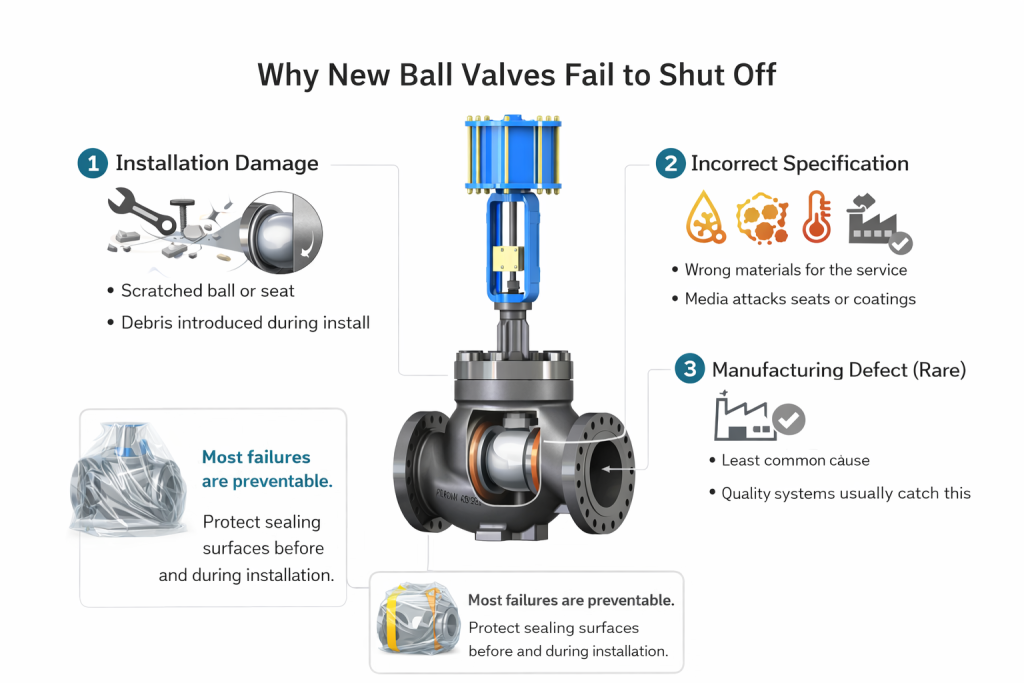
A new valve fails its primary function—a reliable ball valve shut off—for one of three main reasons: damage during installation, incorrect specification for the process media, or, less commonly, a manufacturing defect. Protecting the valve’s sealing surfaces before and during installation is the most critical step.
1. Was the Valve Damaged Before or During Installation?
The journey from the factory to the pipeline is full of dangers. The most common cause for a new valve failing its ball valve shut off test is physical damage to its most critical components: the ball and the seats.
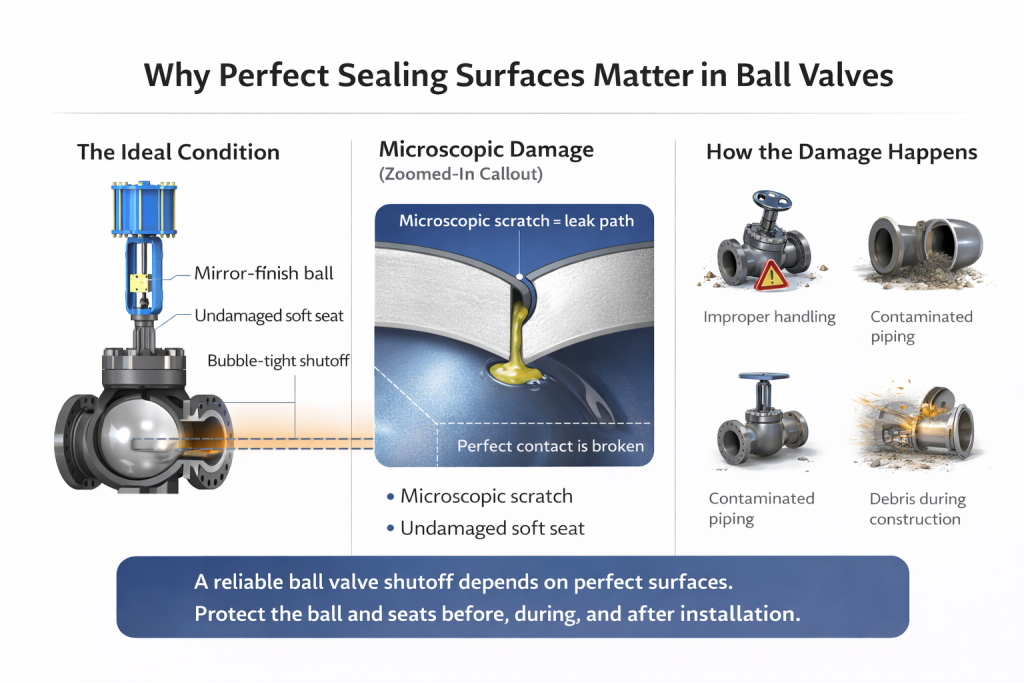
Even a microscopic scratch on the mirror-finish of the ball or a nick on a soft seat can create a leak path. This damage often happens from improper handling or, crucially, from debris left in the pipe during construction.
Dive Deeper: Protecting the Sealing Surfaces
- Handling and Storage: Never lift a valve by its handwheel or actuator. Always store valves with end caps on, in a clean, dry area, and with the ball in the fully open position to protect the sealing surfaces.
- The #1 Culprit – Weld Debris: Weld slag, metal filings, and other “pipe trash” left after construction will be blasted into the new valve at high velocity. A single piece of slag caught during the first closure will permanently damage the seat, destroying any chance of a positive ball valve shut off.
- Installation Best Practices: Thoroughly flush the pipeline before installing the valve. If not possible, use a temporary “commissioning valve” or spool piece for flushing, then install the new valve into a clean line.
| Stage | Action to Take | Why It Works |
|---|---|---|
| Storage | Keep end caps on; store valve fully open. | Protects sealing surfaces from damage. |
| Pre-Installation | Thoroughly flush the pipeline. | Removes weld slag that would destroy seats. |
| Final Check | Visually inspect valve internals. | Final confirmation of pristine sealing surfaces. |
2. Is This the Right Valve for the Service?
Sometimes, the valve isn’t damaged; it’s simply the wrong tool for the job. A valve might pass fluid on its first day because the process conditions instantly destroy its seats. This is a specification error, where the ball valve shut off capability is compromised by a material mismatch.
Dive Deeper: Matching Materials to the Media
- Chemical Incompatibility: Standard soft seats like PTFE are not invincible. Aggressive chemicals can cause them to swell, soften, or dissolve, leading to a loss of the ball valve shut off.
- Abrasive Media: Any solids, sand, or slurry in the process will destroy a soft-seated valve. For these services, a metal-seated valve with hardened coatings is required to achieve a durable ball valve shut off.
- High Temperature: If the process temperature exceeds the seat’s limit, even briefly, the seat can deform or extrude, making a reliable ball valve shut off impossible.
| Failure Mode | Incorrect Specification | Correct Solution |
|---|---|---|
| Abrasive Wear | A soft-seated valve in sandy water. | Specify a metal-seated valve. |
| Temperature Damage | RPTFE seats in a steam-cleaned line. | Choose metal or high-temp polymer seats. |
3. Could It Be a Manufacturing Defect?
While less common from reputable suppliers, a true manufacturing defect can cause a poor ball valve shut off from day one. This could be a flaw in the ball’s coating, an out-of-tolerance seat, or improper assembly. This is why factory testing and your own receiving inspection are vital.

Dive Deeper: Verifying Quality Before Installation
- Review Documentation: Always demand a Material Test Report (MTR) and a factory hydrostatic test report (e.g., to API 598). This confirms the valve passed its quality checks.
- Receiving Inspection: Unbox the valve, cycle it, and visually inspect the internals for any obvious flaws.
- The Gold Standard – Bench Testing: For critical valves, perform your own pressure test before installation. This definitively proves the valve’s ball valve shut off capability and isolates issues to the installation process if it later fails.
| Verification Step | Action | Purpose |
|---|---|---|
| Documentation | Review MTR & API 598 Test Report. | Confirms factory quality for the ball valve shut off. |
| Bench Test | Perform own pressure test. | Proves sealing capability before installation. |
Conclusion: Ensure Success from Day One
A brand-new valve that fails to provide a tight ball valve shut off is almost always due to preventable issues. By taking ownership of the valve’s journey—protecting it during installation, verifying the specification, and confirming its quality—you can ensure your new valve performs perfectly from day one.


 English
 Arabic
 Russian
 French
 Spanish