Introduction
In the field of industrial automation and control, steam, as an important carrier of heat energy, is widely used in power generation, chemical industry, food processing and other fields. In steam piping and equipment systems, it is critical to measure and control steam flow, pressure and temperature. Pneumatic ball valves and control valves (usually referred to as pneumatic control valves) each have their own characteristics for measuring and regulating steam media. However, in practical engineering applications, choosing the right valve has become a challenge for many engineers. In this paper, from an engineering perspective, combined with the characteristics of steam, the valve structure and its performance analysis, the applicability of pneumatic ball valves and control valves for a comprehensive discussion.
Characteristics of the steam medium and its requirements for the valve
Steam has a high temperature, high pressure and high-speed flow characteristics of the valve materials, sealing and regulating performance put forward special requirements:
High Temperature Performance
Steam is usually at a high temperature (such as saturated steam 150-250 ° C, and even super-high-temperature superheated steam more than 300 ° C), the valve material must have excellent high-temperature performance.
High Pressure Resistance
Steam system pressure is generally between 1-10MPa, the strength of the valve body and seals is required.
Precision of Flow Regulation
Steam, as a thermal energy medium, requires precise control of flow to meet process requirements, especially in heat exchange and power equipment.
Corrosion and Wear Resistance
Steam may entrain condensate and impurities, which may cause corrosion or scouring of valve sealing surfaces and internal parts.
Opening and closing speed and regulation stability
Fast response and regulation accuracy directly affect system stability and energy efficiency.
Characteristics and applicability of pneumatic ball valves
Pneumatic ball valve is driven by pneumatic actuator to rotate the ball, so as to realize the switching and regulating function of the fluid. Its main features include:
Advantages analysis
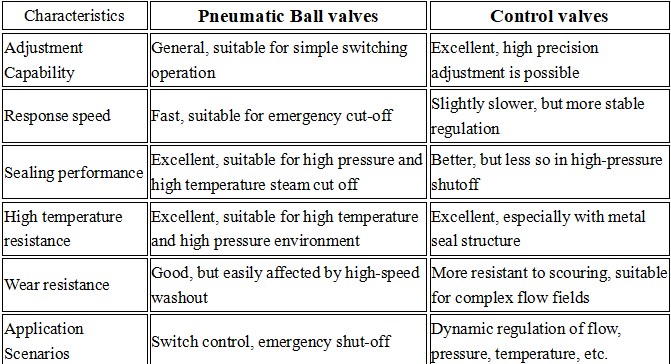
1. Simple structure and good sealing performanceThe full bore design of the ball valve allows the fluid to pass through without pressure loss, with excellent sealing performance, especially in high pressure steam.2. Fast opening and closingPneumatic ball valve opening and closing time is short, especially suitable for the need to quickly cut off steam occasions.3. High temperature and corrosion resistanceBall valves with metal seals or high-temperature-resistant materials are well adapted to high-temperature steam.
Limitations
1. Limited adjustment performanceBall valves have relatively poor regulating characteristics, low flow regulation accuracy, suitable for switching control rather than precise regulation.2. The valve body is susceptible to high-speed steam washout.Under high flow rate conditions, the ball surface and seals are easily damaged by scouring.
Applicable Scenarios
Pneumatic ball valves are mostly used in steam on/off control scenarios, such as steam line distribution, isolation, and emergency shut-off control.
Characteristics and Applicability of Control Valves
Pneumatic control valves are regulating devices consisting of a pneumatic actuator and valve body that change fluid flow by adjusting the spool position, and are widely used in process control systems. Its characteristics include:
Advantages analysis
1. High precision of flow adjustmentThe control valve has good linear or equal percentage characteristics, which can realize precise flow control and meet the demand for dynamic adjustment of steam temperature, pressure and flow.2. Strong stabilityThe regulating valve has rapid response and good stability, and can be adapted to complex working conditions.3. Wide selection of high-temperature resistant materialsSpecial materials and structural designs (e.g., cage-guided, double-seated structures) suitable for steam media can be selected to effectively cope with high-temperature and high-pressure working conditions.
Limitations
1. Slow opening and closing speedCompared with ball valves, the response time of control valves is slightly longer, and may not be as fast as ball valves in case of emergency closure.2. Slightly inferior sealing performanceThe sealing performance of control valves may be insufficient for high-pressure steam shutoff.
Applicable Scenarios
Regulating valves are used in applications where precise control of steam flow, temperature and pressure is required, such as flow regulation of heat pipe networks, boiler feedwater regulation, and precise control of steam heating equipment.
Comparative Analysis of Pneumatic Ball Valves and Control Valves
Selection recommendations for engineering applications
Scenarios where on/off control is dominant
If the steam system only requires start/stop functions, pneumatic ball valves are ideal because of their fast opening and closing, good sealing performance, and higher cost performance. Examples:1. Shut-off valves used to isolate different areas in a steam network.
- Emergency shutdown valves for steam equipment.
Dynamic Regulation Oriented Scenarios
Regulating valves offer significant advantages in applications where precise adjustment of steam flow is required. For example1. Feedwater control for steam boilers.2. Precise regulation of steam temperature or pressure in a process.
    Hybrid Application Scenarios
In some complex systems, pneumatic ball valves and control valves may need to be used in combination. For example, a pneumatically actuated ball valve is used for quick shut-off of the system, while a regulating valve is responsible for continuously regulating the flow rate to improve overall control efficiency and system safety.
    Conclusion
In summary, the suitability of pneumatically actuated ball valves and control valves for steam measurement and control depends on the specific operating conditions and control requirements. From an engineering point of view, pneumatically actuated ball valves are more suitable for on/off control and fast response scenarios, while regulating valves are suitable for dynamic regulation scenarios, especially in complex working conditions that require high-precision control.



 English
 Arabic
 Russian
 French
 Spanish