
Imagine a maintenance technician preparing to work on a high-pressure pipeline. They’ve been told the line is isolated by a single valve upstream. But what if that one valve has a minor, undetectable seat leak? The consequences could be catastrophic: a sudden release of flammable gas, corrosive chemicals, or high-pressure steam. This isn’t a theoretical risk; it’s a very real danger that has led to serious industrial accidents. This single point of failure is a gamble that no responsible operation can afford to take.
For critical applications where line isolation must be 100% verifiable, a Double Block and Bleed (DBB) ball valve is the non-negotiable safety standard. This advanced valve technology integrates two isolation valves and a bleed/drain valve into a single, compact body, providing positive isolation and eliminating the risks associated with single-valve failure.
For over 22 years, BCST Valve has specialized in manufacturing these critical service valves, because we understand that in high-stakes environments, there is no substitute for absolute safety. This guide will walk you through everything you need to know about DBB valve function, standards, applications, and selection.

How Do Double Block and Bleed Ball Valves Actually Work?
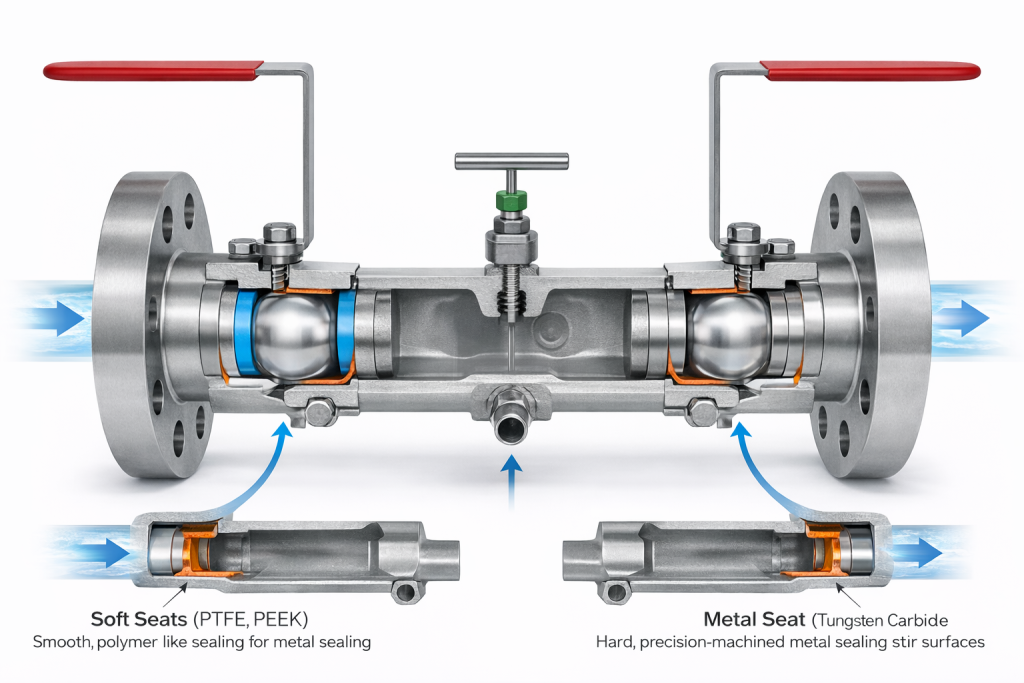
The core function of a Double Block and Bleed ball valve is its ability to provide a verifiable, zero-pressure zone between two positive seals. This is achieved through a three-point system: a first block isolates upstream pressure, a second block isolates downstream pressure, and a bleed port safely vents any trapped pressure from the cavity between them.

The Three-Point Isolation System
- First Block (Upstream Isolation): The first ball valve is closed. This provides the primary seal, stopping the main flow of media and pressure from entering the valve’s central cavity.
- Second Block (Downstream Isolation): The second ball valve is also closed. This provides a redundant, secondary seal, protecting the downstream side of the line or the work area from any potential backflow.
- Bleed Port (Cavity Pressure Relief): This is the most critical step for verification. Once both blocks are closed, the bleed port is opened. If the upstream seat is sealing perfectly, nothing will come out. If it is passing, media will vent, alerting operators immediately.
Double Block and Bleed vs. Single Isolation
| Característica | Single Ball Valve Isolation | Double Block and Bleed (DBB) Valve |
|---|---|---|
| Isolation Points | 1 | 2 (Redundant) |
| Leak Verification | Not possible until failure | Possible in real-time via bleed port |
| Safety Standard | Low; single point of failure | High; positive, verifiable isolation |
| Lo mejor para | Non-critical utility lines | Critical processes, hazardous media |
What Are the API 6D Standards for DBB Valves?
En API 6D standard is the globally recognized specification for pipeline valves. For DBB valves, it provides a strict rulebook for design, manufacturing, and testing, ensuring the valve is robust, reliable, and safe for high-pressure oil and gas applications.
DBB vs. DIB-1 vs. DIB-2: Critical Differences
Within API 6D, understanding the seat configuration is vital for safety:
- Double Block and Bleed (DBB): Two unidirectional seats (Single Piston Effect). Self-relieving cavity. Standard for maintenance isolation.
- Double Isolation and Bleed (DIB-1): One unidirectional, one bidirectional seat. Requires external relief. Used in metering skids.
- Double Isolation and Bleed (DIB-2): Two bidirectional seats (Double Piston Effect). Highest level of isolation from both directions.
| Configuration | Seat Type | Primary Use Case |
|---|---|---|
| DBB | Two SPE (unidirectional) | Standard pipeline isolation |
| DIB-1 | One SPE, one DPE | Metering skids |
| DIB-2 | Two DPE (bidirectional) | Critical bidirectional isolation |
Where Are Double Block and Bleed Ball Valves Essential?
Double Block and Bleed ball valves are essential safety devices in the oil & gas, petrochemical, power generation, and chemical processing industries. They are mandatory anywhere positive, verifiable shutoff is required.
- Oil & Gas: Pipeline isolation, wellheads, and offshore platforms.
- Petrochemical: Isolating reactors and vessels without plant-wide shutdowns.
- Power Generation & LNG: High-pressure steam lines and cryogenic LNG applications (-162°C).
- Procesamiento químico: Safe handling of toxic or corrosive materials.
How Do You Select the Right Double Block and Bleed Ball Valve?
Selecting the right DBB valve requires a systematic approach based on your specific process conditions: pressure, temperature, media, and actuation needs.

- Determine Critical Criteria: Define maximum pressure, temperature, and media type (corrosive, erosive, clean gas, or slurry).
- Selección de materiales:
- Carbon Steel (A105N): Standard Oil & Gas workhorse.
- Stainless Steel (316L): For corrosive media.
- Duplex/Super Duplex: For severe service (seawater).
- Seat Design:
- Soft Seats (PTFE/PEEK): Bubble-tight seal for gas.
- Metal Seats (TCC): For high temp or abrasive media.
Failure Rates and Common Causes
Double block and bleed (DBB) valves generally have low random failure rates when correctly specified. Pipeline risk studies often cite failure probabilities of 10⁻³ to 10⁻⁴ per demand for failing to isolate.
Most Common Failure Modes
Internal leakage past one or both main seats is the primary failure mode. This leads to a loss of effective “double” isolation. External leakage at stem packings or body joints is also a contributor to fugitive emissions.

Root Causes: Seat and ball degradation from erosion/corrosion is common in dirty gas service. Operational errors, such as failing to routinely monitor the bleed connection, can allow seat failures to remain latent until an emergency occurs.
Conclusión
The Double Block and Bleed ball valve is more than just hardware; it is an engineered safety system. By replacing risky single-valve setups with a DBB unit, you invest directly in operational integrity.
At BCST Valve, we have spent over 22 years perfecting these valves. Our commitment to API 6D standards means you are partnering with a team dedicated to your safety.


 English
 Arabic
 Russian
 French
 Spanish