
Butterfly Valve Working Principle: Parts, Types & Actuators
Struggling with inefficient flow control? The wrong valve can cause costly leaks and downtime. Válvulas de mariposa offer a simple, compact, and effective solution for many industrial applications.
A butterfly valve controls flow using a disc mounted on a rotating stem. When the stem turns 90 degrees, the disc moves from being parallel (open) to perpendicular (closed) to the flow, effectively stopping or allowing fluid to pass through the pipe.
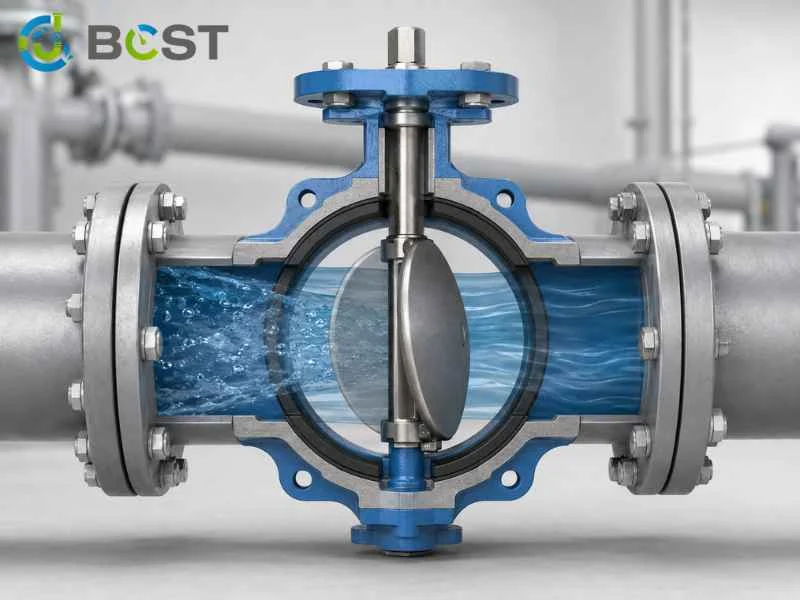
Understanding this basic principle is the first step. When I was younger, I’d watch my father’s team assemble these valves in our factory. I learned that while the concept is simple, the real expertise lies in choosing the right type for the right job. Let’s explore the details that matter for professionals like you.
The Core Mechanism of a Butterfly Valve
You need a reliable valve for your system. But the simple design of a butterfly valve might make you question its strength. Choosing a weak valve leads to operational failure.
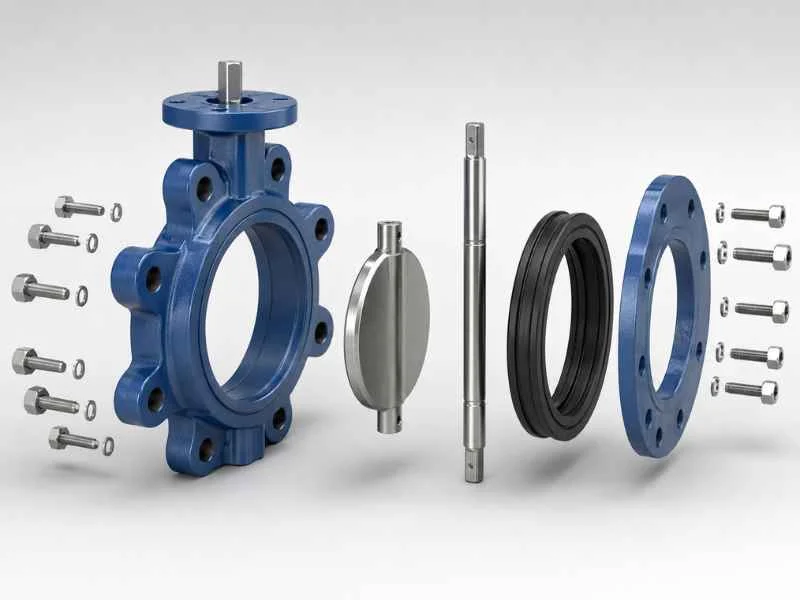
The core mechanism relies on four main parts: the body, disc, stem, and seat. The stem passes through the disc and connects to an actuator. When the stem rotates, the disc turns, pressing against the seat to create a tight seal and stop the flow.
Componentes clave y sus funciones
To truly grasp how a butterfly valve works, you must understand its components. Each part plays a critical role in its operation and reliability. Think of it as a team where every member must perform perfectly.
| Componente | Función |
|---|---|
| Cuerpo | The outer casing that fits between pipe flanges. It houses and protects the internal parts. |
| Disco | The “butterfly” itself. It’s the part that rotates to open, close, or throttle the flow. |
| Vástago | The rod that connects the disc to the actuator. It transmits the rotational force to the disc. |
| Asiento | A liner, usually made of soft material like rubber, that creates the seal with the disc when closed. |
The Quarter-Turn Action
The defining feature of a butterfly valve is its quick, 90-degree rotation. This is called “quarter-turn” operation. When the valve is fully open, the disc is parallel to the flow direction. This offers a nearly unrestricted path for the fluid. To close the valve, you simply turn the handle or actuator 90 degrees. The disc then becomes perpendicular to the flow, blocking the pipe. This rapid action is a major advantage in applications where you need to start or stop flow quickly, such as in emergency shut-off systems or in processes that require frequent cycling. This simplicity reduces wear and tear compared to multi-turn valves.
Exploring Different Butterfly Valve Designs
You assume one butterfly valve fits all applications. But using a standard valve in a high-pressure or corrosive environment can cause catastrophic failure. Understanding the designs is key.
The main designs are concentric (zero offset) and eccentric (double or triple offset). Concentric valves are for general, low-pressure service. Eccentric designs are for more demanding applications involving high pressures, high temperatures, and abrasive or corrosive media. The choice is critical for performance.
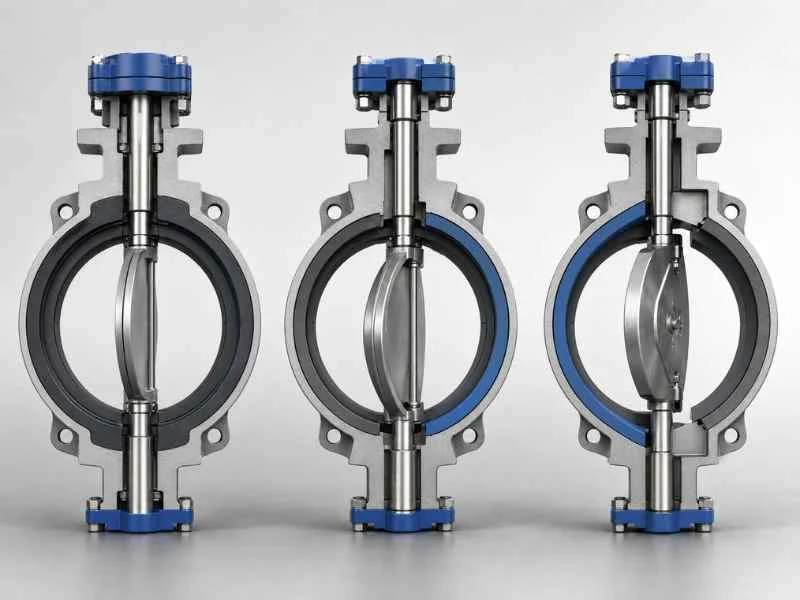
En Butterfly valve working principle changes slightly with different designs, each engineered for specific challenges. Choosing the right one is vital for the safety and efficiency of your plant. For a chief engineer, matching the valve to the service conditions is a top priority.
Concentric (Zero Offset) Butterfly Valves
This is the most basic and common type. In a concentric design, the stem is centered in the middle of the disc, and the disc is centered in the pipe bore. When the valve closes, the disc’s edge makes contact with a soft, resilient seat (like EPDM or NBR rubber) all at once. This design creates a good seal, but the constant contact and friction can cause the seat to wear out over time, especially in frequent use. They are best for clean water, air, and other general-purpose, low-pressure applications.
Eccentric (Offset) Butterfly Valves
Eccentric valves were designed to overcome the limitations of the concentric design.
- Doble Offset: These valves have two offsets. First, the stem is moved back from the center of the disc. Second, the stem is moved slightly to one side of the pipe’s centerline. When the valve opens, these two offsets cause the disc to swing away from the seat almost immediately. This reduces friction and wear on the seat, allowing for a longer service life and better sealing. Double offset valves can handle higher pressures and temperatures than concentric valves.
- Desplazamiento triple: This is the high-performance option. It has the two offsets of a double offset valve, plus a third offset in the angle of the seat itself. This creates a cone-in-cone seating design. This geometry completely eliminates friction during opening and closing. The seal is made with a final, cam-like action right at the point of closure. This allows for a bubble-tight, metal-to-metal seal, making triple offset valves perfect for critical applications like high-pressure steam, oil and gas, and cryogenics.
| Tipo de válvula | Mecanismo de sellado | Pressure/Temp | Typical Use |
|---|---|---|---|
| Concéntrico | Disc compresses soft seat | Bajo | Water, HVAC, General Service |
| Double Offset | Cam-action into seat | Medium to High | Chemical, Oil & Gas, Power Generation |
| Triple Offset | Metal-to-metal conical seal | High to Very High | Critical services, Steam, Cryogenics, Gas |
Actuation Methods for Butterfly Valves
You have the perfect valve, but how do you control it? Manual operation isn’t always practical or safe in a large, automated plant. You need an efficient actuation method.
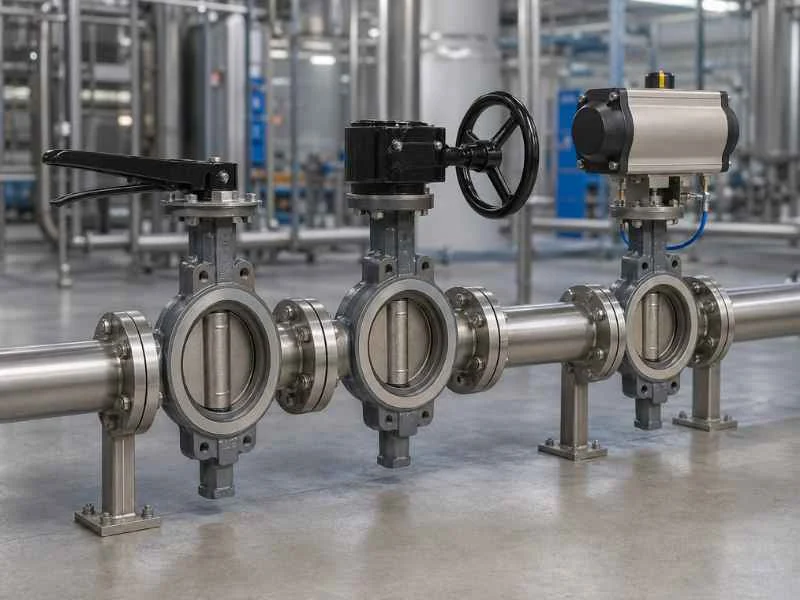
Butterfly valves can be operated manually with a lever or handwheel, or automated with an actuator. Automated options include pneumatic (air-powered), electric (motor-powered), or hydraulic (fluid-powered) actuators. The choice depends on power availability, required speed, and control system integration.
The method you use to open and close your butterfly valve is just as important as the valve itself. The actuator is the “muscle” that drives the valve’s quarter-turn motion. For a complex facility like a chemical plant, automation is often not just a convenience but a necessity for safety and process control.
Manual Operation
Manual operation is the simplest form of actuation.
- Lever Handle: This is common for smaller valves (typically up to DN 200 or 8 inches). A simple lever provides a quick, visual indication of the valve’s position (the lever is parallel to the pipe when open). It’s fast and easy, but it requires the operator to be physically present at the valve.
- Gear Operator (Handwheel): For larger valves, the force required to turn the disc against the flow pressure is too high for a simple lever. A gear operator uses a handwheel connected to a gearbox. This multiplies the operator’s force, making it possible to open or close large valves easily. The trade-off is speed; it takes many turns of the handwheel to achieve the 90-degree rotation.
Automated Operation
Automation is key in modern industry. It allows for remote control, precise positioning, and integration with a plant’s Distributed Control System (DCS).
| Actuator Type | Power Source | Speed | Par de apriete | Lo mejor para |
|---|---|---|---|---|
| Neumático | Compressed Air | Very Fast | Medium to High | Fast cycling, on/off applications, emergency shutdown (ESD) systems. |
| Eléctrico | Electricity | Moderado | Alta | Precise flow control (throttling), remote locations without air lines. |
| Hidráulico | Hydraulic Fluid | Moderado | Muy alta | Extremely large valves or systems requiring massive force. |
Pneumatic actuators are often preferred for their speed and reliability. Electric actuators are excellent for modulation, where you need to hold the valve in a partially open position to control the flow rate accurately. Hydraulic actuators provide the most power but are more complex and costly.
Q&A
Q1: How does a butterfly valve work to regulate flow?
A: A butterfly valve regulates flow by positioning its disc at an angle to the flow. Fully open (0 degrees) allows maximum flow, and fully closed (90 degrees) stops flow. By setting the disc at intermediate positions, like 45 degrees, you can throttle or control the volume of fluid passing through.
Q2: What are the main advantages of how a butterfly valve works?
A: The main advantages are its simple, compact, and lightweight design, which lowers cost and installation expense. Its quarter-turn operation is very fast. It also has a low-pressure drop when fully open. These features make it a versatile and popular choice for many industrial on/off and throttling applications.
Q3: How does a butterfly valve work in high-pressure systems?
A: For high-pressure systems, you must use an eccentric (offset) design. A double or triple offset butterfly valve is required. The offset geometry reduces the torque needed to operate the valve and significantly minimizes wear on the seat. Triple offset valves are engineered to provide a tight shutoff in these conditions.
Q4: Can you explain how a triple offset butterfly valve works?
A: A triple offset valve has three separate offsets. This unique geometry ensures that the disc only contacts the metal seat in the final moment of closing, with a cam-like action. This eliminates all friction during operation, reduces wear, and creates a bubble-tight, zero-leakage seal, ideal for critical service.
Final Thought
Understanding how a butterfly valve works, from its components to advanced designs, empowers you to make better decisions. Choosing the correct valve ensures efficiency and reliability. For expert guidance on selecting the perfect valve for your project, our BCST team is here to help you succeed.


 English
 Arabic
 Russian
 French
 Spanish