
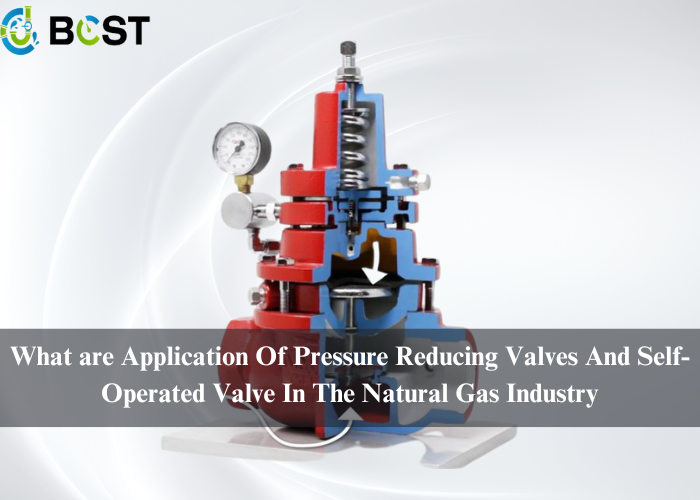
In the natural gas industry, pressure reducing valves and self-operated regulators are two common devices used for gas pressure regulation, each playing crucial roles in various applications and operating conditions. This article will provide a detailed comparison of these two devices, covering their principles of operation, selection criteria, advantages and disadvantages, as well as installation and maintenance considerations.
I. Application of Pressure Reducing Valves in the Natural Gas Industry
1.Principles of Operation:
pressure reducing valves reduce the pressure of high-pressure natural gas to safe and stable output pressures by decreasing the cross-sectional area through which the fluid passes. Typically, they consist of a regulating spring and sensing element (such as a piston or diaphragm) that detects changes in output pressure, adjusting the valve opening to maintain the desired output pressure.
2.Selection Criteria:
Stability and Accuracy: Natural gas transmission requires stable output pressures, necessitating pressure reducing valves with high-precision adjustment capabilities.
Safety: Ensuring safe operation under varying conditions is paramount; pressure reducing valves must reliably prevent excessively high or low pressures.
Flow Adaptability: pressure reducing valves should maintain stable output pressure despite fluctuations in gas flow rates.
Corrosion Resistance and Durability: Given the potential corrosive nature of natural gas, pressure reducing valves require materials and designs that offer excellent corrosion resistance and durability.
3.Analysis of pressure reducing valves Advantages and Disadvantages:
Advantages:
High Stability: pressure reducing valves maintain stable output pressures within a certain range of input pressure variations.
Simplicity and Reliability: Their simple structure facilitates easy maintenance and operation.
Automatic Adjustment: pressure reducing valves automatically adjust valve openings in response to changes in output pressure, ensuring stable pressure output.
Disadvantages:
Limited Applicability: pressure reducing valves are generally suitable for applications where a stable output pressure is required, less so for environments with large variations in output pressure requirements.
Sensitivity to Flow Variations: pressure reducing valves can exhibit significant output pressure fluctuations in response to changes in input pressure and flow rates.
4.Installation and Maintenance:
Installation: pressure reducing valves are typically installed at natural gas pipeline inlets or critical points requiring pressure reduction, ensuring safe pressure conditions for downstream equipment. Maintenance: Regular inspection and cleaning of pressure reducing valves are essential to ensure proper operation. Timely replacement of worn or damaged components helps maintain long-term operational stability.
II. Application of self-Operated Regulators in the Natural Gas Industry
1.Principles of Operation:
self-Operated Regulators rely on the dynamic balance of fluid within the valve to regulate pressure. When output pressure changes, the valve’s opening adjusts to control fluid flow, thereby maintaining the set output pressure. self-Operated Regulators operate without external power sources, utilizing fluid dynamics for pressure regulation, offering potential energy-saving benefits.
2.Selection Criteria for self-Operated Regulators:
Adaptability and Flexibility: self-Operated Regulators are suitable for applications with significant variations in input pressure and flow rates, maintaining relatively stable output pressures.
Energy Efficiency: self-Operated Regulators do not rely on external power sources, relying on fluid dynamics for regulation, potentially saving energy.
Stability and Adjustment Accuracy: While typically less precise than pressure reducing valves , self-Operated valve must ensure stable output pressure and reasonable adjustment accuracy to meet pipeline system requirements for pressure stability.
3.Analysis of self-Operated valve Advantages and Disadvantages:
Advantages:
Energy Efficiency and Environmental Benefits: Operating without external power sources, self-Operated valve conserve energy, contributing to environmental conservation.
Strong Adaptability: self-Operated valve maintain relatively stable output pressures despite significant input pressure and flow rate variations.
Disadvantages:
Lower Adjustment Precision: Compared to pressure reducing valves, self-Operated valve may exhibit slight deficiencies in output pressure stability and adjustment precision.
Complex Design and Maintenance: self-Operated valve often require more intricate engineering design and maintenance support, especially under conditions of high flow rates and pressures.
4.Installation and Maintenance:
Installation: Installation of self-operated regulating valves requires attention to pipeline cleanliness, valve positioning, and sealing inspection. Use appropriate fittings and sealing materials during connection, and provide adequate support structures. After installation, conduct tests on valve startup, pressure regulation, and leakage.
Maintenance: Regularly inspect valve operational performance and seals, and clean the valve internally and externally. Follow manufacturer recommendations for periodic replacement of critical components, and maintain maintenance records to ensure system safety and reliability.
III. Comparison and Selection Recommendations
When selecting between pressure reducing valves and self-Operated valve for specific applications within the natural gas industry, consider the following factors:
Stability Requirements: pressure reducing valves are preferred for applications demanding high stability and precision in output pressure, such as pipeline inlets or critical nodes.
Energy Consumption and Environmental Considerations: self-Operated valve offer potential energy savings but may tolerate slight pressure fluctuations, suitable for mid-to-end segments of long-distance transmission pipelines.
IV. Conclusion
Overall, pressure reducing valves and self-Operated valve each possess unique advantages and limitations in the natural gas industry. Engineers and designers should base their selection on specific project requirements, site conditions, and the imperative for safe, stable, and efficient operations. Comprehensive comparative analysis and technical evaluation ensure the secure and stable operation of natural gas transmission systems across diverse operating conditions.


 English
 Arabic
 Russian
 French
 Spanish