
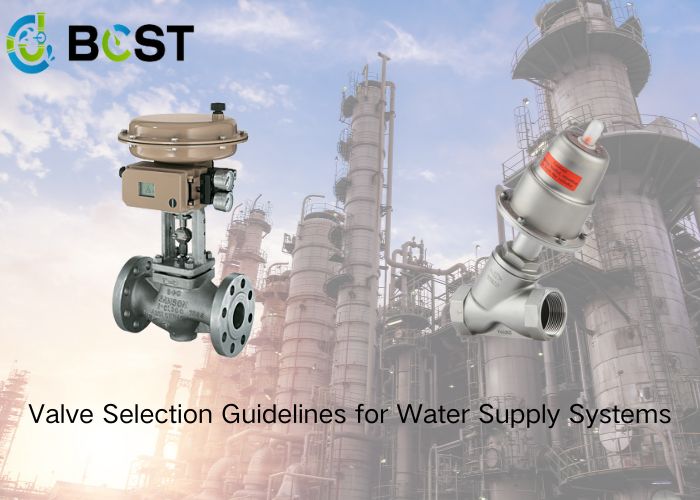
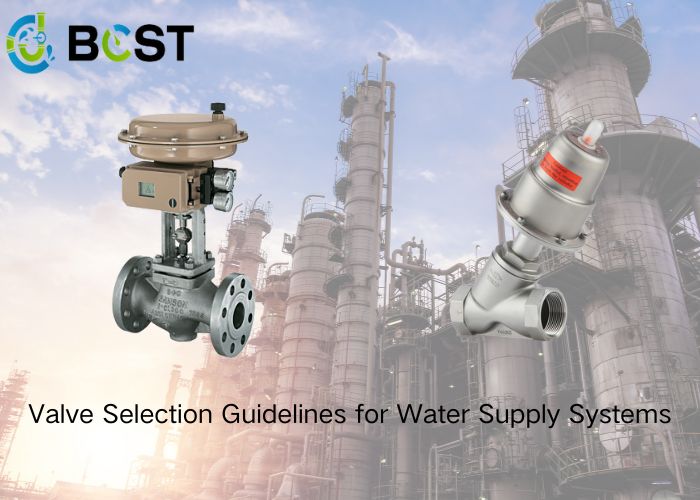
Valve Selection and Installation Locations
1. Valve Selection for Water Supply Pipelines
- For pipe diameters less than 50mm, a gate valve is preferred.
- For pipe diameters greater than 50mm, gate valves or butterfly valves are recommended.
- When flow rate or water pressure needs to be adjusted, a regulating valve or gate valve should be used.
- For low resistance to water flow (e.g., pump suction pipes), a swing check valve is preferred.
- For bidirectional water flow sections, use a gate valve or butterfly valve. Avoid using a globe valve.
- For installations with limited space, a butterfly valve or ball valve should be used.
- For frequently opened and closed pipes, a globe valve is ideal.
- For large diameter pump discharge pipes, a multi-functional valve is recommended.
2. Valve Installation Locations for Water Supply Pipelines
- From the municipal water supply main to the pipeline.
- At junctions of the outdoor ring network in residential areas, valves should be installed according to sectioning requirements. If the ring network is too long, sectional valves should be installed.
- At the end of the main pipes or at the start of branch pipes connected to the residential area water supply main.
- At the start of the household pipeline, water meter, and each branch riser (bottom of riser, at the upper and lower ends of the vertical loop pipeline).
- At branch pipes and connecting pipelines in the loop network.
- For distribution pipes leading to toilets, water points, and where there are three or more distribution points in a pipe, a valve should be set.
- On pump discharge pipes, and suction pipes for self-priming pumps.
- On the inlet and outlet pipes of water tanks, towers, and high-level reservoirs.
- For inlet pipes for equipment such as heaters and cooling towers.
- On supply pipes to sanitary appliances like toilets, wash basins, and shower heads.
- Some accessories, such as automatic air vents, pressure relief valves, water hammer arresters, pressure gauges, and fire hydrants, should be installed with valves before and after them, and backflow preventers and pressure-reducing valves should have valves before and after them.
- A drain valve should be installed at the lowest point of the water supply network.
3. Selection of Check Valves
Check valves should be selected based on factors such as installation location, upstream pressure, sealing performance requirements, and water hammer impact:
- When upstream pressure is low, a swing check valve, ball check valve, or poppet check valve is recommended.
- When tight sealing performance is required after closure, check valves with closing springs should be selected.
- For reducing water hammer, slow-closing check valves with damping devices or quiet check valves should be used.
- The valve disc or valve element should close automatically under gravity or spring force.
4. Locations Where Check Valves Should Be Installed
- Water supply inlet pipe.
- For water heaters or water-using equipment with sealed inlets.
- On the discharge pipe of a pump.
- On the inlet and outlet pipes of water tanks, towers, or high-level reservoirs when using a common pipe for both inlet and outlet.
- Note: If backflow preventers are installed, check valves are not required.
5. Locations for Air Vent Devices in Water Supply Pipelines
- Intermittent water supply networks should have automatic air vents at the highest points and terminal points of the pipe.
- Water supply networks with obvious air accumulation should have automatic air vents or manual air release valves at the peak points.
- In air pressure water supply systems, automatic air vents should be installed at the highest points of the distribution pipe network when using an automatic air supply water tank.
2. Advantages and Disadvantages of Different Valves
1. Gate Valve
A gate valve is a type of valve where the closing element (gate) moves perpendicular to the flow path, used primarily for on/off control.
Advantages:
- Low flow resistance.
- Requires less torque to open or close.
- Suitable for systems with bi-directional flow.
- Lower erosion of sealing surfaces when fully open.
- Simple structure, easy to manufacture.
- Short structural length.
Disadvantages:
- Larger space required for installation due to long opening height.
- Higher wear during opening and closing due to friction on sealing surfaces.
- Generally, two sealing surfaces increase processing, grinding, and maintenance difficulty.
- Slower opening/closing time.
2. Butterfly Valve
A butterfly valve is a valve that uses a rotating disc (or plate) to control flow by rotating it 90 degrees.
Advantages:
- Simple structure, compact, lightweight, suitable for large diameters.
- Quick opening/closing, low flow resistance.
- Suitable for media with suspended solid particles.
- Suitable for various industries such as metallurgy, light industry, electric power, and petrochemical systems.
Disadvantages:
- Limited flow regulation range.
- Not suitable for high temperature or high pressure systems.
- Poor sealing performance, not ideal for places requiring tight seals.
3. Ball Valve
A ball valve is a valve that uses a spherical ball with a hole in it as the closing element, rotating the ball 90° to control the flow.
Advantages:
- Very low flow resistance.
- Suitable for corrosive media and low-boiling liquids.
- Provides tight sealing in wide pressure and temperature ranges.
- Fast opening/closing (some models can open in 0.05 to 0.1 seconds).
- Compact structure and lightweight, ideal for low-temperature systems.
- Can handle high-pressure differentials during closure.
Disadvantages:
- Teflon seals may degrade at high temperatures.
- Poor flow regulation compared to globe valves.
4. Globe Valve
A globe valve is a type of valve in which the disc (valve plug) moves along the valve seat in a linear direction to control the flow.
Advantages:
- Good wear resistance, small opening height, and easy to manufacture.
- One sealing surface, easy maintenance.
- High temperature resistance, suitable for steam and other high-temperature media.
Disadvantages:
- Higher flow resistance.
- Slower opening/closing time.
5. Plug Valve
A plug valve uses a cylindrical or tapered plug to control the flow. The plug rotates 90° to allow or block flow.
6. Safety Valve
A safety valve automatically opens when the pressure exceeds a preset limit to prevent equipment damage due to overpressure.
7. Steam Trap Valve
A steam trap valve is used to discharge condensate, ensuring the safe and efficient operation of steam systems.
8. Pressure Reducing Valve
A pressure-reducing valve automatically regulates and maintains a constant output pressure from varying input pressures.
9. Check Valve
A check valve is used to prevent reverse flow, commonly installed on pump discharge lines or water supply inlets.
Key Points Summary
- Valve selection should consider pipe diameter, fluid properties, installation environment, and other factors.
- Different types of valves have distinct advantages and disadvantages, so the selection should be based on actual needs.
- Valve installation should account for pipeline layout, available space, and ease of maintenance.
This version should be clearer for you. Let me know if any sections need further explanation or adjustment!


 English
 Arabic
 Russian
 French
 Spanish