
What Is the Difference Between a Sluice Gate and a Weir Gate? Navigating Water Control Structure Choices
Many specifications use ‘sluice gate’ and ‘weir gate’ almost interchangeably in water management projects, but this common confusion can lead to expensive mistakes because the two are engineered for fundamentally different hydraulic jobs. Misidentifying the role of these critical water control structures can result in inefficient flow management, incorrect upstream/downstream level control, and even system failure. For any waterworks engineer or project specifier, understanding the nuanced difference between a sluice gate and a weir gate is paramount for optimal operational performance.
This guide will clarify the core distinction, helping you pinpoint when to use a sluice gate instead of a weir gate. We’ll delve into their unique functions, typical designs, and best applications, ensuring you make the right choice for isolation, flow regulation, or water level management. Avoid common pitfalls and ensure precise hydraulic control in your irrigation, stormwater, wastewater, or industrial water treatment projects.
Quick Answer: A sluice gate is primarily used for regulating or isolating flow through an opening, with water typically passing under the gate. A weir gate, conversely, is mainly used for controlling or maintaining upstream water levels, with water typically passing over its crest.
1. Understanding Sluice Gates: Isolation & Flow Regulation
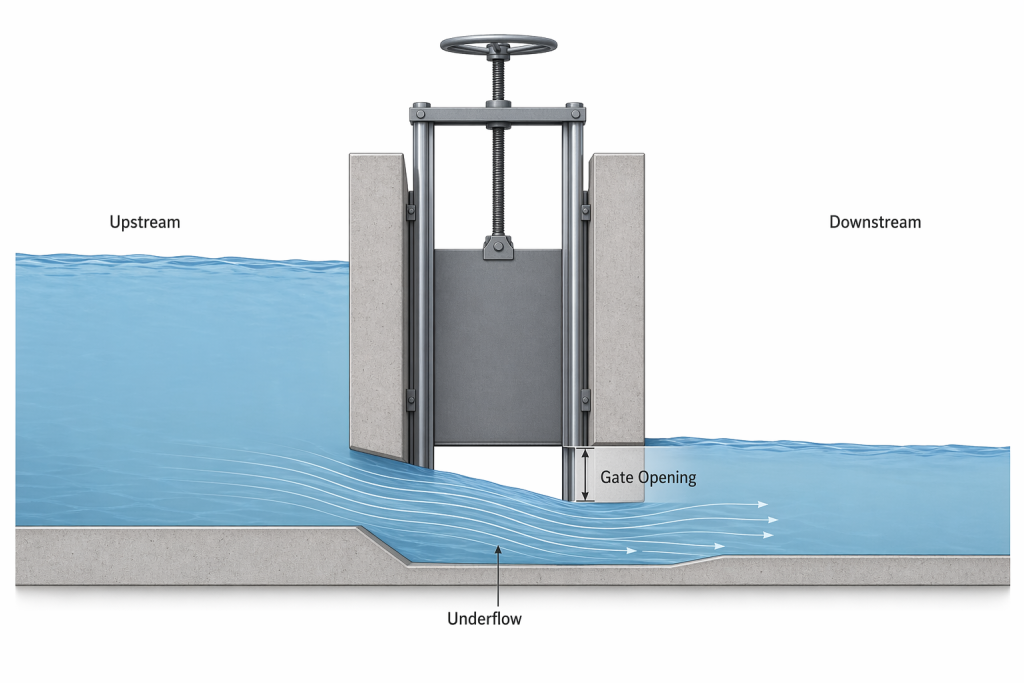
A sluice gate, often interchangeably called a slide gate or penstock, is a versatile water control structure designed to close off or regulate flow through a channel, pipe, or opening. Its primary function is to block, divert, or precisely meter the flow of water by raising or lowering a rectangular or circular gate leaf within a frame.
Key Characteristics of Sluice Gates
- Flow Path: Water typically passes under the bottom edge of the gate (underflow).
- Control Type: Position control, used for isolation or precise flow throttling.
- Drive Mechanism: Operated by a spindle and hoist (manual, electric, or hydraulic) to move the gate leaf vertically.
- Applications: Common in inlet/outlet structures, bypass channels, wastewater treatment plants, and irrigation systems where specific flow rates or complete shut-off are needed. Reliable sealing is critical (though leakage under seating head can be a complex issue).
2. Understanding Weir Gates: Level Control & Overflow
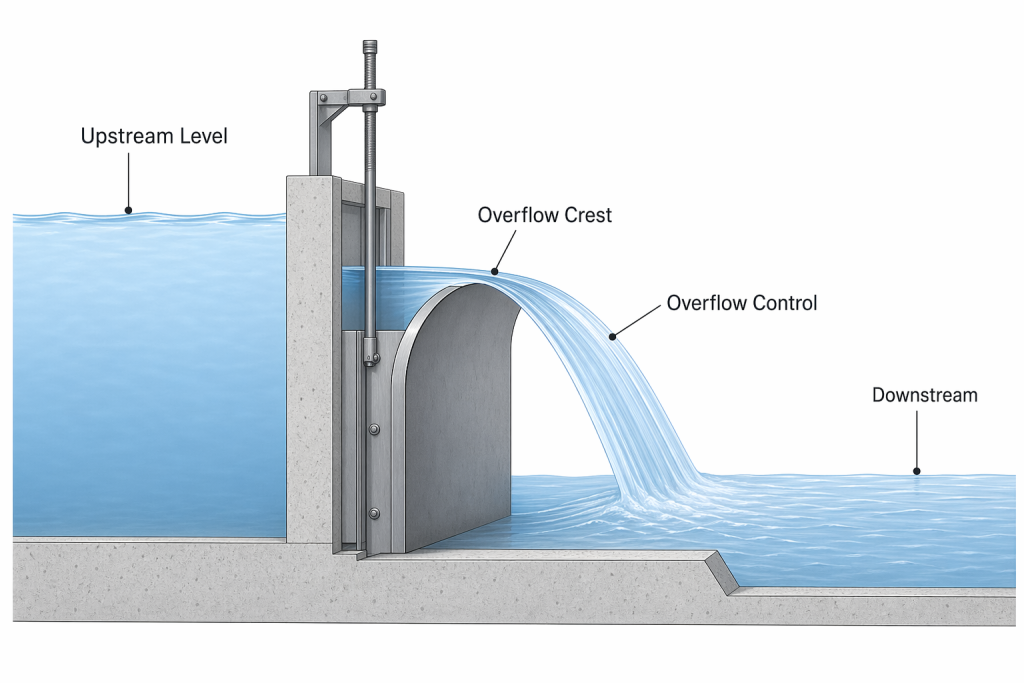
A weir gate is fundamentally designed to manage and maintain upstream water levels by regulating overflow. It often forms a barrier over which water spills, controlling the upstream depth rather than explicitly channeling flow through an opening beneath it.
Key Characteristics of Weir Gates
- Flow Path: Water typically passes *over* the top edge (or crest) of the gate (overflow).
- Control Type: Primarily level control, used to maintain a specific upstream water elevation.
- Drive Mechanism: Can be fixed (a simple weir), or adjustable (a weir gate), with mechanical or hydraulic operation to raise/lower the crest level.
- Applications: Used in agricultural irrigation, river flow regulation, stormwater retention, and treatment plant clarifiers/settling tanks where desired upstream level management or overflow discharge is key.
3. Key Differences: Function, Structure, and Applications
While both are types of water control gates, their distinctions are clear and important for engineering specifications.
| Feature | Sluice Gate | Weir Gate |
|---|---|---|
| Primary Function | Flow Isolation & Regulation | Upstream Level Control & Overflow |
| Flow Mechanism | Underflow (water goes under) | Overflow (water goes over) |
| Leaf Position | Moves vertically to block/open an orifice | Crest height adjusts to set overflow level |
| Typical Design | Rectangular or circular leaf in a frame, on/off or throttling action | Adjustable plate or flap creating a crest for overflow |
| Measurement Role | Can include flow measurement via orifice equation with known head | Often used as an accurate flow measurement device (e.g., V-notch weir) |
4. When to Choose a Sluice Gate vs. a Weir Gate
The choice between a sluice gate and a weir gate is dictated by the specific hydraulic objective of your project.
Opt for a Sluice Gate When You Need:
- Complete Isolation: To fully block flow for maintenance, segmenting a channel, or preventing backflow.
- Precise Flow Regulation: To control the exact volume or rate of water entering or exiting a system.
- Gate Submergence: In applications where the gate opening will be consistently submerged.
- Control of Upstream OR Downstream Levels: Depending on its position and the hydraulic conditions, a sluice gate can influence either.
Choose a Weir Gate When Your Goal Is:
- Maintaining Upstream Water Level: To hold constant elevation in a reservoir, settling tank, or irrigation canal regardless of inflow fluctuations.
- Overflow Discharge: To safely discharge excess water when a certain level is exceeded.
- Flow Measurement: Certain weir designs (e.g., V-notch, rectangular) are excellent for accurate flow rate measurement.
- Skimming Surface Debris: The overflow action can help clear floating debris from the water surface.
5. Common Buyer/Specifier Mistakes
Choosing the wrong water control gate often stems from a misunderstanding of hydraulic principles or project requirements.
- Assuming Interchangeability: Believing one can perform the other’s primary function equally well (e.g., using a sluice gate solely for level control when a weir gate is better suited).
- Ignoring Operating Conditions: Not properly considering factors such as upstream debris (sediment jamming in sluice gates can be an issue), corrosion environment, or desired level of sealing when specifying.
- Incorrect Sizing: Selecting a gate based on maximum pipe size rather than actual flow/level requirements, leading to poor control.
- Overlooking Retrofit Challenges: When replacing existing structures, failing to account for specific site dimensions and civil rework required can lead to project delays and cost overruns. (Related: Retrofitting a sluice gate in an existing channel needs careful planning).
FAQ on Sluice Gates vs. Weir Gates
Can a sluice gate ever function like a weir?
Yes, when a sluice gate is lowered such that water overtops it, the water spilling over its crest will behave like a weir, controlling the upstream level. However, this is usually a secondary function or an unintended hydraulic condition, not its primary design purpose.
Which gate type is better for flood control?
Both can play a role. Sluice gates can isolate specific channels or provide precise flow release during controlled events. Weir gates are often used in spillways or overflow structures to safely pass excess floodwaters once a critical upstream level is reached.
Do sluice gates require seals?
Yes, sluice gates require seals (typically neoprene, EPDM, or UHMWPE) around the gate leaf and bottom to achieve tight shut-off and minimize leakage. The effectiveness of these seals depends heavily on proper installation and frame flatness.
Conclusion: Precision in Specification, Performance in Practice
Understanding the fundamental difference between a sluice gate and a weir gate is more than just academic; it directly impacts the hydraulic performance, operational efficiency, and longevity of your water control systems. By recognizing that a sluice gate prioritizes isolation and flow regulation beneath the gate, while a weir gate focuses on maintaining upstream levels via overflow, engineers can avoid costly misapplications.
At BCST Valve, our expertise spans the full range of water control gate design and manufacturing. We partner with project engineers and specifiers to ensure the correct gate type, sizing, and material selection for your precise hydraulic requirements, guaranteeing optimal performance and peace of mind.
Need Help Choosing the Right Gate Type for Your Channel or Plant?
Don’t let specification confusion lead to costly errors. Consult with BCST Valve’s hydraulic experts.


 English
 Arabic
 Russian
 French
 Spanish