
Why Your Sluice Gate Leaks Under Seating Head: Seal Compression, Frame Distortion, and Installation Tolerance Errors
The sluice gate is fully seated, the actuator shows closed position, and yet water still passes through the opening. This frustrating scenario—a sluice gate that leaks under seating head—is a common and costly problem in water treatment plants, irrigation channels, and stormwater systems. It often isn’t a problem with the seal material itself, but rather a more intricate issue related to the gate’s structural integrity, the uniformity of sluice gate seal compression, or subtle installation tolerance errors.
Most content on sluice gates discusses types and applications, but few tackle this pervasive field frustration head-on. This guide provides a troubleshooting checklist for diagnosing sluice gate leakage causes, delving into the critical impact of sluice gate frame distortion, guide alignment, and gate flatness. Understand why leakage under the seating head is often more complex than simple wear and tear, empowering plant operators and EPC engineers to pinpoint the root cause before resorting to expensive, unnecessary gate replacement.
Quick Answer: A sluice gate leaks under seating head primarily due to uneven seal compression, structural frame distortion, or minute installation tolerance errors in the channels, preventing true watertight closure, even with healthy seals.
1. What “Seating Head” Means in Practice
In the context of sluice gates, “seating head” refers to the differential water pressure acting on the gate system in the closed position, specifically the pressure that pushes the gate leaf more tightly against its frame and seals. This pressure is intended to aid in creating a positive seal. Conversely, “unseating head” would be pressure pushing the gate away from its frame, making sealing more challenging.
AWWA Standards for Leakage Performance
The American Water Works Association (AWWA) provides crucial standards (e.g., AWWA C560 for Fabricated Stainless Steel Slide Gates) that define acceptable AWWA slide gate leakage performance under specified seating heads. For instance, AWWA standards typically allow for a maximum leakage rate often expressed in gallons per minute per foot of seating perimeter (e.g., 0.005 GPM per foot). However, even within these limits, persistent drips can indicate underlying problems.
2. Why Frame Flatness and Guide Alignment Matter
The performance of a sluice gate seal is inherently dependent on the precision of the gate’s frame and guides. These non-seal factors are often the hidden culprits behind why your sluice gate leaks under seating head.
The Impact of Sluice Gate Frame Distortion
Sluice gate frame distortion refers to any deviation from a perfectly flat or true profile in the gate’s embedded frame, often caused by:
- Uneven Grouting: Improper grout mixture or application can lead to localized stresses during curing, subtly twisting or bowing the frame.
- Rough Handling: During transport or installation, an accidental impact can deform a frame not properly braced.
- Concrete Shrinkage/Settlement: Over time, the surrounding civil structure can shift, inducing stresses into the embedded frame.
A distorted frame means the gate leaf can never achieve full, uniform contact with the seals, creating leak paths where sealing surface deviation is too great for the gasket to compensate.
Misaligned Guides and Gate Flatness
Similarly, if the gate leaf itself is not perfectly flat or if its guides are out of parallel, the gate will bind or seat unevenly. Imprecise sluice gate guide alignment means that as the gate lowers, it might twist or cock slightly, preventing consistent sluice gate seal compression. Even a minor deviation of 1-2 millimeters can be enough to create a persistent leak path under significant seating head pressure.
3. Why Leakage is Often an Installation or Tolerance Issue, Not Just a Seal Issue
While worn or damaged seals can certainly cause leakage, especially if sediment jamming causes abrasion, new sluice gates sometimes leak from day one. In these cases, the problem almost always points to either poor installation practices or tight tolerance requirements that were not met.
Tolerance Stack-Up and Seal Gap
Installation tolerance errors refer to the cumulative effect of small deviations from perfect alignment or dimensions. Individually, each deviation might be negligible, but when combined (e.g., slight frame distortion + minor guide misalignment + a minuscule irregularity on the concrete channel wall), they “stack up.” This can create a physical gap between the gate leaf, its seals, and the embedded frame, exceeding the compression capability of the seals and leading to sluice gate seal gap leakage.
Typical sources of these errors include:
- Inaccurate embedment of the gate frame into the civil structure.
- Improper leveling or plumbing of the gate frame.
- Insufficient (or uneven) grouting, leading to voids or pressure points.
- Lack of final verification of gate flatness and guide parallelism post-installation.
4. Side-Seal vs. Bottom-Seal Considerations
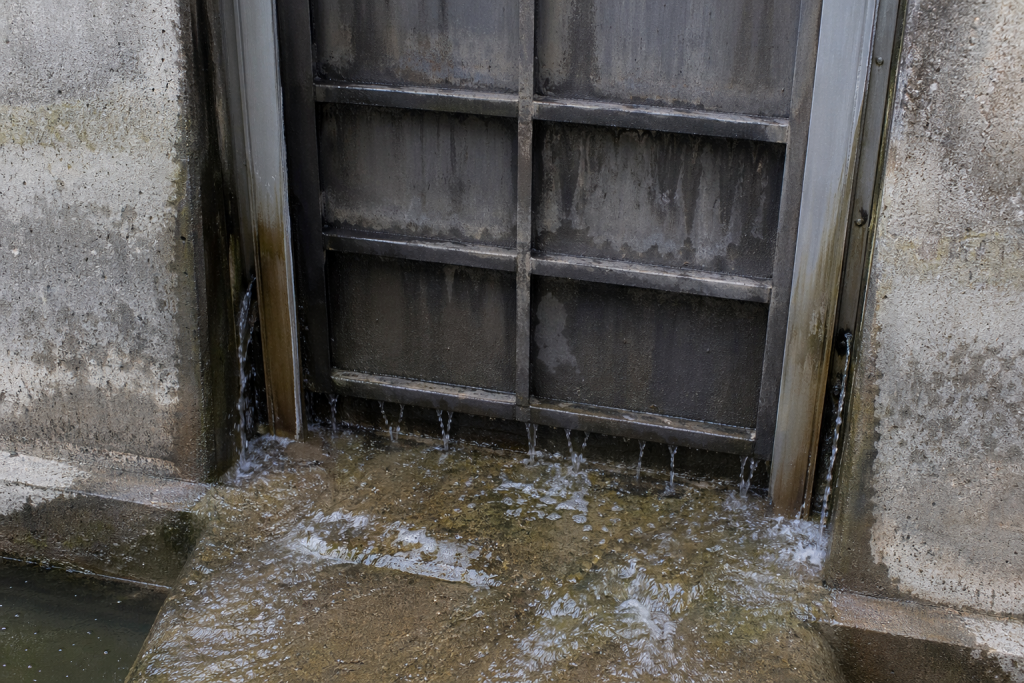
Leakage patterns can often provide clues. Water ingress from the sides typically points to frame or guide alignment, while bottom leakage can indicate invert irregularities or debris.
Differentiating Seal Failure Modes
| Seal Location | Primary Leakage Pattern | Common Causes |
|---|---|---|
| Side Seals | Streamers or drips down the sides of the gate/frame | Frame distortion, guide misalignment, uneven gate leaf, insufficient bolt tension (if adjustable) |
| Bottom Seal | Continuous flow or steady drip under the gate leaf | Debris on invert, uneven invert/sill, bottom seal wear, insufficient seal compression |
Even with adjustable side seals, there are limits to how much they can compensate for gross structural imperfections. Proper tensioning of adjustable seals is key to achieving consistent sluice gate seal compression.
5. Checklist for Diagnosing Leakage Before Replacing the Gate
Before any major intervention, systematically check these points if your sluice gate leaks under seating head:
- Visual Inspection for Debris: Check the entire seating area, especially the invert, for trapped rocks, silt, or rags that prevent full closure. (This is a common cause of incomplete gate closure).
- Gate Flatness & Squareness: Use a straight edge and feeler gauges to check if the gate leaf is truly flat and square to its travel path.
- Frame Flatness: After dewatering, inspect the embedded frame’s seating surfaces for flatness and any signs of distortion or uneven wear.
- Guide Parallelism: Measure the distance between the guides at multiple points to ensure they are parallel and allow smooth, bind-free travel.
- Seal Condition & Type: Inspect seals for cuts, hardening, loss of resilient properties, or improper material for the application. Ensure correct sluice gate seal material selection.
- Hoist/Actuator Travel: Confirm the hoist mechanism is allowing the gate to travel its full stroke and exerting adequate down-seating force without over-torquing.
- Embedded Frame Integrity: Look for cracks in the concrete around the embedment indicating structural movement.
- Grout Inspection: Check for any voids or deteriorated grout behind the frame.
FAQ on Sluice Gate Leakage
What is considered an acceptable leakage rate for a sluice gate?
Acceptable leakage rates are defined by standards like AWWA C560. While these allow for minimal leakage (e.g., 0.005 GPM per foot of seating perimeter), a truly well-installed and maintained gate should minimize visible leakage under seating head for non-critical applications, or be designed for bubble-tight in critical ones.
Can I adjust the seals on my sluice gate?
Some sluice gates feature adjustable side seals that can be tightened to improve sealing. However, over-tightening can cause excessive friction and difficulty in operation. Bottom seals are typically fixed and would require maintenance (replacement) if worn.
How important is gate flatness for leak prevention?
Gate flatness is extremely critical. Even minor warpage or unevenness of the gate leaf can create localized gaps that prevent uniform seal compression against the frame, allowing water to bypass the seal despite proper actuation force.
Conclusion: Solving Sluice Gate Leakage with Forensic Precision
When your sluice gate leaks under seating head, the answer is rarely a simple seal replacement. Understanding the complex interplay of seal compression, potential frame distortion, and subtle installation tolerance errors is crucial for accurate diagnosis. By moving beyond basic assumptions and performing a systematic examination, plant operators and engineers can resolve persistent leakage issues efficiently.
At BCST Valve, we are experts in designing and manufacturing sluice gates with superior sealing performance, engineered to minimize sluice gate seal gap leakage and resist structural challenges. We understand that precise fabrication and meticulous installation contribute equally to long-term, leak-free operation. Contact us for solutions that deliver verifiable shut-off.
Seeing Leakage Under Seating Head? Don’t Guess, Diagnose!
Send your gate dimensions, head condition, and installation photos for a technical review by BCST Valve experts.


 English
 Arabic
 Russian
 French
 Spanish