
Why the Temperature Transmitter 4-20mA is the Best Choice for Reliable Signal Transmission? The accuracy and reliability of signal transmission are critical in industrial settings; indeed, this is the key to continuous smooth operation. Consequently, the Temperature Transmitter 4-20mA is the best and, furthermore, a very reliable solution among the many signal transmission options. In this article, we will discuss why the 4-20mA current loop is the preferred type of signal. Additionally, we’ll compare it with other options, thus showing its advantages for precise temperature measurement and control.
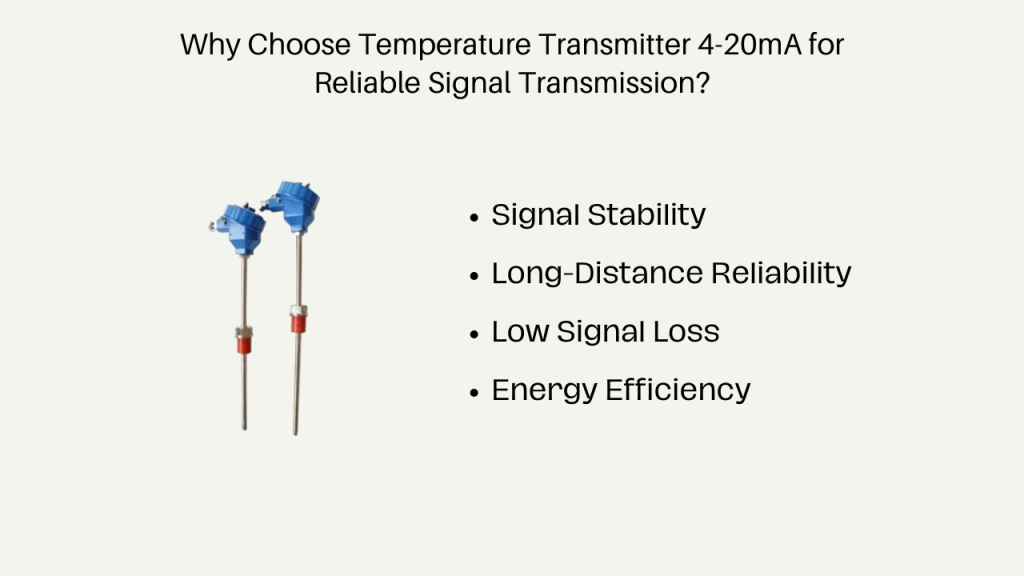
Understanding the 4 20 mA Signal Transmission
Derived from the 4-20mA Signal Transmission4-20mA , the Temperature Transmitter 4 20 mA is intended to convert the temperature readings into an electrical signal that will potentially range between 4mA and 20mA. This range is the same across different sectors to transfer data to control or monitoring systems in case the temperature. A 4 mA signal is at the lowest point in the sensor’s range, 20 mA at the highest. This simplicity guarantees that linear and straightforward data transmission to monitoring systems and industrial controllers can easily handle it.
Key Advantages of 4 20 mA over Other Signal Types
1. Noise Resistance. A formidable advantage of Temperature Transmitter 4 20 mA signals is their high noise immunity, that is their ability they keep on working in the presence of electric noise pollution.
Other methods of signal transmission, such as voltage signals, are susceptible to interference of noise, which typically hinders them to transmit the data in a proper way. The current loop technology employed in 4-20mA sureties the stable and error-free transmission of data, even in electrically noisy environments, so it is quite useful for control and industrial equipment.
2. Long-Distance Transmission. In these plants, temperature transmitters usually send control signals over relatively long distances. Contrasting to voltage-based signals, which lose quality over distances, the Temperature Transmitter 4 20 mA preserves signal strengths along the entire length of the wire, or in other words, the whole distance. This peculiar feature makes 4-20mA transmitters a very suitable choice in remote parts of the plant where data accuracy is needed.
3. Failure Detection. The fundamental feature of the Temperature Transmitter 4 20 mA is its built-in ability to detect wiring faults. If the current goes below 4mA, a warning signal comes up without delay. This inceptive backup mechanism ensures that it is immediately known to operators and the system is down for less time and the total system becomes more reliable.
Comparing 4-20mA with Other Signal Types
The Temperature Transmitter 4 20 mA is a common signaling approach, 0-10V also exists and the digital method is another option. Here’s a description of these alternatives:
1. 0-10V Signal Transmission Signal Quality: Voltage signals like 0-10V are easily affected by electrical noise, especially in the presence of heavy machinery or motors in the environment. Distance Limitation: Voltage drops are an issue as the signal moves on long distances that causes databases to be transmitted improperly. None of these are issues with Temperature Transmitter 4 20 mA. Fault Detection: Voltage signals lack the ability to carry out clear fault detection as the transmitters cannot connect easily the fault with the system.
2. Digital Signals (e.g., HART or Fieldbus)Signal Quality: The digital signals are highly precise and can also transmit auxiliary data. They, however, involve the use of technical equipment and infrastructure. Cost and Complexity: The digital systems are expensive and a bit complex to fit as they need necessary knowledge to maintain them. The compare and contrast is that the Temperature Transmitter 4 20 mA is easier and cheaper, hassle-free, and with extra high reliability, it is functioning without the support of a complex infrastructure.
Пригодность: The digital systems could be more suitable for tasks that require high-resolution data and advanced diagnostics whereas the Temperature Transmitter 4 20 mA is a better choice for a simple, reliable temperature measurement.
Why Choose Temperature Transmitter 4 20 mA for Industrial Applications?
First of all, the Temperature Transmitter 4-20mA is characterized by its reliability and stability. This industrial unit is the most reliable and stable for industrial use cases that demand precise monitoring and regulation of temperatures.
One of the unique features of this temperature transmitter is its noise resistance. Temperature transmitters can also transmit signals without any degradation to the signal quality. and built in failure detection make it a clear choice over other signal types. Industries that depend on correct temperature control, such as oil and gas, power generation, and chemical manufacturing, remain to be the main users of 4-20mA current loop for its exclusive performance.
Key Benefits of Temperature Transmitter 4 20 mA
Minimal Signal Degradation: Long-distance capabilities are not only maintained by the signal quality but also offer a great throughput rate.
Strong Noise Resistance: It can adequately shield electrical noise impact in the settings that are physically harsh.
Built-in Fault Detection: The new system has a built-in function that will signal an alarm only if a faulty and dangerous situation arises, thus reducing the time for immediate repairs.
Simplicity and Reliability: It provides a direct and cost-effective way of dealing with issues.
Заключение
Reliable temperature control and precise observation of temperature levels are essential for keeping structures safe and operational, across numerous industries. For this purpose, the Temperature Transmitter 4-20mA is known to be the standard. The multiple features it has, from strong signal transmittal to its capacity as a system for discovering flaws, enables the industrial usage of this highly dependable equipment.
The comparison between the electrical signals and digital signals tells a story – the 4-20mA current-loop signals stands out with its unmatched simplicity, preciseness and very low margin of signal loss, a trait highly appreciated in the industries. When connected to the system, it can efficiently work without signal distortion or data loss – a clear indication of the reliable performance delivered by the Temperature Transmitter 4 20 ma


 English
 Arabic
 Russian
 French
 Spanish