
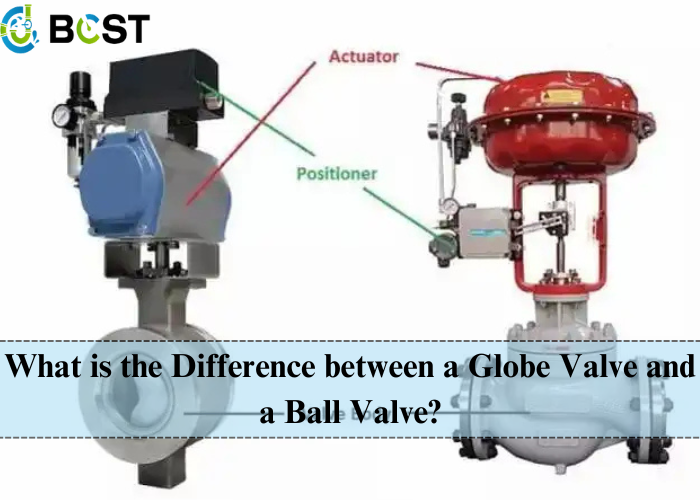
In the industrial field, valves are critical devices for controlling the flow of fluids (gas, liquid, etc.). Among the many types of valves, globe valves and ball valves are the two most common types, and they are widely used in chemical, petroleum, natural gas, pharmaceutical, and other industries. Although they are used to control the start, stop, and regulation of fluids, they differ significantly in design, working principle, performance, and application scenarios.
This article will detail the main differences between globe and ball valves and explore their advantages and disadvantages.
1. Differences in structure and working principle
1.1 The structure and working principle of the globe valve
The globe valve is a commonly used control valve. Its working principle is to rotate the valve stem to move the valve core up and down, thereby changing the valve opening to control fluid flow. The valve core of the globe valve is usually disc-shaped or conical. When the valve is open, the fluid flows through the channel under or on both sides of the valve seat; when the valve is closed, the valve core is in close contact with the valve seat to prevent the fluid from passing.
1.2 Особенности
Structural features: The globe valve’s valve stem is usually rotated and lifted, and the valve disc moves in the vertical direction of the valve seat.
Good sealing: The large contact surface between the valve core and the globe valve seat strengthens the globe valve’s sealing performance, making it suitable for use in working conditions that require good sealing.
Manual operation is typical: the handwheel rotates the valve stem, driving the valve disc up and down to regulate flow.
1.3 Structure and working principle of ball valve
A ball valve is a rotary valve that controls fluid flow by rotating a ball with a through hole. Inside the ball, there is a through channel. When the valve is open, the ball rotates 90 degrees to align the channel with the pipe, allowing the fluid to pass; when the valve is closed, the ball rotates another 90 degrees, the channel is perpendicular to the pipe, and the fluid cannot pass.
1.4 Features:
Structural features: The main component of the ball valve is the sphere, which has a through hole inside. The channel is aligned with the pipeline when the sphere rotates to a particular position.
Easy to operate: Ball valves must be rotated 90 degrees to be fully open or closed, making the operation quick and easy.
High sealing performance: The ball valve’s sealing depends on the contact between the ball and the valve seat, so it has good sealing performance, especially in high-pressure situations.
2. Differences in operation methods
2.1 Operation of the globe valve
The operation of the globe valve mainly depends on the hand wheel, which controls the valve opening by rotating the hand wheel to move the valve stem up and down. Due to the lifting movement of the valve stem, the globe valve usually takes a long time to open or close, especially in the larger-diameter globe valve.
Manual operation: The most common mode of operation is manual, which is suitable for working conditions where the fluid flow rate requirements are not high but the adjustment accuracy requirements are high.
Automatic operation: The valve’s opening and closing can also be controlled by electric, pneumatic, and other means. It is mainly used in production lines that require automatic control.
2.2 Operation of the ball valve
The operation of the ball valve is effortless. Generally, only 90 degrees of rotation is needed to complete the start-stop control. Because the design of the ball valve enables it to open and close quickly, it has significant advantages in occasions that require frequent start-stops.
Manual operation: The ball rotates by rotating the valve stem, which is suitable for occasions that require quick start and stop.
Automatic operation: Ball valves are widely used in automatic control systems and are often used by electric, pneumatic, and other automatic control devices.
3. Differences in fluid control performance
3.1 Fluid control performance of globe valve
The globe valve is suitable for applications requiring precise flow and pressure regulation. Due to its structural design, the globe valve can achieve fine flow control and has good stability in the half-open state. This makes it very suitable for working conditions that require precise fluid flow rate control, such as reactor feed systems in chemical production.
3.2 Advantage
Suitable for regulating flow: Even in the partially open state, the globe valve can still effectively control the flow, and the significant pressure drop generated when the fluid passes through the valve body makes it suitable for systems that require pressure regulation.
Fluid stability: The globe valve can maintain fluid stability even at low flow rates.
3.3 Fluid control performance of ball valve
Ball valves are more suitable for situations requiring quick start and stop, especially in systems that need to be fully open or closed. Since the channel diameter in the ball is usually the same as the pipe diameter, the fluid resistance of the ball valve is minimal when it is fully open, and almost no additional resistance is generated to the fluid.
3.4 Advantage
Small flow resistance: When fully open, the ball valve will hardly produce additional resistance to the fluid, making it suitable for systems with low fluid resistance requirements.
Quick operation: Only a 90-degree rotation is required to complete the start and stop operation, suitable for frequent start and stop conditions.
4. Differences in applicable media
4.1 Applicable medium of the globe valve
The globe valve is suitable for various media, including water, steam, oil, and corrosive media. Because the valve core and seat have strong sealing properties, it can work under high pressure, high temperature, or corrosive media. In the chemical, pharmaceutical, and other industries, the globe valve is often used to control corrosive liquids and high-temperature steam.
4.2 Applicable media of ball valve
Ball valves also suit various media, including gases, liquids, and corrosive media. Their design makes them ideal for use in pipeline systems requiring rapid start and stop, so they are widely used in industries such as natural gas transportation and oil extraction. In addition, ball valves are suitable for transporting non-corrosive and corrosive liquids.
5. Differences in maintenance and service life
5.1 Maintenance and service life of globe valve
The maintenance of the globe valve is relatively simple. Still, due to its complex structure, especially the considerable friction between the valve stem and the valve seat, it is easy to wear in high-frequency use. Therefore, regular inspection and maintenance are necessary, mainly in corrosive media and high-temperature and high-pressure conditions. Particular attention should be paid to the wear of the seal.
5.2 Advantage
Easy maintenance: The structure is relatively simple and easy to disassemble and replace parts.
Long service life: Under suitable working conditions, the globe valve has a long service life, primarily when regulating flow.
5.3 Maintenance and service life of ball valve
The ball valve’s structure is relatively simple, and the wear between the ball and the valve seat is small, so its service life is long. Especially when frequent flow adjustment is not required, the ball valve’s maintenance requirements are low, and the service life is longer. In addition, the ball valve usually has a self-cleaning function, which can remove dirt on the ball’s surface when the fluid passes through, reducing the need for maintenance.
5.4 Advantage
Long service life: Ball valves usually have a longer life due to less wear. This makes them especially suitable for working conditions with frequent start-ups and stops.
Low maintenance requirement: simple structure, easy to maintain, and service.
6. Differences in application scenarios
6.1 Application scenarios of globe valves
The globe valve is suitable for occasions that require precise control of flow, pressure, and temperature. It is widely used in chemical, pharmaceutical, electric power, heating, and other industries. Due to its good sealing performance, the globe valve is particularly suitable for controlling steam, hot water, and corrosive media.
6.2 Typical applications
Reactor feeding system in chemical production
Hot water and steam piping systems
Corrosive liquid delivery system
Application scenarios of ball valves
Ball valves are more suitable for systems that require quick start and stop, such as natural gas transmission, oil extraction, fire protection systems, etc. Due to their easy operation and low fluid resistance, ball valves have been widely used in natural gas, oil, and water supply systems.
6.3 Typical applications
Gas and oil transportation systems
Fire water system
Rapid start and stop system in industrial production
7. Заключение
By comparison, it can be found that there are significant differences between globe valves and ball valves in terms of structure, operation mode, fluid control performance, applicable media, maintenance requirements, and application scenarios. Globe valves are more suitable for working conditions that require precise flow and pressure regulation and are ideal for chemical, pharmaceutical, and other industries. In contrast, ball valves are more suitable for systems that require fast start and stop, have low fluid resistance, and are widely used in natural gas, oil, water supply, and other industries.
Choosing the right valve type can improve the system’s working efficiency, reduce maintenance costs, and increase the equipment’s service life. Therefore, in different industrial applications, the choice of valves should be determined according to specific process requirements and working conditions.


 English
 Arabic
 Russian
 French
 Spanish