
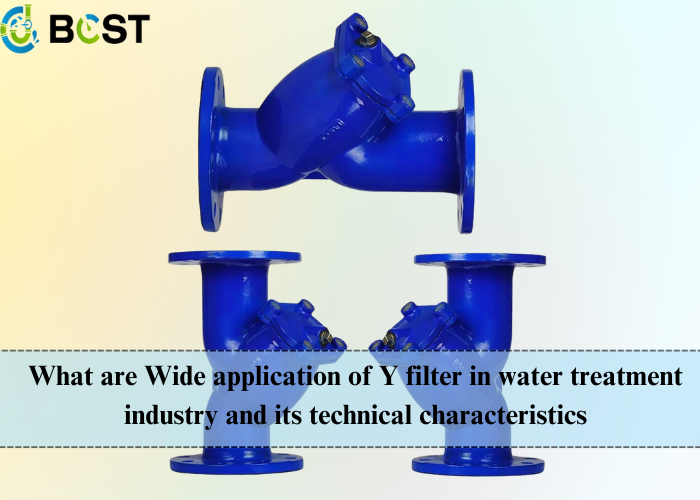
Y-type filters, as common and effective industrial filtration equipment, play a crucial role in the water treatment industry and various sectors of liquid processing. Their simple yet practical design effectively removes solid particles from fluids, protecting pipeline systems and equipment from damage and ensuring process stability and reliability. This article explores the operational principles, technical characteristics, selection criteria, advantages and disadvantages, and specific applications of Y-type filters in different industries.
I. Operational Principles and Structure
The operational principle of Y-type filters is based on their unique structural design. Typically, they consist of Y-shaped or inverted Y-shaped filter chambers with internal filter screens or baskets designed to trap solid particles from fluids. The working process as follows:
Fluid entry into the filter: Fluid enters the internal space of the Y-type filter through its inlet.
Particle separation: Once inside the Y-type filter, solid particles in the fluid are intercepted and captured by the filter screen or basket, effectively separating the particles.
Filtering effectiveness: The aperture size of the filter screen or basket can be chosen according to specific requirements to ensure desired filtration effectiveness.
Y-type filters are generally designed to be disassembled and cleaned. This allows for relatively easy operation and maintenance when removing accumulated particles. Typically, when the particles inside the filter reach a certain level, the inlet valve is closed, the filter screen or basket is removed for cleaning, and then reinstalled into the equipment.
Technical Characteristics
Y-type filters exhibit several notable technical characteristics in industrial applications, making them an indispensable component in fluid processing:
Pressure resistance: Y-type filters can typically withstand relatively high operating pressures, enabling safe operation in various industrial environments.
Multiple material choices: Depending on different operating conditions and fluid characteristics, Y-type filters can be made from materials such as stainless steel, copper, plastics, etc., ensuring corrosion resistance and durability.
Adjustable filtration precision: The filtration precision of the filter can be adjusted by selecting appropriate filter screens or baskets to meet specific particle handling requirements.
Simple and reliable structure: The simple Y-shaped design provides good mechanical strength and stability, minimizing the likelihood of failures and ensuring reliable operation.
II. Selection Requirements
When selecting Y-type filters, several key factors need consideration to ensure optimal performance in specific applications:
Flow rate requirements: Choose an appropriate size of Y-type filter based on the fluid flow rate to prevent becoming a bottleneck in the system’s fluid flow.
Operating pressure: Determine the maximum operating pressure in the application environment and select a filter capable of safely withstanding that pressure.
Fluid characteristics: Analyze the chemical properties of the fluid to be processed, particle size, and morphology to choose suitable filter screens or baskets.
Material durability: Consider the fluid’s corrosiveness and abrasion resistance requirements to select materials that prolong the equipment’s service life.
Ease of cleaning and maintenance: Consider whether the filter is easy to clean and maintain to reduce downtime and maintenance costs.
The selection of Y-type filters should consider not only static parameters such as size and material but also dynamic factors during operation to ensure long-term stable and efficient operation of the equipment.

III. Advantages and Disadvantages Analysis
As a common industrial filtration equipment, Y-type filters possess the following advantages and disadvantages:
Преимущества:
Effective solid particle filtration: Capable of effectively capturing various solid particles in fluids, including sediments, sand, rust particles, etc., protecting downstream equipment from damage.
Simple and reliable structure: Simple design, high mechanical strength, stable operation, low failure rate, and low maintenance costs.
Applicable to various fluids: Whether in water treatment, chemical, food processing, or pharmaceutical industries, Y-type filters effectively meet the filtration needs of different types of fluids.
Недостатки:
Increased flow resistance: After prolonged use, the filter screen or basket may accumulate a large amount of particles, leading to increased fluid resistance and requiring regular cleaning and maintenance.
Limited filtration precision: Compared to some high-precision specialized filtration equipment, Y-type filters may have limitations in filtration precision, unable to handle extremely small particles.
IV. Application Scenarios and Industry Applications
Y-type filters find widespread applications in various industrial sectors, including but not limited to:
Water treatment industry: Used in municipal water supply systems for pretreatment to remove impurities and solid particles, ensuring water quality meets standards.
Chemical industry: Widely applied in filtering chemical liquids during chemical production to prevent pipeline and equipment blockages and damage, ensuring production safety and continuity.
Food and beverage industry: In food processing and beverage production, Y-type filters are used for fluid pre treatment and purification to ensure product cleanliness and safety.
Pharmaceutical industry: In pharmaceutical production, Y-type filters are used to filter medicinal liquids, production materials, and injection water to ensure drug purity and quality standards, preventing contamination and cross-infection.
Energy industry: In oil and natural gas pipeline systems, Y-type filters are commonly used to filter mediums such as oil and liquid natural gas, preventing pipeline blockages and valve and pump damage.
Manufacturing industry: In hydraulic systems, Y-type filters filter hydraulic oil to protect hydraulic pumps, valves, and motors, prolonging equipment life and ensuring system stability and reliability.
In each industry, Y-type filters are critical process equipment that ensures normal equipment and process operation through effective solid particle filtration, enhancing production efficiency and product quality.
V. Заключение
Y-type filters, as simple yet practical industrial filtration equipment, demonstrate their importance and indispensability in fluid processing across industries such as water treatment, chemical, food and beverage, pharmaceutical, energy, and manufacturing. Through proper selection and application, Y-type filters effectively improve equipment operation efficiency, reduce maintenance costs, and ensure process stability and safety.


 English
 Arabic
 Russian
 French
 Spanish