
Введение
In modern industrial automation, Distributed Control Systems (DCS) serve as an essential control technology widely applied in process control and production management. Pneumatic control valves, as one of the key actuating components in DCS systems, can precisely regulate parameters such as fluid flow, pressure, and temperature. This article will explore the application of pneumatic control valves in DCS systems in detail, including their working principles, functions, advantages and disadvantages, as well as practical application cases.
1. Basic Concept of Pneumatic Control Valves
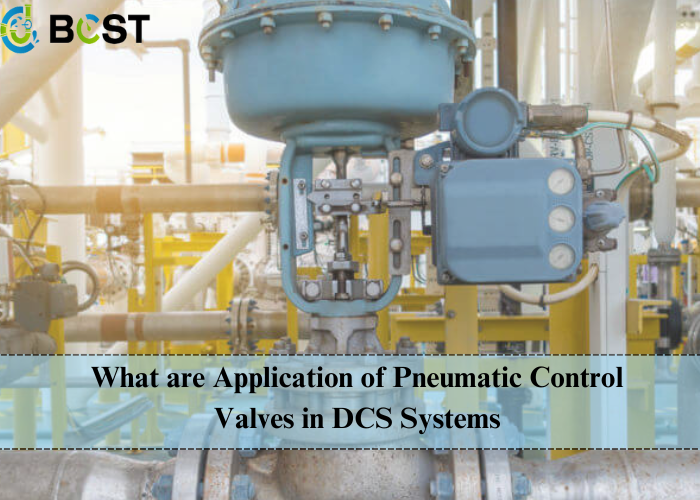
A pneumatic control valve is a device that uses a pneumatic actuator to adjust the valve opening. It typically consists of a valve body, valve seat, actuator, and feedback device. Depending on the type of pneumatic drive mechanism, pneumatic control valves can be classified into cylinder-type and diaphragm-type. Pneumatic control valves are characterized by fast response, high control precision, and strong adaptability, making them suitable for various industrial processes involving flow control.
1.1 Принцип работы
The working principle of a пневматический регулирующий клапан is primarily based on pneumatic driving technology. When the DCS system sends a control signal, the pneumatic actuator receives the signal and adjusts the pressure or flow of air to drive the valve open or closed, thereby achieving precise control over fluid flow. The relationship between the valve opening and the set value in the DCS system forms a closed-loop control system.
1.2 Main Components
Valve Body: Responsible for the fluid passage, determining the flow characteristics of the fluid.
Actuator: Converts control signals into mechanical movement, typically powered by compressed air.
Position Feedback Device: Monitors the valve opening in real-time and sends data back to the DCS system.
Control Interface: Connects with the DCS system, receives control signals, and transmits status information.
2. Application of Pneumatic Control Valves in DCS Systems
2.1 Signal Reception and Processing
In a DCS system, the control signals for пневматические регулирующие клапаны are usually analog signals ranging from 4-20mA or digital signals. The DCS system sends instructions to the pneumatic control valve through the control module, indicating the target opening of the valve. This process must ensure the accuracy and timeliness of the signals to maintain precision in fluid control.
2.2 Action Execution
Upon receiving the control signal, the actuator of the пневматический регулирующий клапан adjusts the air supply based on the set valve opening. The internal cylinder or diaphragm moves accordingly, changing the valve opening to regulate fluid flow. For example, when an increase in flow is needed, the actuator will open the valve, while it will close to reduce the flow.
2.3 Closed-Loop Control
Closed-loop control is a crucial application mode for pneumatic control valves within a DCS system. Through feedback mechanisms, the DCS system can monitor the actual valve opening and fluid flow in real-time. The system compares the actual values with the set values and automatically adjusts the valve opening according to the deviation to maintain system stability. For instance, when the flow exceeds the set value, the system will automatically close the valve, and vice versa.
2.4 Fault Detection and Safety Protection
The DCS system features fault detection capabilities, enabling real-time monitoring of the pneumatic control valve’s status. In case of a malfunction, such as valve jamming or loss of response, the system will issue an alarm and implement appropriate safety measures to prevent accidents. This functionality plays a critical role in ensuring the safe operation of the system.
2.5 Coordinated Control
In complex industrial production processes, multiple pneumatic control valves often need to work in coordination. The DCS system can employ advanced control algorithms to manage multiple valves in unison, optimizing the overall process. For instance, in chemical production, various reactors may require different flow rates and pressures; the DCS system can flexibly adjust each pneumatic control valve’s opening based on actual needs, achieving optimal production efficiency.
3. Advantages and Disadvantages of Pneumatic Control Valves
3.1 Advantages
Fast Response: Пневматические регулирующие клапаны can quickly respond to control signals, making them suitable for dynamic processes.
High Control Precision: They possess excellent flow characteristics, allowing for refined flow control.
Strong Durability: Pneumatic actuators are typically made from corrosion-resistant materials, suitable for harsh industrial environments.
Low Maintenance Costs: Compared to electric control valves, pneumatic control valves have lower maintenance costs, making them ideal for large-scale applications.
3.2 Disadvantages
Dependency on Air Supply: Pneumatic control valves require an external source of compressed air; insufficient air supply can affect their normal operation.
Higher Energy Consumption: In some cases, the energy consumption of pneumatic systems may be relatively high, requiring economic considerations.
Limited Environmental Adaptability: Their adaptability may be limited under extreme temperatures or specific media conditions.

4. Practical Application Cases
4.1 Chemical Industry
Pneumatic control valves are widely used in controlling flow rates in reactors, separators, and heat exchangers in chemical production. The precise control provided by DCS systems can significantly enhance production efficiency and product quality. For example, in a chemical enterprise, pneumatic control valves are employed to regulate the inflow of reactants, ensuring the stability of the reaction process and improving product yield.
4.2 Oil Refining
In oil refining processes, pneumatic control valves are utilized to control the flow and temperature of crude oil. The DCS system can monitor various indicators in real-time during the refining process, ensuring product stability and safety. A large refinery achieved precise blending of different petroleum products by implementing pneumatic control valves, enhancing production efficiency while reducing energy consumption.
4.3 Water Treatment
In the water treatment industry, pneumatic control valves regulate water flow and the dosing of chemical agents. Automated control via the DCS system not only improves treatment efficiency but also decreases labor costs. For instance, a municipal wastewater treatment plant utilized pneumatic control valves to achieve precise control over chemical dosing, significantly boosting the compliance rate of water quality standards.
4.4 Food Processing
In the food processing sector, pneumatic control valves regulate the mixing and transportation of liquid ingredients. For example, in beverage production, pneumatic control valves can accurately control the mixing ratio of syrup and water, ensuring product consistency and taste. The application of DCS systems has made the production process more automated, reducing human errors and increasing production efficiency.
4.5 Pharmaceutical Industry
In the pharmaceutical industry, pneumatic control valves are used to control the fluid delivery and mixing during drug production. Given the high standards for hygiene and control precision required in pharmaceutical processes, the use of pneumatic control valves effectively ensures product quality and compliance with strict production standards.
5. Future Development Trends
5.1 Smart and Digital Integration
With the advancement of Industry 4.0 and smart manufacturing, pneumatic control valves will increasingly transition towards smart and digital integration within DCS systems. By incorporating sensors, artificial intelligence, and big data analytics, pneumatic control valves can achieve higher levels of automated control and preventive maintenance.
5.2 Application of High-Performance Materials
In the future, pneumatic control valves will utilize more high-performance materials to enhance their adaptability and durability under extreme conditions. For instance, materials that resist high temperatures and corrosion will be widely adopted in pneumatic control valves for the petrochemical and chemical industries.
5.3 Environmental Protection and Energy Efficiency
As awareness of environmental protection grows and sustainable development becomes imperative, the design of pneumatic control valves will place greater emphasis on energy efficiency and environmental performance. Developing low-energy pneumatic drive mechanisms and optimizing energy usage in pneumatic systems will be key future directions.
5.4 Integrated Solutions
Future DCS systems will focus more on integrated solutions, allowing pneumatic control valves to collaborate with other control elements (such as electric valves, pumps, sensors, etc.) to achieve more complex control tasks. In intricate processes, coordinated control between pneumatic control valves and other devices will further enhance overall production efficiency and safety.
6. Заключение
The application of pneumatic control valves in DCS systems has significantly enhanced the automation level and control precision of industrial processes. By implementing closed-loop control, fault detection, and coordinated scheduling, pneumatic control valves can meet various demands in complex production environments. Despite some shortcomings, their advantages in practical applications make them indispensable equipment across many industrial fields. With the continuous development of industrial automation technology, pneumatic control valves are expected to play an even more significant role in future production, contributing to improved industrial efficiency and safety.


 English
 Arabic
 Russian
 French
 Spanish