
True Union vs. Standard Ball Valves: Which Should You Choose for Your System?
When designing or maintaining a fluid handling system, selecting the right valve goes beyond simply choosing a ball valve. The connection type can significantly impact future maintenance, downtime, and overall operational efficiency. Two primary configurations often cause confusion: the стандартный шаровой кран и true union ball valve. Research on infrastructure maintenance highlights that up to 40% of isolation valves in some distribution networks become inoperable due to lack of service. True Union valves directly address this by allowing for seat and seal replacement without pipeline modification.
At BCST Valve, we believe in empowering engineers, plumbers, and advanced DIYers with precise information. While both types serve the fundamental purpose of flow control, their design nuances dictate their ideal applications. This guide will clarify their differences, advantages, and help you make an informed decision. For a foundational understanding of what unions bring to ball valves, refer to our comprehensive article: The Ultimate Guide to Ball Valves with Unions.

Understanding the Standard Ball Valve (and its limitations)
A стандартный шаровой кран is characterized by a solid, non-disconnecting body where the pipe connections (threaded, soldered, or solvent-welded) are integral to the valve itself. Once installed, it forms a permanent part of the pipeline.
- Benefits:
- Simplicity in design and installation (initial).
- Generally lower upfront material cost.
- More compact in some designs.
- Limitations:
- Poor Serviceability: If the valve needs repair, replacement, or inspection, the surrounding piping must typically be cut and then reassembled. This is labor-intensive and requires additional materials (new pipe sections, solvent, solder, etc.).
- Increased Downtime: The extensive work required to remove and replace a fixed valve leads to longer periods of system shutdown.
- Risk of Damage: Cutting and re-joining pipes carries a higher risk of leaks if not done perfectly, and can potentially damage adjacent components or finishes.
Decoding the True Union Ball Valve (The pinnacle of serviceability)
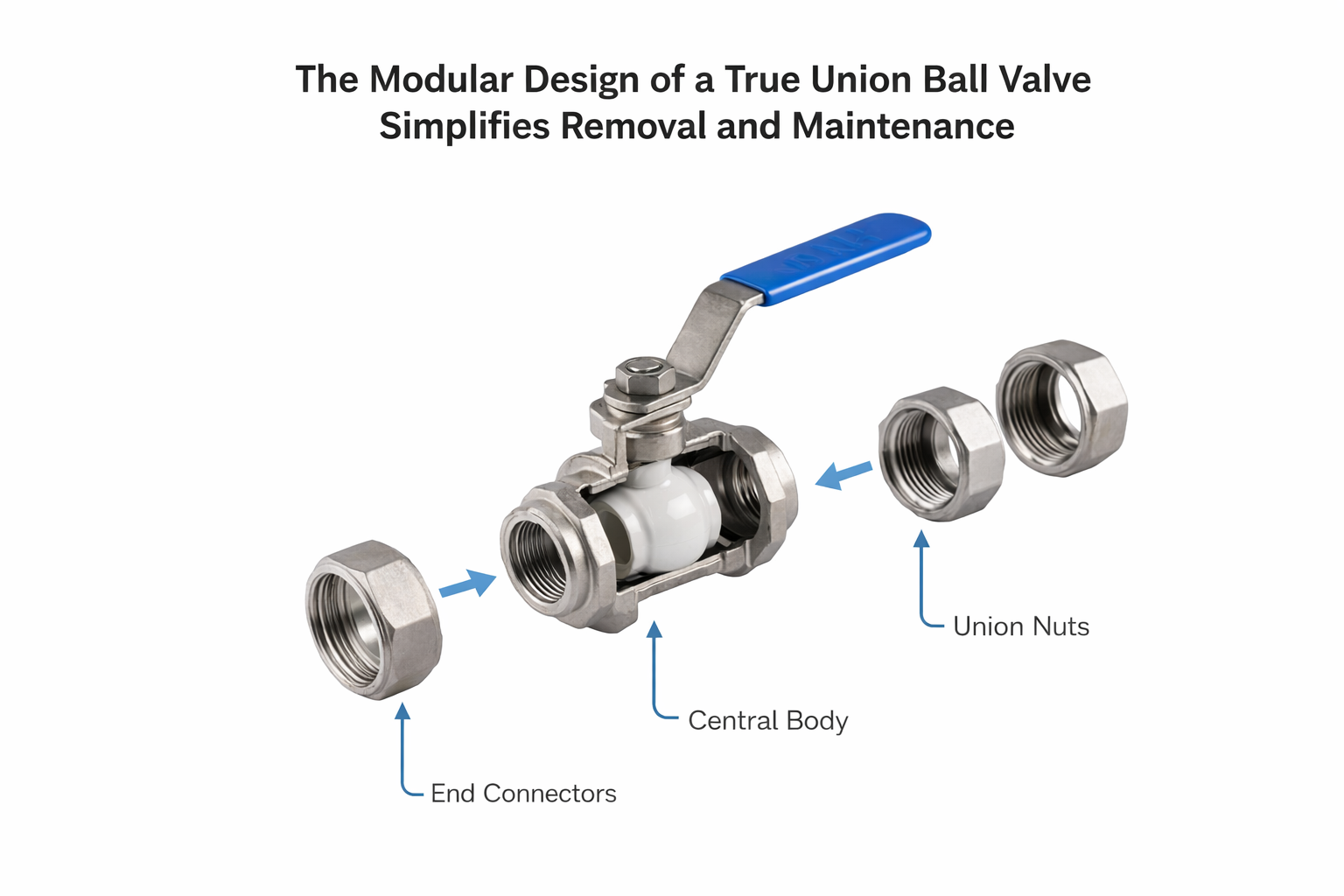
Сайт true union ball valve is designed for ultimate serviceability. It consists of three main components: a central valve body and two independent end connectors, each secured by a large, threaded union nut. These nuts draw the ends onto the central body, compressing an O-ring for a leak-tight seal.
- Benefits:
- Exceptional Serviceability: The central valve body can be completely removed from the pipeline by simply unscrewing the two union nuts, leaving the end connectors (and thus the connected pipes) undisturbed. This allows for quick replacement, cleaning (particularly important for clog-prone media), or repair.
- Reduced Downtime: Maintenance tasks are significantly faster, minimizing system shutdown periods.
- Cost-Effective Maintenance: Less labor, fewer materials, and reduced risk of damage during maintenance translate to substantial long-term savings. This directly ties into the benefits discussed in Why Your Plumbing System Needs Serviceable Valves: 3 Key Benefits.
- Гибкость системы: Allows for easy swapping of components or future system modifications.
- Соображения:
- Higher initial material cost than a standard ball valve.
- Slightly larger footprint due to the union nuts.
Head-to-Head Comparison: Key Differences
| Характеристика | Стандартный шаровой кран | True Union Ball Valve |
|---|---|---|
| Serviceability | Poor; requires cutting pipe | Excellent; valve body easily removable |
| Installation (Initial) | Relatively straightforward | Slightly more involved (aligning 3 parts) but still easy |
| Cost (Upfront) | Нижний | Выше |
| Maintenance Cost | High (labor, materials, downtime) | Low (quick, minimal materials, little downtime) |
| Space Requirement | More compact | Slightly larger due to nuts |
Making the Right Choice: When to Use Each
When to Choose a Standard Ball Valve
Standard ball valves are often suitable for applications where:
- Initial budget is the primary concern and long-term maintenance costs are less prioritized.
- The valve is expected to be a permanent fixture that rarely, if ever, needs replacement or internal servicing.
- It’s for a non-critical line where extensive downtime for repair wouldn’t cause significant issues.
- Space is extremely limited, and the slightly larger footprint of a union connection is prohibitive.
- The media is clean, non-corrosive, and valve failure is highly improbable. Example: a basic residential outdoor spigot.
When to Choose a True Union Ball Valve
True union ball valves justify their slightly higher upfront cost in situations where serviceability, flexibility, and reduced downtime are paramount. These include:
- Критически важные приложения where downtime is extremely costly (e.g., industrial processes, medical facilities).
- Connections to expensive equipment like pumps, filters, heaters, softeners, or manifolds, where these components might need to be removed for maintenance or replacement.
- Applications involving corrosive or dirty media that might necessitate frequent internal cleaning or seal replacement.
- Systems requiring future flexibility or upgrades.
- Areas where access for traditional pipe cutting and re-joining is awkward or limited.
- Any main shut-off point in a system, either residential or commercial, for ease of ongoing access.
For more specific use cases, explore our guide: Top 5 Applications for a Ball Valve with Union.
A Note on Ball Valves with Single Unions
There’s also a middle-ground option: ball valves with a union on only one side. While this offers more serviceability than a fully hard-piped standard valve (allowing the valve to be detached from one side), it doesn’t provide the complete and easy removal of the central body that a true union offers. These can be a cost-effective compromise when only one end needs to be easily disassembled.
Conclusion: Prioritize Your Project’s Needs
The choice between a true union and a standard ball valve ultimately comes down to a careful assessment of your specific application’s requirements, long-term maintenance strategy, and budget. While standard ball valves offer a lower initial cost, true union ball valves consistently deliver superior long-term value through unparalleled serviceability, reduced downtime, and lower maintenance expenses.
At BCST Valve, we offer a wide range of both standard and true union ball valves in various materials and connection types to suit your precise needs. Consult with our experts to ensure you select the valve that provides optimal performance and longevity for your system.
Ready to select the perfect ball valve for your project?


 English
 Arabic
 Russian
 French
 Spanish