
Stiff or Leaking Ball Valve? When Grease is the Right Solution
A ball valve that’s hard to operate or—worse—is passing fluid can quickly escalate from an annoyance to a major operational setback. Before resorting to a costly and time-consuming valve replacement, many maintenance teams consider injecting grease. But is this always the right approach? The key often lies in understanding the precise problem and applying the correct greasy solution.
This guide delves into the specific scenarios where ball valve grease (either a lubricant or a sealant) can effectively resolve issues of stiffness or leaking. It builds upon the foundational knowledge from “The Essential Guide to Ball Valve Grease: Lubrication vs. Sealing,” helping you diagnose problems and implement effective first-response actions.
For maintenance technicians and plant operators, knowing when and how to appropriately use these injectables can significantly increase operational efficiency, extend valve life, and potentially avoid unplanned downtime.
Understanding the Problem: Why Ball Valves Get Stiff or Leak
Before applying a solution, it’s crucial to identify the root cause of a valve’s malfunction:
- Stiffness / High Operating Torque:
- Lack of Lubrication: Friction between the ball and seats, or the stem and packing, can naturally increase over time, making the valve difficult to turn.
- Debris Accumulation: Foreign particles or process media build-up can create physical resistance.
- Seat Wear/Damage: Deformed or damaged seats can bind the ball.
- Leakage:
- Seat Leaks (Internal Passing): Erosion, scoring, chemical attack, or minor physical damage to the valve seats can create pathways for fluid to pass when the valve is closed.
- Stem Packing Leaks (External Leakage): Degraded, hardened, or improperly compressed stem packing allows process fluid to escape to the atmosphere.
- Body Leaks: Less common, but usually indicative of casting flaws or severe corrosion that grease cannot fix.
When Lubricants are the Solution for a Stiff Ball Valve
If your ball valve is becoming progressively harder to turn, but still operates without significant grinding or obvious damage, the problem is often increased friction. This is where a high-quality valve lubricant shines.
Case 1: Insufficient Lubrication / Increased Friction
- The Problem: The natural lubricant between the ball and seats (e.g., PTFE or other soft seating materials) has degraded, worn away, or simply needs a boost. This can also apply to stem packing lubrication.
- The Solution: Injecting a suitable valve lubricant. This compound will create a fresh, low-friction film between the moving parts, restoring smooth operation and significantly reducing the operating torque required. This is an ideal application for proactive maintenance or the first step in reactive maintenance.
- Key Benefit: Reduces wear on internal components and extends the life of actuators.
Case 2: Minor Debris or Scouring Interfering with Movement
- The Problem: Small amounts of particulate matter or minor scouring on the ball or seat surfaces can create resistance during valve cycling.
- The Solution: While lubricants are primarily for friction reduction, some advanced compounds can also help to carry away or encapsulate minor debris and fill microscopic scratches, smoothing the ball’s path. This can temporarily alleviate stiffness caused by subtle surface imperfections.
- Важное замечание: This is for minor issues only. Heavy build-up or large debris requires mechanical cleaning or repair, not lubrication.
When Sealants are the Solution for a Leaking Ball Valve
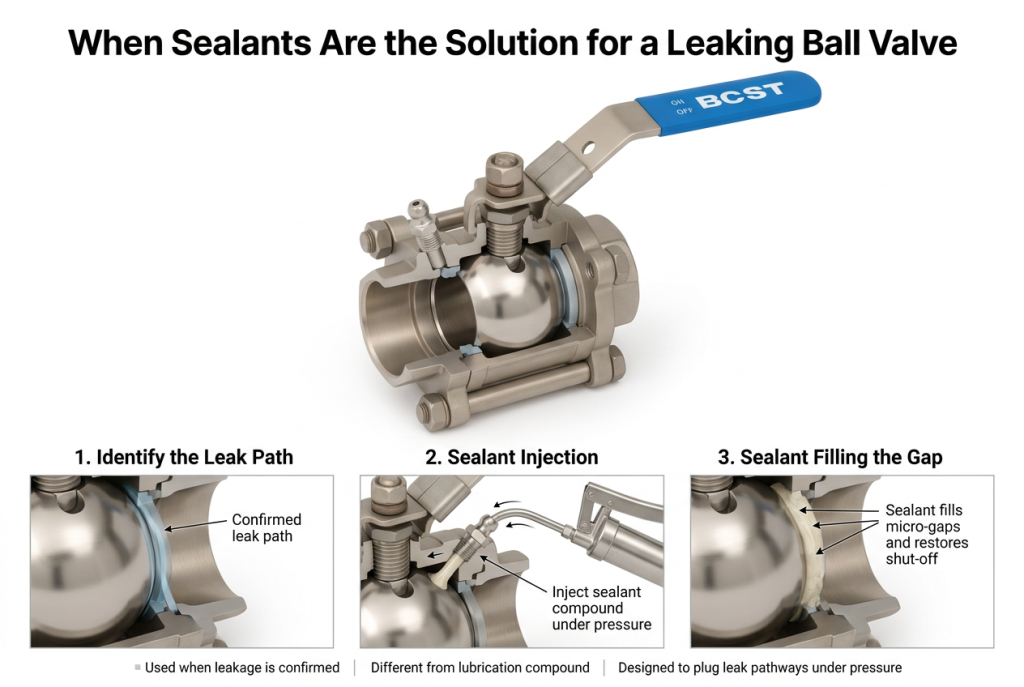
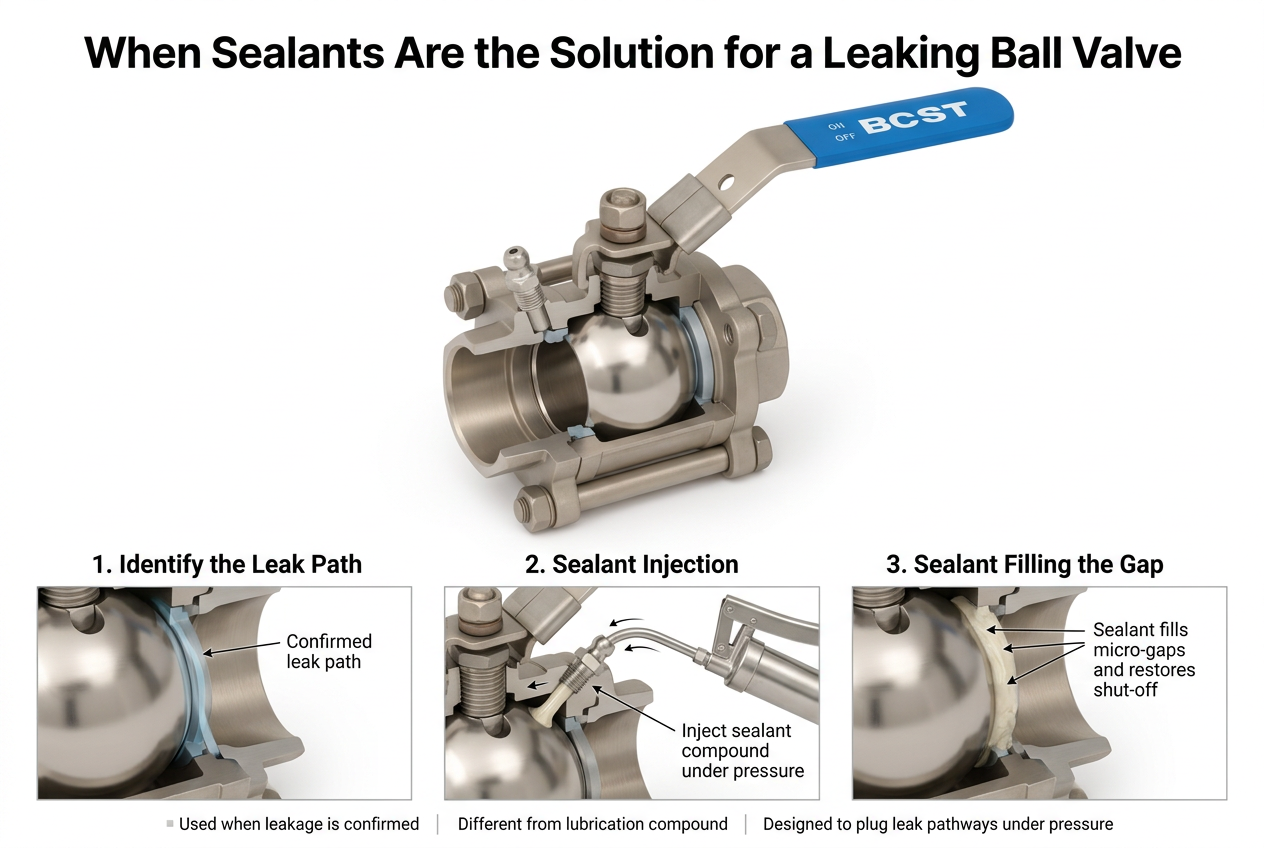
When a valve is confirmed to be leaking (either internally or externally), the focus shifts from lubrication to sealing. This often requires a different type of injectable compound—a sealant—designed to plug leak pathways.
Case 1: Minor Seat Leaks (Internal Passing)
- The Problem: The valve is closed but allowing process fluid to pass through, indicating minor imperfections, scratches, or wear on the seating surfaces.
- The Solution: Injecting a specialized valve sealant. These compounds typically contain fibrous or particulate fillers suspended in a viscous base. When injected, the sealant is forced into the leak path, congealing and physically blocking the flow.
- Key Benefit: Provides an emergency or temporary repair, allowing the system to remain operational until a planned shutdown for full maintenance or replacement.
Case 2: Minor Stem Packing Leaks (External Leakage)
- The Problem: Process fluid is visibly escaping around the valve stem, indicating deteriorated or insufficient stem packing.
- The Solution: Many ball valves designed for maintenance include a port to inject stem packing sealant. This material, often a pliable, fibrous compound, supplements or replaces the existing packing, stopping the external leak.
- Важное замечание: This is a powerful, but often temporary, measure to contain external leaks from packing. It provides a crucial bridge to a planned outage rather than an end-all fix.
When Grease is NOT the Solution: Recognizing Limitations
While grease is a powerful tool, it’s not a miracle cure for all valve problems. Misapplication or over-reliance can lead to further damage or safety risks.
Major Damage / Wear Beyond Repair
- Severe Scoring: If the ball or seats are heavily scored, galled, or extensively eroded, grease/sealant cannot rebuild the material.
- Broken Components: Internal springs, seals, or mechanical parts that are broken cannot be fixed with an injectable.
- Structural Cracks: Body cracks or severely corroded sections require valve replacement, not sealing.
Chemical Incompatibility
- Using a grease or sealant that is not compatible with the process media can lead to rapid degradation of the compound itself. This can result in contaminant issues, further leakage, or even accelerated corrosion of valve components.
Excessive Debris or Hardened Build-up
- Grease cannot dissolve or flush out large quantities of hardened scale, rust, or sticky process build-up that is causing stiffness or preventing proper closure. Attempting to force movement or seal in such cases can damage the valve.
Over-Pressurization Risks
- Injecting too much grease/sealant, or injecting into a completely blocked pathway, can dangerously over-pressurize the valve’s internal cavity. This can lead to seat damage, body deformation, or even catastrophic failure, posing severe safety risks.
Заключение
A ball valve that’s stiff or leaking is a clear indicator of a problem. Ball valve grease, whether it’s a lubricant for smooth operation or a sealant for leak repair, offers specific and highly effective solutions, but only when applied correctly and to the appropriate issues.
Understanding these distinctions enables maintenance professionals to make informed decisions, ensuring they don’t exacerbate problems or delay necessary repairs. Proactive lubrication, as part of a structured maintenance program, is always preferable to reactive intervention. Learn more about developing a proactive ball valve lubrication program for long-term reliability.
Struggling with valve performance? Let our experts help.


 English
 Arabic
 Russian
 French
 Spanish