
Understanding fluid properties is essential in many industrial systems. Whether engineers are designing pipelines, selecting valves, or calculating gas flow rates, specific gravity (SG) is one of the most commonly used parameters. Although the concept is simple, it plays a major role in many engineering calculations.
This article explains what specific gravity is, how it is calculated, and why it is widely used in industrial engineering.
Introduction to Specific Gravity
Specific gravity, often abbreviated as SG, is a basic property used to compare the density of different substances. It is also commonly called relative density.
Instead of measuring density directly, engineers often compare the density of a substance with a reference material. This comparison makes calculations easier and allows different fluids to be evaluated quickly.
In industrial applications, specific gravity is frequently used in:
- Fluid mechanics calculations
- Gas flow measurement
- Valve sizing and system design
- Process engineering and chemical industries
Because it is a dimensionless value, specific gravity allows engineers to compare materials without worrying about different measurement units.
Definition of Specific Gravity
Specific gravity is defined as the ratio of the density of a substance to the density of a reference substance.
The reference material depends on the type of substance being measured:
- Вода is normally used for liquids and solids
- Воздух is commonly used for gases
The basic formula is:
SG = ρsubstance / ρH2O
Where:
- ρsubstance = density of the material
- ρreference = density of the reference substance
For liquids, the reference density is typically the density of water at 4°C, which is approximately 1000 kg/m³.
This simple ratio removes units and produces a number that shows whether a material is heavier or lighter than the reference.
Specific Gravity of Gases
When dealing with gases, specific gravity is defined differently. Instead of comparing the gas with water, it is compared with air.
The specific gravity of a gas is the ratio of the gas density to the density of air under the same conditions.
Typical standard conditions include:
- Температура: 60°F
- Давление: 14.696 psia
Using the ideal gas law, engineers can show that the ratio of densities is equal to the ratio of molecular weights. Therefore, gas specific gravity can also be calculated using:
SG = M_gas / M_air
Where:
- MWgas = molecular weight of the gas
- MWair = molecular weight of air (≈ 28.967)
This relationship simplifies many engineering calculations, especially in gas flow and pipeline design.
Specific Gravity vs Relative Density (SI Terminology)
Traditionally, the term specific gravity has been widely used in engineering and industrial practice.
However, in the International System of Units (SI), the preferred term is relative density.
Both terms describe the same concept: the ratio of the density of a substance to the density of a reference material.
Despite the SI terminology change, the term specific gravity is still commonly used in many industries such as:
- Oil and gas
- Химическая обработка
- Water treatment
- HVAC and energy systems
Difference Between Density and Specific Gravity
Although density and specific gravity are closely related, they are not the same.
Плотность
Density measures the mass per unit volume of a substance. It always has units.
Common density units include:
- kg/m³ (kilograms per cubic meter)
- lb/ft³ (pounds per cubic foot)
Specific Gravity
Specific gravity is simply the ratio of two densities. Because it is a ratio, it has no units.
For example:
- A liquid with SG = 0.8 is lighter than water
- A liquid with SG = 1.2 is heavier than water
This makes specific gravity a convenient way to compare fluids.
What is Difference Between Liquid, Vapor, and Gas?
Density of Water
Water is the most commonly used reference substance for specific gravity calculations.
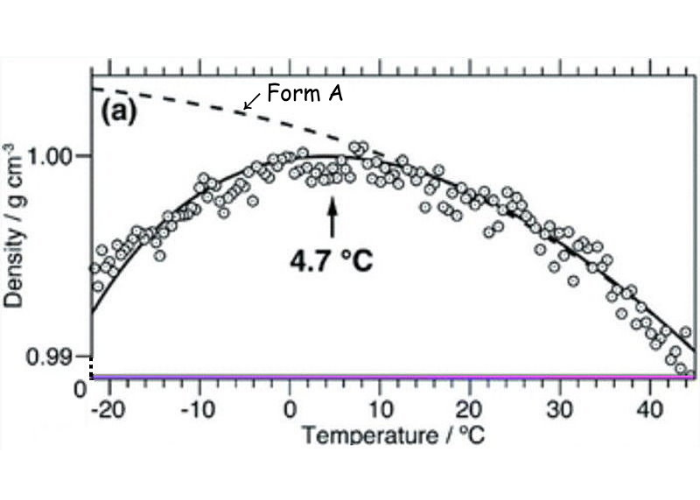
The density of water changes slightly with temperature and pressure. Under typical conditions:
- На сайте 4°C, density ≈ 1000 kg/m³
- На сайте 20°C, density ≈ 998 kg/m³
- In imperial units, density ≈ 62.4 lb/ft³
Because water has a stable and well-known density, it serves as an ideal reference material in engineering calculations.
Temperature changes can affect density. As water becomes warmer, it expands slightly and its density decreases.
Specific Gravity of Steam
Steam behaves very differently from liquid water.
When water turns into steam, it expands greatly and its density drops significantly. Because of this large difference, the specific gravity of steam relative to water is much less than 1.
The exact value depends on temperature and pressure conditions. In industrial systems such as boilers or power plants, engineers must account for these variations when designing equipment.
Understanding the properties of steam is especially important in:
- Производство электроэнергии
- Heat transfer systems
- Industrial boilers
- Process heating
Relationship Between Density and Specific Gravity
The mathematical relationship between density and specific gravity is straightforward.
Specific Gravity (Sp. Gravity) = (Density of Substance) / (Density of Reference Substance)
This relationship means that if the density of a substance is known, its specific gravity can easily be calculated.
For example, suppose a gas has a density of 0.8 kg/m³, and air under the same conditions has a density of 1.2 kg/m³.
SG = 0.8 / 1.2 = 0.67
This indicates that the gas is lighter than air.
Specific Gravity of Natural Gas and Hot Water
Natural Gas
Natural gas typically has a specific gravity between 0.6 and 0.7 when compared with air.
The exact value depends on the gas composition. Natural gas contains different hydrocarbons such as methane, ethane, and propane, which affect its density.
Gas specific gravity is widely used in:
- Pipeline design
- Flow measurement
- Gas meter calibration
- Valve sizing
Hot Water
Hot water has a slightly lower density than cold water because heating causes thermal expansion.
As a result, the specific gravity of hot water is slightly less than 1 when compared to water at room temperature.
Density Units and Measurement Systems
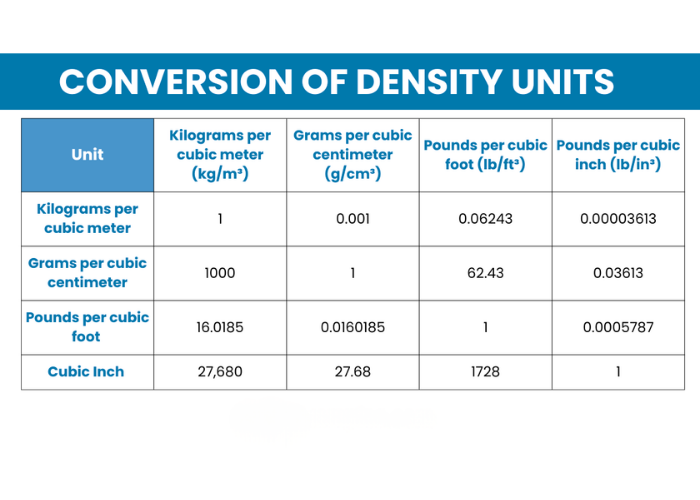
Density can be expressed in several units depending on the measurement system.
Common units include:
- kg/m³ – standard SI unit
- lb/ft³ (pcf) – common in imperial systems
In international engineering projects, converting between units is often necessary. Accurate unit conversion is important to avoid calculation errors in design and process control.
Understanding Specific Gravity Values
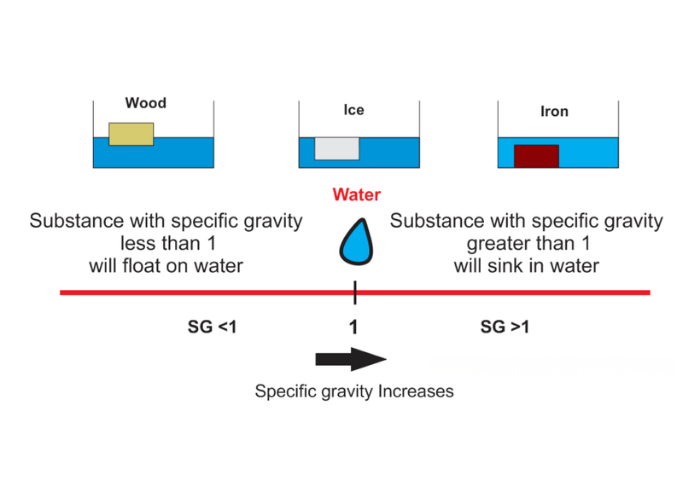
Specific gravity values help engineers quickly understand how a substance compares with the reference material.
Typical interpretations include:
- SG = 1 → same density as the reference
- SG > 1 → heavier than the reference
- SG < 1 → lighter than the reference
For example:
- Mercury has an SG of about 13.6, meaning it is much heavier than water
- Gasoline has an SG around 0.7, meaning it is lighter than water
These values help engineers predict how fluids behave in pipelines, tanks, and separation processes.
How to Calculate Specific Gravity
Calculating specific gravity is simple and involves only a few steps.
Step 1: Obtain the density of the substance.
Step 2: Determine the density of the reference material.
Step 3: Divide the substance density by the reference density.
SG = ρ₁ / ρ₂
In modern engineering practice, many engineers use specific gravity calculators or software tools to perform these calculations quickly and accurately.
Заключение
Specific gravity is a simple but powerful concept used throughout engineering and industrial design. By comparing the density of a substance to a reference material, engineers can quickly understand fluid behavior without complex calculations.
Although density provides absolute values, specific gravity offers a convenient relative measure that is widely used in practice.
From gas pipeline design на клапан sizing and flow analysis, specific gravity plays an important role in many industrial systems. Understanding how it works helps engineers design safer, more efficient, and more reliable processes.


 English
 Arabic
 Russian
 French
 Spanish