
Why Your “General Service” Butterfly Valve Only Lasted 3 Weeks in a Slurry Line.
Your slurry line just chewed through another “general service” butterfly valve, causing an emergency shutdown and massive re-work. You are facing immense costs from downtime because a cheap valve failed in a service it was never designed for. Experimental and numerical investigations on slurry machines show that as flow rate increases, wear on pressure-side surfaces worsens, implying that higher-throughput slurry lines will statistically see more frequent valve repair or replacement unless designs and materials are upgraded.
General service butterfly valves fail quickly in slurry lines due to their resilient elastomer seats and centric disc designs. These are highly susceptible to abrasion and erosion from solid particles in slurry. They cannot maintain a seal, leading to leakage, premature wear, and rapid slurry valve failure in abrasive applications.

The initial savings from a cheap valve vanish quickly when you face extensive downtime and replacement costs. Understanding this mismatch is crucial for Purchasing Managers and Maintenance Planners. As Emily, I have witnessed this exact scenario leading to costly operational headaches. Hassan, our Chief Engineer, always emphasizes, “For slurry service, you are not just buying a valve; you are investing in abrasion resistance. Understanding why your current valve failed is the critical first step. The second is learning exactly how to choose the right valve for abrasive slurry applications to ensure it never happens again.”
Why Do Standard Butterfly Valves Fail So Quickly in Abrasive Slurry Lines?
You installed a seemingly cost-effective valve in your slurry line, expecting reasonable performance. Instead, it failed in weeks. Why does this type of slurry valve failure happen so rapidly when standard butterfly valves encounter abrasive media?
Standard butterfly valves fail quickly in abrasive slurry lines because their soft elastomer seats and exposed disc edges are easily eroded and abraded by solid particles. The centric disc design causes the disc to rub against the seat during operation. This quickly damages the seal, leading to leakage, loss of shutoff, and catastrophic valve degradation under abrasive conditions.

The Incompatibility of Design with Abrasive Environments
When we ask, “Why do standard butterfly valves fail so quickly in abrasive slurry lines?” the answer lies primarily in their fundamental design limitations when exposed to punishing media. Emily has seen countless instances where the wrong valve type choice created a continuous loop of costly replacements and repeated slurry valve failure. Hassan often explains, “It’s not that the standard butterfly valve is a bad design; it’s simply designed for a different job. You would not use a bicycle for hauling rocks.”
The core reasons for rapid valve degradation are:
- Resilient Seat Material: Most standard butterfly valves rely on elastomer seats (e.g., EPDM, Nitrile, Viton) for bubble-tight shutoff. These soft materials are excellent for sealing gases and clean liquids. However, solid particles in slurry act like miniature grinding wheels against these elastomer seats. Every time the valve closes, these particles become trapped between the disc and the seat, leading to cutting, gouging, and erosion of the sealing surface. The integrity of the seal is quickly compromised, resulting in external leakage or internal bypass. Over time, the elastomer can even tear away completely.
- Centric Disc Design and Rubbing Action: In a standard butterfly valve, the disc rotates centrally within the valve body. As the disc opens and closes, its edge scrapes or rubs directly against the resilient seat. This frictional contact is already a point of wear in clean services. In slurry applications, this rubbing action, combined with abrasive particles, rapidly accelerates seat wear. The particles embedded in the elastomer or carried by the fluid between the disc and seat act as an abrasive compound. This destroys the sealing integrity within a very short service life, marking a classic case of slurry valve failure.
- Exposure of Metal Components: While the main sealing issue is with the seat, slurry also affects the valve disc and stem. For standard butterfly valves, the disc material is often chosen for general corrosion resistance (e.g., ductile iron, stainless steel). However, prolonged abrasion from high-velocity slurry can erode the disc edge and even the flow path through the valve body. If the slurry is also corrosive, this abrasion exposes fresh metal surfaces to chemical attack, accelerating material degradation. This combined attack (synergistic abrasion-corrosion) is particularly destructive.
- Accumulation of Solids: Slurry can also build up in crevices around the disc and stem bushings. This solid accumulation can hinder disc movement, increase operating torque, and lead to stem binding or damage to the stem packing. All these factors contribute to premature slurry valve failure and increased maintenance demands.
In contrast, high performance butterfly valves (HPBVs) are designed to mitigate these issues. They have offset disc designs that lift the disc away from the seat, minimizing rubbing. Triple offset butterfly valves (TOVs) are especially adept at frictionless sealing. Crucially, many HPBVs use metal seats that can be hard-faced with materials like Stellite or tungsten carbide, or they use ceramic-lined components. This provides far greater abrasion resistance for slurry service. Therefore, high performance butterfly valve vs butterfly valve is a critical distinction for preventing slurry valve failure in abrasive applications.
| Standard Butterfly Valve Feature | Impact in Abrasive Slurry | Consequence for Your Plant |
|---|---|---|
| Soft Elastomer Seat | Particles embed, cut, and erode. | Rapid leakage, loss of shutoff, valve replacement. |
| Centric Disc Rubbing | Accelerated wear on disc and seat. | High frictional damage, increased torque, seal failure. |
| Exposed Disc Edge | Erosion by high-velocity particles. | Compromised disc integrity, ineffective flow control. |
| Standard Stem Packing | Slurry ingress, stem abrasion. | Packing leakage, stem damage, actuator issues. |
| General Service Design | Not built for particulate handling. | Extremely short service life, constant slurry valve failure. |
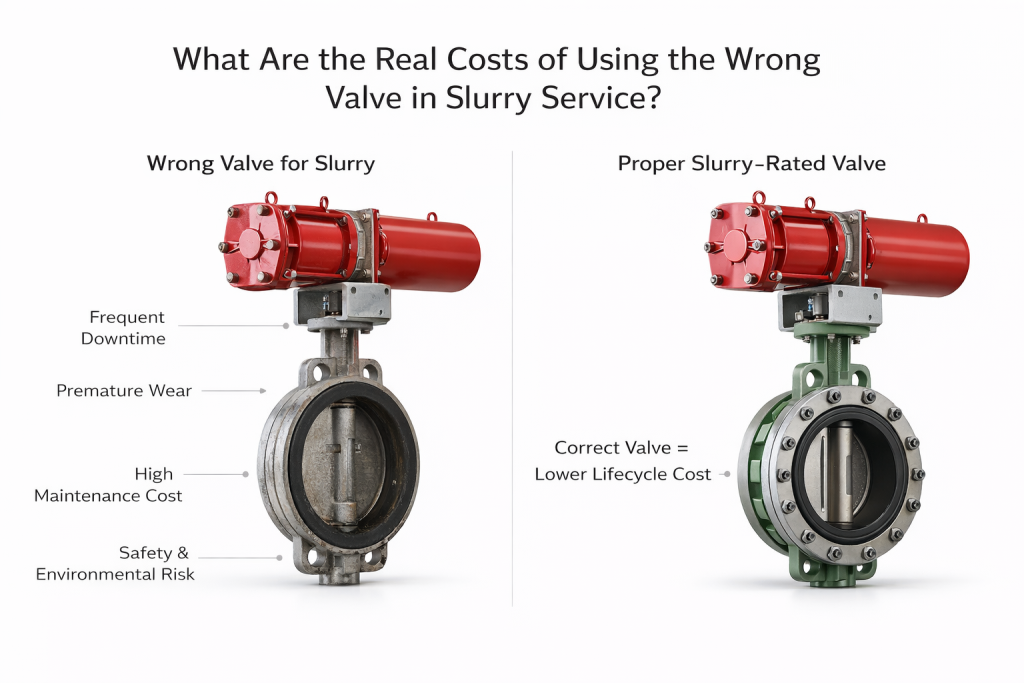
What Are the Real Costs of Using the Wrong Valve in Slurry Service?
You are constantly replacing “cheap” valves in your slurry lines, justifying the initial low price. But are you truly seeing the bigger picture? What are the hidden, long-term financial and operational costs when you misapply valves in abrasive service? You need to deeply understand the true economic impact of frequent slurry valve failure.
Using the wrong valve type in slurry service leads to immense hidden costs. These include excessive downtime (lost production revenue), frequent replacement costs (more valve purchases, increased inventory), high labor costs for emergency maintenance, safety risks from leakage, and potential environmental compliance issues. The initial savings quickly turn into substantial financial drains and operational inefficiencies.
The Financial Drain Beyond the Initial Purchase Price
When considering “what are the real costs of using the wrong valve in slurry service?”, Purchasing Managers and Maintenance Planners need to look beyond the initial purchase price. Emily has seen firsthand how a short-sighted “cost-saving” decision can lead to exponential expenses down the line. Hassan, with his experience in plant operations, frequently reminds teams that lifecycle costing is the only accurate way to evaluate valve investments. A low-cost standard butterfly valve that leads to a slurry valve failure in three weeks is infinitely more expensive than a premium high performance butterfly valve that lasts multiple years.
Here is a breakdown of the comprehensive costs:
- Lost Production Revenue (Downtime): This is often the largest hidden cost. Every hour your slurry line is down for valve replacement or repair directly equates to lost production. For high-volume operations, even a single day of downtime can mean substantial lost revenue. These are sales you simply cannot recover. This is a primary concern for Plant Owners.
- Frequent Replacement and Inventory Costs: If valves fail every few weeks, you need to purchase replacement valves constantly. This leads to significantly higher annual procurement budgets for valves. You also need to maintain a larger spare parts inventory for standard butterfly valves, tying up capital. The true cost of replacement high performance butterfly valves (or standard ones) isn’t just the sticker price, but the total number bought over time to combat constant slurry valve failure.
- Excessive Labor Costs:
- Emergency Maintenance: Valve failures rarely happen at convenient times. Emergency repairs often involve overtime pay for maintenance crews.
- Diagnostic and Repair Labor: Your skilled technicians are constantly diverted from preventative maintenance or critical upgrade projects to deal with repeat slurry valve failure. This impacts overall plant efficiency and labor allocation.
- Cleanup Labor: Slurry leaks and spills require substantial cleanup efforts, adding more manpower costs.
- Secondary Equipment Damage: A failed valve can also lead to downstream equipment damage. For example, if a valve fails to seal, slurry might bypass a filter or separator, causing abrasive damage to pumps, heat exchangers, or other sensitive equipment. The cost to repair or replace these larger components dwarfs the valve cost.
- Safety and Environmental Risks: Leaking slurry can pose safety hazards (slipping, chemical exposure) to your personnel. If the slurry contains hazardous chemicals, a spill can lead to environmental contamination, regulatory fines, and remediation costs. Emily has heard stories of plants paying massive environmental penalties because minor component failures escalated into a major slurry valve failure.
- Reduced System Performance and Control: A leaking valve means poor flow control and inefficient process operation. This can affect product quality, yields, and energy consumption. Your processes will not run at optimal efficiency with compromised fluid control.
For Purchasing Managers, this means pushing for lifecycle cost analysis over just initial price. For Maintenance Planners, it means advocating for durable, application-specific valves to reduce your workload and improve plant uptime. The modest price difference for a high performance butterfly valve (e.g., stainless steel high performance butterfly valves) is a strategic investment that pays dividends through years of reliable service and a drastic reduction in slurry valve failure.
| Cost Category | How Misapplication Impacts It | Estimated Financial Impact (Illustrative) | Strategy for Mitigation |
|---|---|---|---|
| Lost Production | Unplanned downtime for repair/replacement. | Significant revenue loss per incident | Invest in HPBVs for extended uptime. |
| Valve Replacements | Buying multiple cheap valves annually. | Substantial annual procurement costs | Purchase durable, application-specific valves. |
| Labor Costs | Overtime, re-deployment for emergency repairs. | High emergency repair expenses | Reduce emergency calls with reliable equipment. |
| Secondary Damage | Erosion of pumps, pipes, filters. | Major component replacement costs | Correct valve selection safeguards downstream assets. |
| Safety/Environmental Fines | Leaks, spills leading to hazards or fines. | Substantial penalty and remediation costs | Prevent process breaches with robust valves. |
| Production Inefficiency | Poor flow control, sub-optimal yields. | Reduced monthly output and efficiency | Ensure precise control and process stability. |
Заключение
Using general service butterfly valves in slurry lines leads to rapid slurry valve failure and immense downtime costs. Proactively choose triple offset butterfly valves with hard-faced metal seats or ceramic linings from specialized manufacturers like BCST Valve. This investment ensures long-term reliability and cost-effective fluid control in abrasive applications.
Stop Costly Slurry Valve Failures – Get the Right Solution:


 English
 Arabic
 Russian
 French
 Spanish