
Matching Embedments, Frame Dimensions, and Hoist Loads Without Major Civil Rework
As highlighted in the ASCE Infrastructure Report Card for Water/Wastewater, the scale of aging infrastructure makes replacing an aging sluice gate a frequent but complex challenge often feels like opening Pandora’s Box. The challenge isn’t just procuring a new gate, but dealing with the inevitable compatibility issues: a modern gate won’t fit the old opening, the existing embedments are off, or the hoist mechanism doesn’t align. These subtle incompatibilities quickly escalate into major civil rework, costing hundreds of thousands of dollars in unplanned excavation, concrete adjustments, and project delays. For crucial infrastructure, the cost of downtime makes this scenario unacceptable.
At BCST Valve, we understand that you’re not just buying a gate; you’re buying project continuity. This guide focuses on enabling a seamless sluice gate retrofit in an existing channel strategy. We specialize in providing custom-engineered solutions that precisely match existing embedments, custom sluice gate frame dimensions, and existing hoist loads. Our expertise ensures a true drop in sluice gate replacement without the need for extensive piping modification for valve replacement, safeguarding your budget and schedule.
Quick Answer: A sluice gate retrofit in an existing channel is best achieved by custom-engineering a new gate that precisely matches existing embedments and frame dimensions. This strategic approach by manufacturers like BCST Valve eliminates the need for costly major civil rework, ensuring a seamless, drop-in replacement.
1. Why Retrofits Fail at Dimensioning, Not at Procurement
Modern sluice gate designs often feature optimized dimensions that do not perfectly align with structures built decades ago. The challenge of a replace sluice gate without civil rework project lies in these precise dimensional discrepancies, even millimeters can wreak havoc.
The Hidden Costs of Dimensional Mismatch
- Frame-to-Wall Opening: A new gate frame that is too large or too small for the existing wall opening necessitates cutting concrete or building up the opening with new concrete.
- Embedment Compatibility: The anchor bolt patterns or methods of fastening a new gate frame to the channel wall must align with the existing infrastructure. Forcing a fit can compromise structural integrity.
- Sealing Surface Irregularities: Old concrete channels may have eroded or irregular invert (bottom) sealing surfaces, which a standard new gate’s bottom seal simply cannot accommodate. This can lead to persistent sluice gate leakage.
- Actuator & Stem Interface: The new gate’s stem connection may not be compatible with the existing hoist mechanism, or the hoist might not align with the new gate’s stem path.
Each of these points represents potential sluice gate civil rework expenses, extending timelines, increasing labor, and creating unexpected complications.
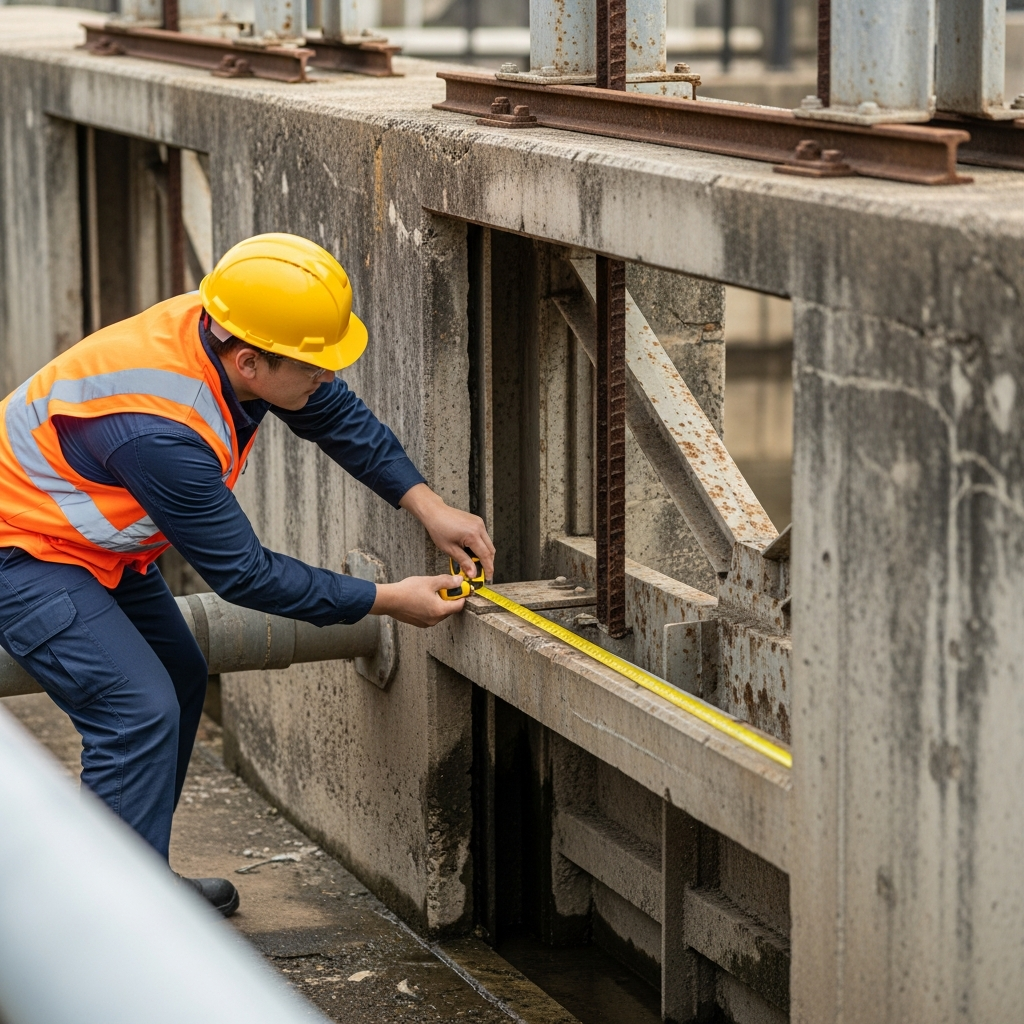
2. Existing Wall Opening, Embedment, and Sealing Surface Checks
A successful sluice gate replacement existing embedment project begins with a comprehensive site assessment and detailed dimensional verification.
Critical Measurements for Custom Sluice Gates
BCST Valve’s retrofit process prioritizes matching your existing infrastructure. Our engineering process ensures that every custom frame adheres to the AWWA C561 Standard for Fabricated Stainless Steel Slide Gates, ensuring long-term structural compliance.:
- Wall Opening Dimensions: Exact height, width, and squareness of the concrete opening.
- Existing Embedment Details: Type, size, spacing, and projection of existing anchor bolts or any embedded frame features. We need to know if we can utilize them or if new ones are required minimally.
- Sealing Surface Condition: Invert flatness, smoothness, and overall integrity of the concrete or existing sill material where the gate bottom seal will seat. This might reveal needs for a flush-bottom gate.
- Channel Depth & Width: Ensure the new gate is appropriately sized for the hydraulic conditions of the channel.
Without these precise measurements, any new gate risks becoming a custom sluice gate dimension nightmare that requires field modification, jeopardizing quality and increasing costs.
| Retrofit Element | BCST Custom Solution | Project Benefit |
|---|---|---|
| Existing Wall Dimensions | Fabrication to custom frame dimensions. | No concrete cuts, no infill, replace sluice gate without civil rework. |
| Embedment Patterns | Custom anchor bolt layouts, attachment methods. | Utilizes existing bolts, reduces drilling. |
| Sealing Invert | Custom sill design, rubber bottom seals, flush-bottom options. | Improved sealing performance, reduced leakage. |
| Hoist & Actuation | Stem extension, custom yoke, actuator mounting bracket. | Integrates with existing hoist structures. |
3. Stem Load / Hoist Load Review: Beyond Basic Lifting
When executing a sluice gate retrofit in an existing channel, it’s not enough to simply specify a gate that fits. The operational forces, including stem-to-gate connection and hoist compatibility, are paramount.
Ensuring Hoist Load Compatibility
The existing hoist mechanism (manual handwheel, electric motor, hydraulic cylinder) has a specific rated thrust capacity and travel length. A new sluice gate must:
- Match Stem Type & Size: Ensure the new gate’s stem diameter, material, and connection (e.g., rising vs. non-rising stem) are compatible or easily adaptable to the old hoist.
- Operate Within Hoist Capacity: The lifting and seating forces required by the new gate must fall within the existing hoist’s sluice gate hoist load capabilities. This involves calculating hydrostatic loads, friction forces from seals, and potential jamming loads from sediment.
- Actuator Mounting: If installing a new actuator, ensuring physical space and structural support for modern actuator mounting brackets is part of the sluice gate actuator retrofit.
4. Stainless Steel vs. Coated Carbon Steel for Retrofit Life-Cycle Decisions
The choice of material for your retrofit not only affects initial cost but also long-term maintenance and lifespan, especially when considering a replace sluice gate without civil rework that minimizes future interventions.
Optimizing for Longevity and Maintenance
- Stainless Steel (304/316): Offers superior corrosion resistance, minimal maintenance, and excellent longevity, making it a lower life-cycle cost option despite higher initial investment. Ideal for harsh or highly corrosive environments.
- Coated Carbon Steel: More economical upfront. Requires robust, multi-layer epoxy or polymer coatings (e.g., fusion-bonded epoxy) to prevent corrosion. Maintenance involves regular inspection and coating repair, adding to life-cycle costs.
- UHMWPE Guides & Seals: Regardless of frame material, specifying durable, low-friction materials like UHMWPE for guides and resilient rubber for seals enhances reliability and reduces operating torque.
FAQ on Sluice Gate Retrofitting
What information do I need to provide for a sluice gate retrofit quote?
To start, provide existing drawings (if available), photos of the installation, precise wall opening dimensions, details of existing embedments (anchor bolt locations), approximate operating head, and existing hoist type/stem connection details. The more information, the more accurate the custom design.
How long does a custom sluice gate retrofit take?
Fabrication time for custom sluice gates can vary from 6-12 weeks depending on complexity, materials, and current lead times. This is significantly faster and less disruptive than the months or even years required for extensive civil rework.
Can BCST Valve visit my site for measurements?
While we primarily work from client-provided measurements and drawings, for complex or particularly critical projects, our engineering team can discuss site visits to ensure absolute precision, especially in situations where existing documentation is limited.
Conclusion: Seamless Integration for Uninterrupted Water Management
The path to modernizing your water infrastructure does not have to be paved with costly major civil rework and debilitating project delays. A well-executed sluice gate retrofit in an existing channel is a strategic investment that preserves operational continuity while upgrading critical components. The key lies in partnering with a manufacturer who can precisely match existing embedments and custom sluice gate frame dimensions.
BCST Valve specializes in engineering custom sluice gate replacements for existing channels. Our commitment to precision ensures your new gate is a true drop in sluice gate replacement, integrating seamlessly with your current infrastructure, matching hoist loads, and minimizing site disruption. Send us your project details, and let us design a solution that works for your timeline and budget.
Need a Replacement Gate That Matches an Existing Opening or Embedment?
Send your old drawing, opening dimensions, and hoist details for a custom retrofit quote.


 English
 Arabic
 Russian
 French
 Spanish