
How Do Metal-Seated Valves in Middle East Refineries Survive High-Sulfur Crude and Sand?
Your standard metal-seated шаровой клапан fails prematurely in the separator outlet line. The high-sulfur crude is causing corrosion, and the entrained sand is eroding the ball and seats, causing the valve to leak.
The solution lies in a dual-pronged approach: selecting base materials compliant with NACE MR0175 to resist sour service corrosion and applying specialized hard-facing coatings (like Карбид вольфрама) to the ball and seats to withstand severe abrasion from sand.

First, How Do You Stop the Corrosive Attack from Sour Crude?
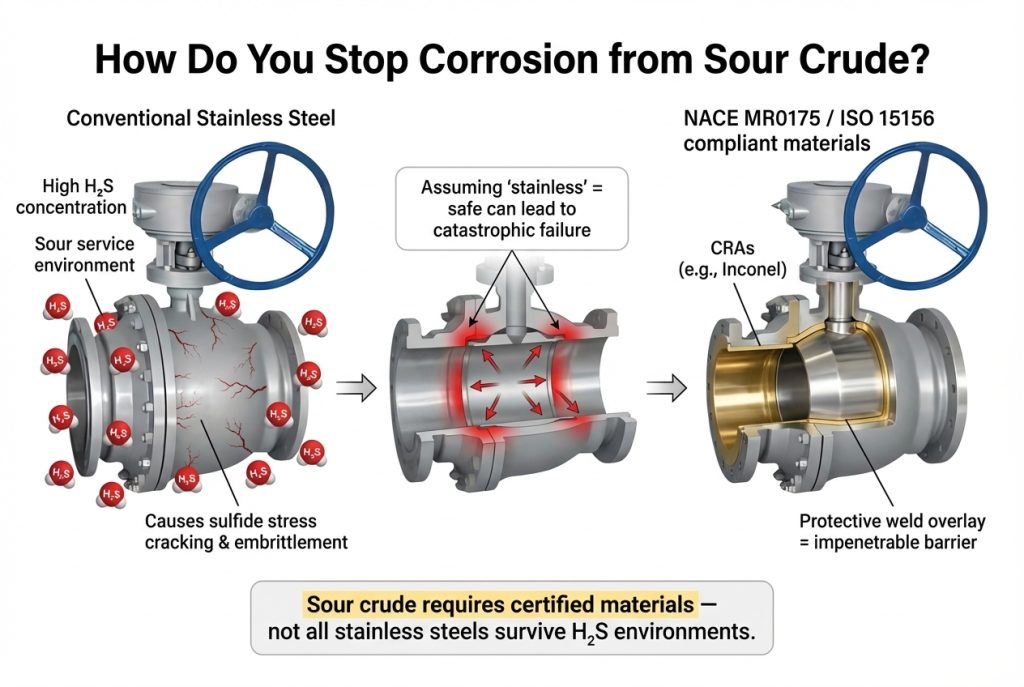
You see a valve is made of stainless steel and assume it’s corrosion-resistant. But the high concentration of hydrogen sulfide (H₂S) in many Middle Eastern crude oils creates a “sour service” environment that attacks conventional steels, making them brittle and causing catastrophic failure.
To combat this, you must select base materials that conform to the NACE MR0175 (ISO 15156) standard. This often involves using corrosion-resistant alloys (CRAs) like Inconel or applying a protective weld overlay cladding inside the valve body.
Dive Deeper: Material Selection Beyond the Data Sheet
The NACE MR0175 standard is your foundational guide. It defines acceptable materials and their required condition (e.g., hardness, heat treatment) to prevent Sulfide Stress Cracking (SSC), a form of brittle failure caused by H₂S.
- Protect the Body: For cost-effectiveness, a carbon steel body can be used, but all internal “wetted” surfaces must be protected by a weld overlay (typically 3mm thick) of a corrosion-resistant alloy (CRA) like Inconel 625.
- Select Resilient Internals: The ball, stems, and seats must be made from solid NACE-compliant materials. Choices include Duplex stainless steel or high-nickel alloys like Inconel 718 и Monel K500.
| Part | Standard Material | NACE Compliant Solution |
|---|---|---|
| Кузов/капот | Carbon Steel (A216 WCB) | Carbon Steel with Inconel 625 weld overlay |
| Шар | Stainless Steel (316) | Solid Duplex or Nickel Alloy (e.g., Inconel 718) |
| Стебель | Stainless Steel (17-4PH) | Monel K500 or Inconel 718 |
Second, How Do You Defeat Abrasive Sand Erosion?
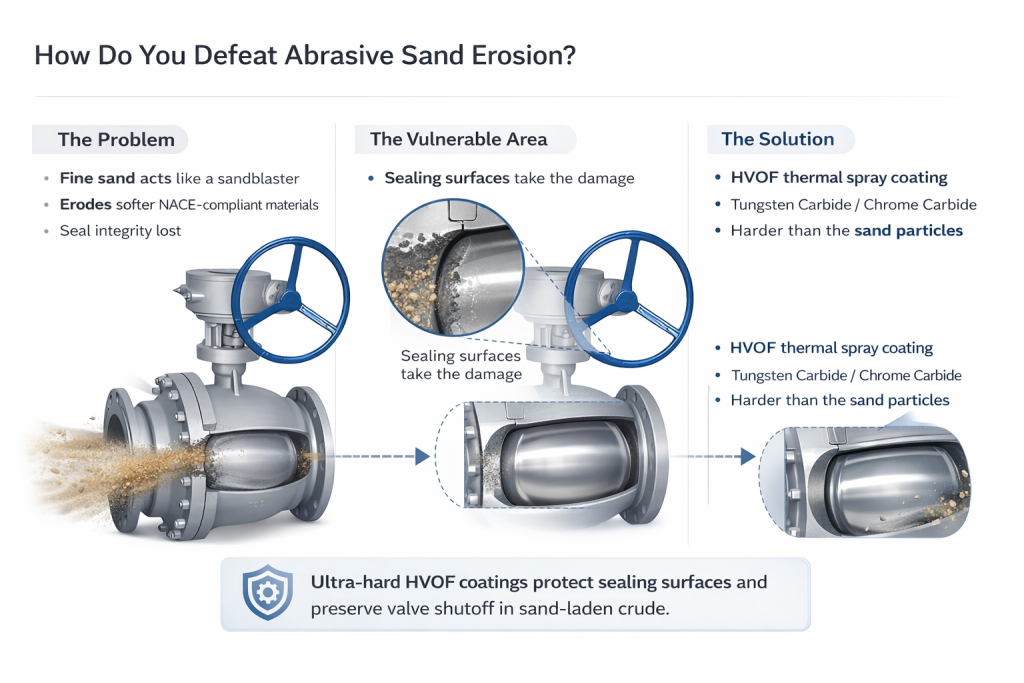
You’ve solved corrosion, but sand particles in the crude act like a sandblaster, eroding the softer NACE materials and destroying the seal. You must apply an ultra-hard coating to the ball and seat sealing surfaces. The best method is a High-Velocity Oxygen Fuel (HVOF) thermal spray of materials like Карбид вольфрама.
Dive Deeper: Why HVOF Coatings are Superior
The HVOF thermal spray process is not welding. It accelerates powdered coating material to supersonic speeds, creating a mechanically bonded layer that is extremely dense, hard, and has very high bond strength without damaging the base metal.
- Low Heat Input: The process doesn’t alter the metallurgy or hardness of the NACE-compliant base material.
- Extreme Hardness: HVOF Tungsten Carbide coatings can exceed 1300 HV, making them substantially harder than sand particles. The sand glances off rather than digging in.
| Coating Type | Преимущество | Disadvantage for this Service |
|---|---|---|
| Stellite 6 (Weld) | Good for general impact. | High heat can compromise NACE properties. |
| ENP | Good corrosion resistance. | Too soft; easily eroded by sand. |
| HVOF Tungsten Carbide | Superior hardness & erosion resistance. Low heat process. | Higher cost, but justified by reliability. |
Conclusion: The Winning Combination
Standard metal-seated valves are not enough for the dual threat of sour and abrasive service common in Middle East refineries. A successful specification requires a systems approach:
- Устойчивость к коррозии: NACE MR0175 compliant base materials (like Inconel) for all wetted components.
- Устойчивость к истиранию: HVOF-applied Tungsten Carbide coating on the critical ball and seat sealing surfaces.
This combination creates a specialized metal seated ball valve that ensures long-term, reliable performance in the toughest refinery applications.


 English
 Arabic
 Russian
 French
 Spanish