
As a common type of industrial valve, the шаровой клапан is used to control the opening and closing of the fluid. It has good sealing performance and durability and is widely used in petroleum, chemical, electric power, and other industries. To achieve automatic control and improve operating efficiency, the шаровой клапан is usually used in conjunction with an actuator.
The choice of actuator directly affects the performance and use of the шаровой клапан, so understanding how to choose the proper actuator is crucial to ensure the system’s safe, stable, and efficient operation.
1. Basic concepts of globe valves and actuators
Сайт шаровой клапан is a straight-through valve usually used to control fluid opening and closing. Its structural feature is that the valve stem drives the valve disc to move up and down, thereby adjusting the amount of fluid passing through. The globe valve has a good adjustment function and sealing performance and is suitable for occasions that require frequent opening and closing.
The actuator is a mechanical device that drives the valve to open and close. It converts the received control signal (such as a pneumatic, electric, or hydraulic signal) into mechanical motion to drive the valve.
2. Типы и характеристики приводов
According to the driving mode and usage scenario, actuators can be divided into the following categories:
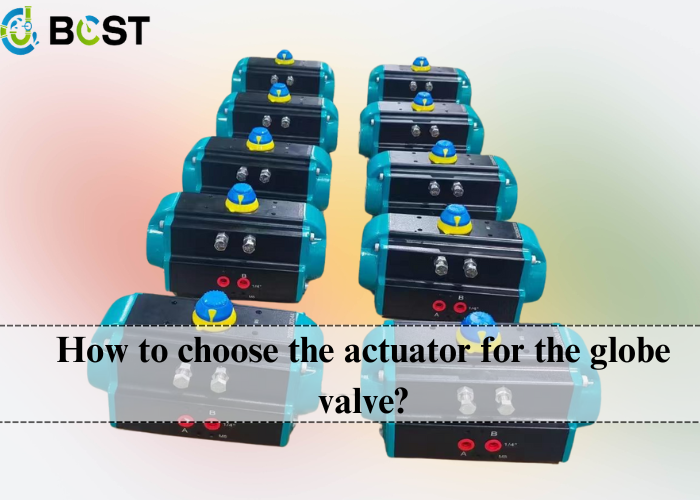
2.1 Пневматический привод

Pneumatic actuators are driven by compressed air and are widely used in industrial automation systems. Their working principle is to use compressed air to push the piston or diaphragm, generating linear or rotary motion, which drives the valve’s opening and closing or adjustment.
Преимущество:
Fast response speed, suitable for occasions with frequent opening and closing.
Simple structure, easy maintenance, and low cost.
It is suitable for inflammable and explosive occasions because it does not use electrical components and has explosion-proof properties.
Shortcoming:
A compressed air system is required, but its scope of use is limited.
The operating accuracy is relatively low and is suitable for occasions requiring low control accuracy requirements.
2.2 Электрический привод

The electric actuator drives the gear or screws through the motor to open, close, or adjust the valve. The electric actuator has high control accuracy and reliability and is widely used in occasions that require precise control.
Преимущество:
The control accuracy is high, making it suitable for precise adjustment of parameters such as fluid flow, pressure, and temperature.
It can be remotely controlled and monitored and is suitable for modern automation systems.
It is not dependent on a compressed air system and has many applications.
Shortcoming:
The reaction speed could be faster and more suitable for opening and closing.
The motor part may generate sparks and is unsuitable for flammable and explosive occasions.
2.3 Гидравлический привод
Hydraulic actuators drive pistons or gears through the pressure of hydraulic oil to provide greater thrust or torque. They are suitable for working conditions that require greater thrust and are often used to drive high-pressure, large-diameter valves.
Преимущество:
It can provide strong force and is suitable for large-diameter valves or high-pressure environments.
The operation is stable and suitable for long-term continuous working occasions.
Shortcoming:
It needs to be equipped with a hydraulic system that has high maintenance costs.
Hydraulic fluid may leak, posing a risk of environmental contamination.
2.4 Intelligent Actuator
The intelligent actuator integrates an electronic control system, can monitor the valve’s status in real-time, and has a self-diagnosis function. It has high control accuracy and is suitable for complex automation control systems.
Преимущество:
It has a self-diagnosis function, which can detect faults in time and give the alarm.
It can exchange data with the central control system and support remote control and management.
Shortcoming:
The cost is relatively high and suitable for high-end automation systems.
Requires complex programming and maintenance.
3. Principles for selecting globe valve actuators
When choosing the proper actuator for your globe valve, there are several key factors to consider:
3.1 Valve size and type
Different sizes and types of globe valves require different torque and stroke requirements for the actuator. For small-diameter valves, pneumatic or electric actuators can usually be selected, while for large-diameter, high-pressure globe valves, hydraulic actuators may be a better choice. The actuator must provide sufficient thrust or torque to drive the valve to work properly.
3.2 Working Environment
The selection of actuators needs to consider the characteristics of the working environment, such as temperature, humidity, corrosiveness, etc. In high- or low-temperature environments, actuators with high or low resistance are necessary. Pneumatic actuators are usually a better choice in inflammable and explosive environments because they do not generate electric sparks.
3.3 Control accuracy requirements
Electric or intelligent actuators may be better if the system has high control accuracy requirements for parameters such as fluid flow, pressure, or temperature. They can provide more precise operation and be used with automated control systems to achieve complex regulation tasks.
3.4 Рабочая частота
The operating frequency of the globe valve is another essential factor to consider when selecting an actuator. For systems that require frequent opening and closing, pneumatic actuators are usually the first choice because of their quick response and low cost. Electric or hydraulic actuators can provide higher stability and control accuracy for systems that do not require frequent operation.
3.5 Remote Control and Automation Requirements
Bright or electric actuators are the best choice if the system needs to be remotely controlled or automated. These actuators can interact with the automation control system to support remote operation and real-time monitoring.
4. Matching of actuator and globe valve
4.1 Matching of thrust and torque
The actuator’s thrust or torque must be large enough to ensure that the globe valve can be driven normally for opening and closing operations. The magnitude of the thrust or torque depends on the valve size, pressure level, sealing structure, and other parameters. When selecting an actuator, it is necessary to ensure that its rated thrust or torque value is greater than or equal to the globe valve’s opening and closing torque.
4.2 Itinerary Matching
The stroke of the globe valve refers to the moving distance of the valve stem, and the stroke of the actuator must match the stroke of the globe valve. If the stroke of the actuator is too large or too small, it will affect the globe valve’s regular operation and may even cause the valve to fail to open or close completely.
4.3 Control Signal Matching
The actuator’s control signal must match the system’s control requirements. Common control signals include a 4-20mA current signal, pneumatic signal, or digital signal. In an automation system, the actuator usually needs to communicate with the controller or PLC (Programmable Logic Controller), so it is necessary to ensure that the actuator’s communication protocol is compatible with the control system.
4.4 Matching of feedback signals
Many modern automation systems require real-time monitoring of the globe valve status, so the actuator needs to have a feedback function. For example, electric or intelligent actuators are usually equipped with position feedback devices, which can feed back information such as valve opening and operating status to the control system to ensure the system’s safe operation.
5. Application scenarios of globe valve actuators
5.1 Нефтегазовая промышленность
Globe valves are often used in the oil and gas industry to control the flow and pressure of oil and gas. Pneumatic actuators are widely used in oil and gas pipelines and refineries due to their fast opening and closing and explosion-proof performance. On some occasions, when precise control is required, electric actuators can provide higher control accuracy.
5.2 Химическая промышленность
The chemical industry’s process is complex and requires precise regulation of the fluid’s flow and pressure. Globe valves are usually equipped with electric or intelligent actuators to achieve automated control and remote operation, ensuring the stability and safety of the production process.
5.3 Power Industry
In thermal power and nuclear power plants, globe valves are mainly used to control the flow of steam and cooling water. Hydraulic actuators are often used in these high-pressure and high-temperature working conditions due to their high thrust and reliability. In some low-pressure situations, pneumatic actuators are the first choice due to their low cost and fast response.
5.4 Water treatment industry
In water treatment plants, globe valves control water flow and pressure and are usually equipped with pneumatic or electric actuators. The actuators can be used with automated control systems to achieve automated operation and precise control of the water treatment process.
6. Подведите итоги
The selection of actuators for globe valves needs to be determined according to specific working conditions, operating requirements, and environmental conditions. There are various types of actuators, each with different advantages and disadvantages.
Therefore, in practical applications, factors such as valve size, operating frequency, control accuracy and working environment must be considered comprehensively to select the most suitable actuator.
By reasonably selecting the actuator, the working efficiency and safety of the globe valve can be improved, thereby ensuring the stable operation of the entire system.


 English
 Arabic
 Russian
 French
 Spanish