

How Does a Ball Valve Work?
Что такое шаровой кран?
A шаровой клапан uses a rotating ball with a hole through it. When the hole aligns with the pipe, flow is open. When the ball is turned 90 degrees, the solid part blocks the flow, providing a quick and tight shut-off.

The genius of the ball valve mechanism is its simplicity. My father used to keep a cut-open ball valve on his desk. He’d tell me, “Emily, the best designs are the ones with the fewest moving parts. There is less that can go wrong.” That principle is why the ball valve has become one of the most trusted components in nearly every industry. It’s a design that is brilliantly effective because it is fundamentally simple. Let’s take a closer look at how that simple design translates into such reliable performance.
What is the basic mechanism of a ball valve?
You’re worried that a complex valve mechanism will break down or be slow to operate in an emergency. You need a valve that is both fast and mechanically simple to ensure reliability.
The ball valve how it works principle is based on a quick quarter-turn action. A lever rotates a solid ball with a hole (bore) through its center. When open, the bore allows straight-through flow. When closed, the solid wall of the ball stops it.
Dive Deeper: The Core Components in Action
The elegance of the ball valve comes from how three core components work together: the ball, the stem, and the seats. Understanding this interplay is the key to appreciating why this valve is so dominant for its intended purpose. It’s a mechanical harmony that provides both efficiency and a secure seal.
The Ball: The Heart of the Valve
The ball is what gives the valve its name and its function. It’s a precisely machined sphere with a hole, known as a bore or port, drilled through the center. The size of this port defines the valve’s flow characteristics.
- Full Port (Full Bore): The bore diameter is the same as the inside diameter of the pipe. This creates virtually no flow restriction, making it extremely efficient. It is the ideal choice when you need to minimize pressure drop.
- Standard Port (Reduced Bore): The bore is one pipe size smaller than the valve’s pipe size. This creates a slight flow restriction but makes the valve more compact and cost-effective.
- V-Port: Instead of a round hole, the ball has a V-shaped notch. This design is not for simple on/off service. It allows the flow to be controlled more precisely as the valve is opened, making it suitable for some throttling applications.
| Port Type | Ограничение потока | Primary Use | Стоимость |
|---|---|---|---|
| Full Port | Очень низкий | High-efficiency systems, low pressure drop | Выше |
| Standard Port | Low to Moderate | General on/off service, where some pressure drop is acceptable | Нижний |
| V-Port | Переменная | Throttling and flow control | Специализированный сайт |
The Stem: Connecting Action to Control
The stem is the shaft that connects the handle or actuator on the outside of the valve to the ball on the inside. When you turn the handle 90 degrees, the stem transfers that rotational force to the ball, opening or closing the valve. A critical safety feature related to the stem is the “blow-out proof” design. This means the stem is inserted from inside the valve body, with a shoulder that prevents it from being pushed out by high internal pressure, even if the handle and packing were removed. This is a non-negotiable safety feature for any high-pressure application.
The Seats: Creating the Seal
The seats are two rings, typically made of a soft material like PTFE (Teflon), that are positioned on the upstream and downstream sides of the ball. When the valve is in the closed position, the rotating ball compresses against these seats. The soft material deforms slightly, creating an incredibly tight seal that prevents fluid from passing. This “bubble-tight” shut-off is one of the ball valve’s most significant advantages. The effectiveness of this seal is what makes it a superior isolation valve compared to many other types.
What is a ball valve’s primary function?
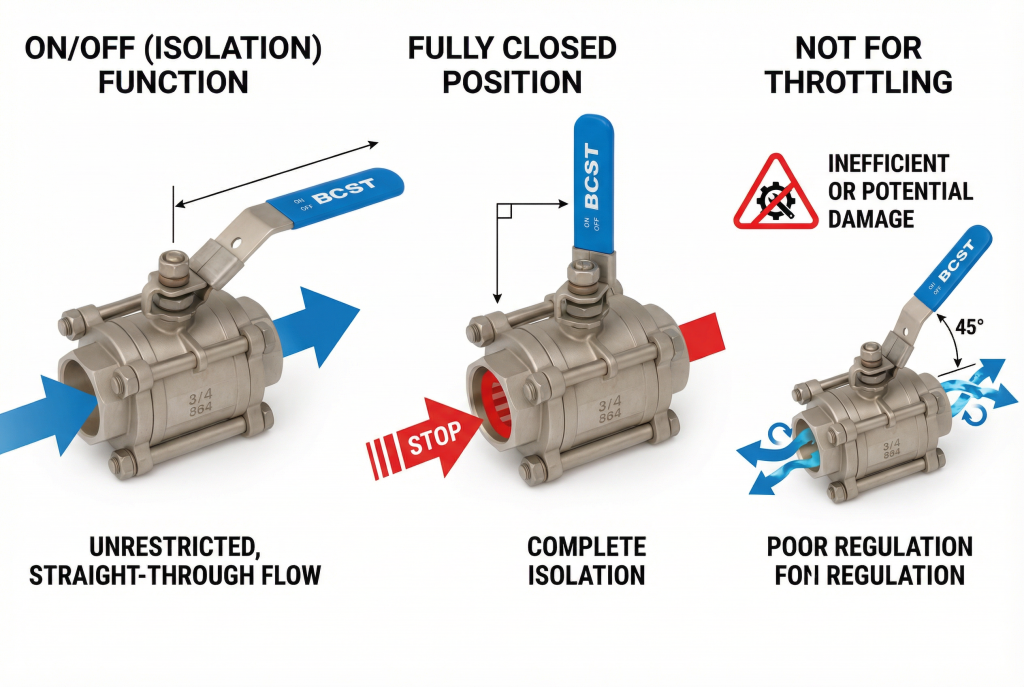
You need to control flow in your system, but choosing the wrong valve for the job leads to inefficiency and damage. You need to know exactly what function a ball valve is designed for.
The primary ball valve function is on/off service, also known as isolation. It is engineered for quick, full opening or full closing with minimal resistance to flow. It is generally not designed for regulating or throttling flow.
On/Off Excellence and Throttling Risks
The what is a ball valve question is best answered by its function. It is the quintessential shut-off valve, but using it outside of that role can cause serious problems. Its design makes it a master of one trade but a poor choice for another.
Built for On/Off Service (Isolation)
The ball valve excels at isolation for several reasons that stem directly from its design. Firstly, the quarter-turn (90-degree) action means it can be operated extremely quickly. This is critical for emergency shut-down procedures where seconds count. Secondly, when a full-port ball valve is fully open, the straight, unobstructed path it provides is like having a smooth piece of pipe. This results in a very low pressure drop, meaning the valve doesn’t waste energy by creating unnecessary resistance in the system. Finally, the wiping action of the ball across the seats as it opens and closes helps to clear away any minor debris, keeping the sealing surfaces clean and maintaining the integrity of the seal over many cycles. This combination of speed, efficiency, and reliability makes it the preferred choice for starting and stopping flow in a pipeline.
The Dangers of Throttling a Standard Ball Valve
Throttling means using a valve in a partially open position to regulate the flow rate or pressure. While you technically can partially open a ball valve, it is a very bad idea for standard designs. When a ball valve is partially open, it creates a narrow gap between the edge of the bore and the seat. The fluid is forced through this small opening at a very high velocity. This concentrated, high-speed jet acts like a sandblaster, eroding the soft seat material. This phenomenon, known as “wire drawing,” will quickly damage the seat, and the valve will no longer provide a tight seal when you try to close it fully. This damage is irreversible and destroys the valve’s primary function. The intense turbulence created can also cause vibration and noise, potentially damaging surrounding piping.
The Exception to the Rule: V-Port Ball Valves
There is a specialized version designed to handle some control applications: the V-port ball valve. Instead of a round bore, the ball has a V-shaped or U-shaped notch. As the valve is opened, the “V” gradually exposes the flow path. This design creates an equal percentage flow characteristic, meaning that each degree of rotation provides a more predictable and controllable change in flow rate. This makes the V-port ball valve a good hybrid solution when you need better control than a standard ball valve can offer but don’t require the precision of a globe valve.
| Характеристика | Стандартный шаровой кран | Шаровой кран V-Port |
|---|---|---|
| Основная функция | On/Off Isolation | Modulating Control / Throttling |
| Port Shape | Round (Bore) | V-Shaped Notch |
| Flow Characteristic | Quick Opening | Equal Percentage / Linear |
| Seat Wear in Throttling | High / Rapid Failure | Low / Designed for it |
What are the key parts in a ball valve diagram?
You’re looking at a valve, but without knowing its internal parts, you can’t properly maintain it or specify the right one. You need to understand its anatomy to make informed decisions.
A typical ball valve diagram shows the main Body, the perforated Ball that controls flow, the Stem connecting the ball to the Handle, and the Seats that create the seal. Each part is crucial for the valve’s operation.

Dive Deeper: Anatomy and Common Variations
Looking at a labeled diagram is like having a blueprint for the valve. It demystifies the component and helps you understand how different construction methods affect its performance, cost, and maintainability. When my father first taught me, he insisted I learn the name and purpose of every single part, from the body down to the packing gland.
The Full Anatomy
- Тело: This is the pressure vessel of the valve—the main framework that holds everything together. The material (e.g., stainless steel, brass, carbon steel) is chosen based on the fluid compatibility, pressure, and temperature.
- Мяч: The heart of the valve, as we discussed. It rotates to block or allow flow. Its material must also be compatible with the media.
- Стебель: The shaft that connects the external handle or actuator to the internal ball. Its design (e.g., blow-out proof) is critical for safety.
- Упаковка: A set of seals, often made of graphite or PTFE, that are compressed around the stem. The packing’s job is to prevent the fluid from leaking out of the valve around the stem. This is a common point of failure if not properly maintained.
- Сиденья: The soft rings (usually PTFE) that the ball seals against in the closed position to provide the bubble-tight shut-off.
- Handle/Actuator: The device used to operate the valve. This can be a simple manual lever or a more complex automated actuator (pneumatic, electric, or hydraulic) for remote or large-scale operation.
Common Body Construction Types
The way the valve body is assembled has a major impact on its cost and how it can be maintained.
| Body Type | Описание | Техническое обслуживание | Стоимость |
|---|---|---|---|
| One-Piece | The body is a single, cast piece. The valve is assembled through one end. | Non-repairable (“throw-away” valve). | Самый низкий |
| Two-Piece | The body is made of two pieces that screw together. | Can be disassembled to replace seals, but it is difficult. | Средний |
| Three-Piece | The body consists of three parts bolted together. | Easiest to maintain. The center section containing the ball and seats can be swung out or removed for repair without taking the entire valve out of the pipeline. | Самый высокий |
Understanding these variations is key. A one-piece valve might be fine for a simple, non-critical water line, but for an industrial process line where downtime is costly, a three-piece valve is a much wiser investment because it can be repaired quickly and easily.
Заключение
A ball valve works through a simple yet robust mechanism: a rotating ball with a hole. It is the top choice for fast, reliable on/off control with minimal flow resistance.


 English
 Arabic
 Russian
 French
 Spanish