
Your actuator stalls on a high-pressure line during commissioning. The project is delayed, costs are rising, and the culprit isn’t a faulty valve—it’s a fundamental misunderstanding of its internal sealing mechanism. Choosing between a floating и trunnion ball valve isn’t just a spec sheet detail; it’s a critical decision that dictates long-term performance and total cost of ownership.
A плавающий шаровой клапан uses line pressure to force the entire ball into a downstream seat to seal. Conversely, a trunnion ball valve mechanically anchors the ball with supports and uses spring-loaded seats that move to the ball, resulting in lower torque and superior sealing in high-pressure applications.
While both are “ball valves,” their reaction to pressure is effectively opposite. This difference is the deciding factor between a reliable, low-maintenance asset and a source of constant leaks, high torque issues, and actuator upsizing costs. This guide breaks down the physics to prevent these costly errors.
The Physics of Sealing: A Tale of Two Mechanisms

Passive Sealing: How a Floating Ball Valve Uses Pressure Against Itself
The floating valve employs a “downstream sealing” principle. The ball is not rigidly fixed and “floats” between two seats. Line pressure acts on the upstream face of the ball, pushing the entire assembly into the downstream seat to create a seal. The total seat load is a function of the pressure acting on the ball’s area. As pressure increases, the force pushing the ball into the soft seat grows exponentially.
This design is brilliantly simple and effective for low-to-medium pressure. However, this same force becomes the valve’s primary weakness under high pressure or in large sizes (above ANSI Class 300/600), leading to massive friction and impractical torque requirements.
Active Sealing: The Engineered Precision of a Trunnion Valve
The trunnion valve utilizes an “active” or “piston effect” sealing design. The ball is mechanically anchored by top and bottom supports (trunnions), which absorb the immense force from line pressure. Sealing occurs in two stages:
- Low-Pressure Seal: Internal springs push the seats against the stationary ball, ensuring a tight seal even at near-zero pressure.
- High-Pressure Seal: Line pressure gets behind the seat ring, adding to the spring force and energizing the seat. This creates an even tighter seal.
Because the operating torque is divorced from the line pressure and both seats work independently, true upstream and downstream sealing is achieved—a hallmark of API 6D valve standards.
Torque & Wear: The Long-Term Performance Consequences
The difference in sealing physics directly translates to real-world impacts on cost, reliability, and service life.
The Torque Requirement: Actuator Sizing and Spiraling Costs
- Floating Valves: Experience high “break torque.” The massive friction from the pressure-induced seat load requires huge, expensive actuators that might seem oversized but are necessary just to get the ball moving.
- Trunnion Valves: Benefit from a significant low-torque advantage. Torque is low and predictable, determined by bearing and manageable seat friction, not line pressure. This allows for smaller, less expensive actuators and reduced structural support costs.
Seat Wear and Seal Integrity Over 5-10 Years
- Floating Valves: The high compressive load and friction during cycling can cause seat deformation (cold flow), extrusion, and galling over time, leading to inevitable leaks.
- Trunnion Valves: The seats are not primary load-bearing components. They experience far less mechanical stress, maintaining their integrity for a much longer service life and ensuring tight shutoff year after year.
| Характеристика | Плавающий шаровой кран | Шаровой кран с цапфовым креплением |
|---|---|---|
| Primary Sealing Force | Line Pressure on Ball Area | Spring Energy + Line Pressure on Seat Area |
| Типовой диапазон размеров | ≤ 4″ (100mm) | ≥ 2″ (50mm), Dominant > 4″ |
| Pressure Class | ANSI 150 – 600 | ANSI 600 – 2500+ |
| Рабочий крутящий момент | High, directly proportional to ∆P | Low, largely independent of ∆P |
| Seal Type | Downstream Sealing Only | Independent Upstream & Downstream Sealing |
| Износ сиденья | High potential under high cycles/pressure | Low; seats are not load-bearing |
| DBB Capability | Not inherently possible | Standard design feature (API 6D) |
| Total Cost of Ownership | Low initial cost, higher long-term potential | Higher initial cost, lower long-term cost |
The “Gray Area” Decision Matrix: Choosing Between 2″ and 6″
What about an application, like 4″ ANSI Class 300, where either valve could theoretically work? Use this checklist to make the right call:
- High Cycling Frequency? → Choose Цапфа to avoid premature seat wear.
- High Pressure Drop (ΔP)? → Choose Цапфа to avoid high torque and actuator upsizing.
- Critical Isolation Required? → Trunnion is mandatory for its Double Block and Bleed (DBB) capability.
- Actuation Budget Constrained? → Price the complete package. A floating valve’s larger actuator can make the total cost higher than a trunnion’s.
When Only a Trunnion Will Do: Critical Service Applications
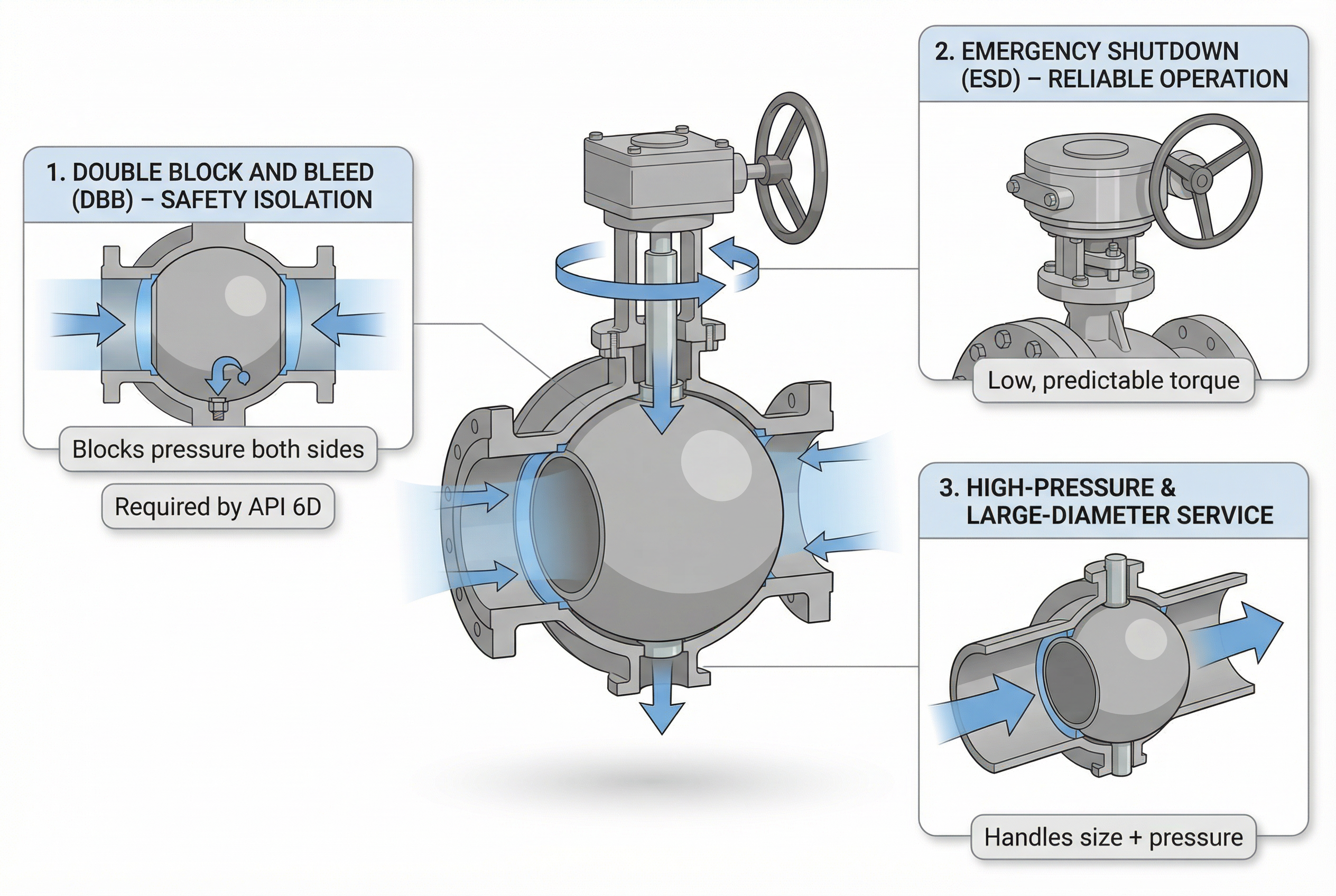
- Двойной блок и кровотечение (DBB): This is a non-negotiable safety feature for pipeline isolation required by API 6D standards, and it’s only possible with a trunnion’s independent seats.
- Emergency Shutdown (ESD): Low, predictable torque is essential for the reliability and speed of ESD systems.
- High-Pressure Gas & Compressor Stations: The combination of large size and high pressure makes floating valves physically inoperable or economically unfeasible.
The BCST Manufacturing Standard: Theory to Reliability
Understanding the physics is half the battle; manufacturing a valve that performs flawlessly is the other. At BCST, our process ensures engineering theory translates to field reliability.
- Material Traceability: We control traceability from certified foundries, ensuring the valve body can handle the forces absorbed by the trunnion supports.
- Precision Machining: Our CNC machining guarantees the tight tolerances required for the ball-to-trunnion interface and seat pockets, which is critical for low torque and long life.
- Rigorous Testing: Every BCST trunnion ball valve undergoes testing per API 6D и API 598, including low-pressure seat tests to verify spring-energized sealing and high-pressure tests to confirm absolute integrity.
View our BCST trunnion ball valve specifications to see our commitment to these standards.
Часто задаваемые вопросы
Q1: Why is a trunnion valve better for high pressure?
A trunnion valve is better because its mechanically anchored ball absorbs the line pressure force, preventing it from creating massive friction at the seats. This results in significantly lower operating torque, making the valve reliable and operable under high pressure.
Q2: What is the difference in torque between a floating and trunnion valve?
The torque in a floating valve increases exponentially with pressure, as it must overcome the friction of the entire line load. In a trunnion valve, torque is low and largely independent of pressure, making it drastically lower in high-pressure applications.
Q3: How does a floating ball valve seal actually work?
A floating ball valve seals by using upstream line pressure to push the un-anchored ball downstream. This force physically compresses the ball into the downstream elastomeric or polymer seat, creating a tight seal.
Conclusion & Expert Consultation
The sealing mechanism dictates performance. Floating valves are for general service; trunnion valves are for severe service. Choosing correctly prevents failure and lowers the total cost of ownership.
Don’t let a simple valve spec become a long-term liability. If your application involves high pressure, large sizes, or critical isolation, our engineering team can provide a detailed analysis to ensure you specify the right valve.


 English
 Arabic
 Russian
 French
 Spanish