
How to Avoid Mistakes to Choose a Ball Gas Valve?
Choosing a ball gas valve seems straightforward, but a simple specification error can lead to safety incidents, compliance violations, and costly emergency replacements. The truth is, most gas valve failures aren’t caused by manufacturing defects; they’re caused by engineers overlooking critical gas-specific requirements.
The key to safe and compliant gas valve selection is moving beyond just size and pressure. You must focus on material compatibility, gas-specific certifications, seal technology, and built-in safety features. These four factors are the difference between a reliable, long-lasting installation and a significant liability.
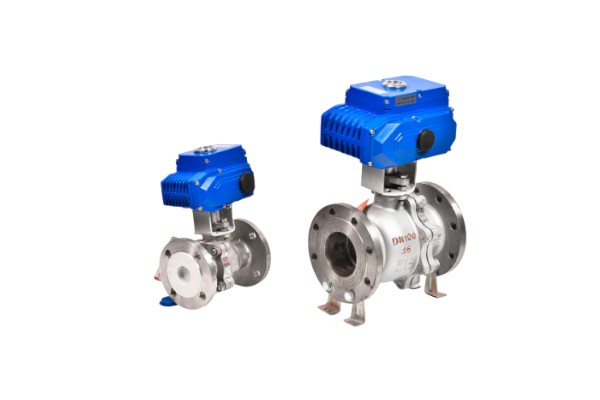
Having seen countless valve specifications in my career at BCST, I’ve noticed a recurring pattern. Engineers, under pressure to meet deadlines and budgets, often fall back on what they know from water or steam systems. But gas is an entirely different beast. A valve that’s perfectly safe for high-pressure water can become a dangerous leak point in a gas line. This guide is built from those observations—to give you the insider knowledge needed to specify every ball gas valve with confidence and ensure the safety of your facility.
What Makes a Ball Gas Valve Different from a Regular One?
You have two valves that look almost identical, but one is rated for gas and the other isn’t. Using the wrong one isn’t just a minor error; it’s a direct violation of safety codes and a risk to your entire system. So, what’s the actual difference?
A ball gas valve is fundamentally different from a standard water or oil valve due to its materials, certifications, and safety design. A gas-rated valve uses seals like PTFE that won’t degrade with gas exposure, holds specific gas service certifications (like CSA or UL), and often includes fire-safe design features.
Can a Ball Valve Be Used for Gas?
Yes, ball valves can be used for gas applications—but only when they are specifically rated and certified for gas service. A standard ball valve designed for water or oil is absolutely not interchangeable or safe for gas lines. The primary reasons for this strict distinction are the unique properties of gas: its combustibility, its compressibility (which affects seal performance), and the challenges in detecting small leaks.
The key differentiators that make a ball valve safe for gas include:
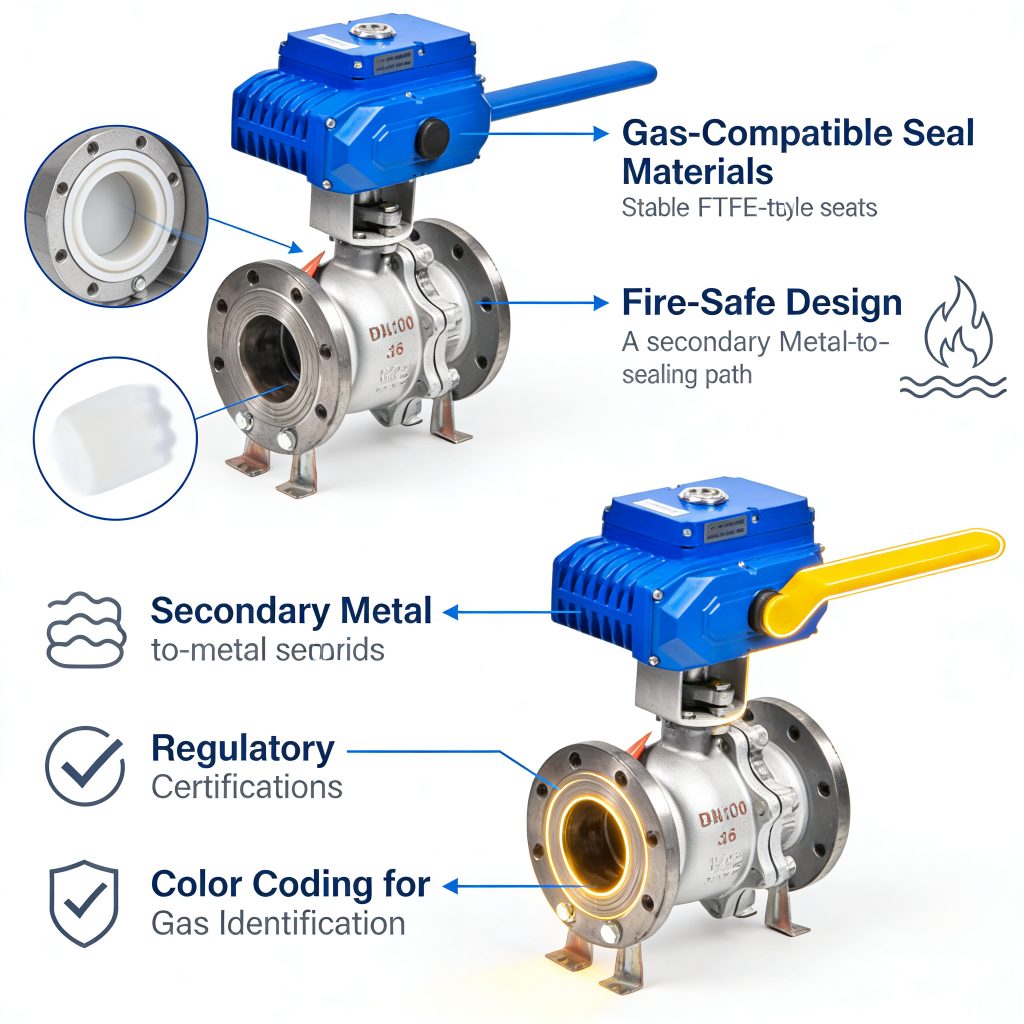
- Gas-Compatible Seal Materials: Standard rubber seals (like EPDM or NBR) can swell, harden, or degrade when exposed to natural gas or LPG. Gas valves use materials like PTFE that remain stable.
- Fire-Safe Design: If a fire occurs, the valve must be able to maintain a seal. Gas valves are often required to be “fire-safe tested” to standards like API 607.
- Regulatory Certifications: The valve must carry markings from an approved body (like CSA or UL) certifying it for gas service.
- Color Coding: The industry standard for gas valve handles is yellow, providing an immediate visual identification.
How to Tell If a Ball Valve Is for Gas?
You can’t afford to guess. Here is a definitive checklist to determine if a valve is gas-rated.
1. Visual Identification Markers:
- Yellow Handle: This is the most common and immediate indicator.
- Body Markings: Look for stamps like “GAS,” “NAT,” “LPG,” or a WOG rating that explicitly includes ‘G’ (e.g., “600 WOG”).
- Certification Stamps: Search the valve body for logos from CSA (Canadian Standards Association), UL (Underwriters Laboratories), or EN 331 (European standard).
2. Documentation Verification:
- Specification Sheet: The datasheet is your source of truth. It must clearly state “Gas Service” or list the specific gas certifications it holds.
- Seal Material: Confirm the seal material is listed as PTFE, RPTFE, or another gas-compatible compound, not just a generic elastomer.
What is NOT Sufficient Proof?
- Pressure Rating Alone: A “600# WOG” valve is not automatically gas-rated without a specific gas certification.
- Material: A stainless steel ball gas valve is not inherently gas-safe without the proper seals and certifications.
Is Material Selection for Gas Valves More Than Just Stainless vs. Brass?
Engineers often default to stainless steel for durability or brass for cost savings. This simplistic approach is the first major factor that is commonly missed. The right material depends on a careful analysis of the gas type, operating environment, and total lifecycle cost.
The choice of body material for a ball gas valve directly impacts its corrosion resistance, lifespan, and suitability for the environment. Stainless steel (316) is best for corrosive or outdoor applications, brass is for low-pressure residential use, and carbon steel is for high-pressure industrial lines.

Why Your Material Choice is More Complex Than You Think
Here’s a more detailed decision framework to move beyond the basic choice:
1. Stainless Steel Ball Gas Valve Applications
This is your premium, long-term solution.
- When to Specify:
- Corrosive gas environments (e.g., sour gas with H₂S, wet gas with high moisture).
- Outdoor installations exposed to weather.
- Industrial natural gas ball valve trunk lines.
- When a 25-30+ year service life is the goal.
- Grade Selection:
- 316 Stainless Steel: The best choice for corrosive gas, coastal areas, or any application where chemical resistance is paramount.
- 304 Stainless Steel: A good, slightly more economical choice for standard, clean industrial natural gas lines.
2. Brass Ball Gas Valve Applications
This is your residential and light commercial workhorse.
- When to Specify:
- Low-pressure residential natural gas (typically under 5 PSI).
- Indoor, climate-controlled environments.
- Common residential sizes like the 1 2 ball gas valve and 3 4 ball gas valve.
- Critical Limitation: Ensure you are using DZR (dezincification-resistant) brass if any moisture is present in the line to prevent material degradation.
3. Carbon Steel Applications
This is for heavy-duty, high-pressure industrial use.
- When to Specify:
- High-pressure industrial gas transmission lines (often >500 PSI).
- Large diameter pipelines (3″ and larger).
- Crucial Note: Carbon steel is not inherently corrosion-resistant and must have a suitable protective coating for the installation environment.
Why is Your 600# WOG Valve Not Legal for Gas Service?
This is the second, and perhaps most critical, factor engineers miss: a pressure rating is not a safety certification. Simply because a valve can handle the pressure does not mean it is legal or safe for flammable gas service.
Gas service requires specific certifications (like CSA or UL) that validate material compatibility, seal integrity, and fire-safe performance—standards that a simple pressure test for water or oil does not cover. Installing a valve without the correct gas certification is a code violation.
The Danger of Assuming Pressure Rating Equals Safety
A standard industrial valve is tested for its ability to contain pressure. A gas-certified valve is tested for its ability to do so safely with a combustible medium, often under fire conditions.
Required Certifications to Look For:
- North America:
- CSA (Canadian Standards Association): This is mandatory for gas installations in Canada and the benchmark standard in the US.
- UL (Underwriters Laboratories): UL 842 is another key certification required by many US municipal codes.
- International:
- EN 331: The primary European standard that specifically governs valves for gas installations.
When you write your specification, you must call out the required certification for your jurisdiction. A real-world example I saw involved a commercial facility that had to pay over $50,000 to retrofit their entire natural gas system because the installed valves had the right pressure rating but lacked the required CSA certification, failing the final inspection.
Why Do Standard Valve Seals Fail in Gas Service?
You’ve selected the right material and confirmed the certification. The third missed factor lies deep inside the valve: the seal technology. The difference between a reliable seal and a catastrophic leak comes down to choosing a material compatible with your specific gas.
Standard elastomer seals found in water or oil valves will swell, harden, or chemically degrade when exposed to natural gas or LPG, leading to inevitable leaks. Gas valves require stable seal materials like PTFE that are inert to hydrocarbons and maintain their integrity over decades of service.
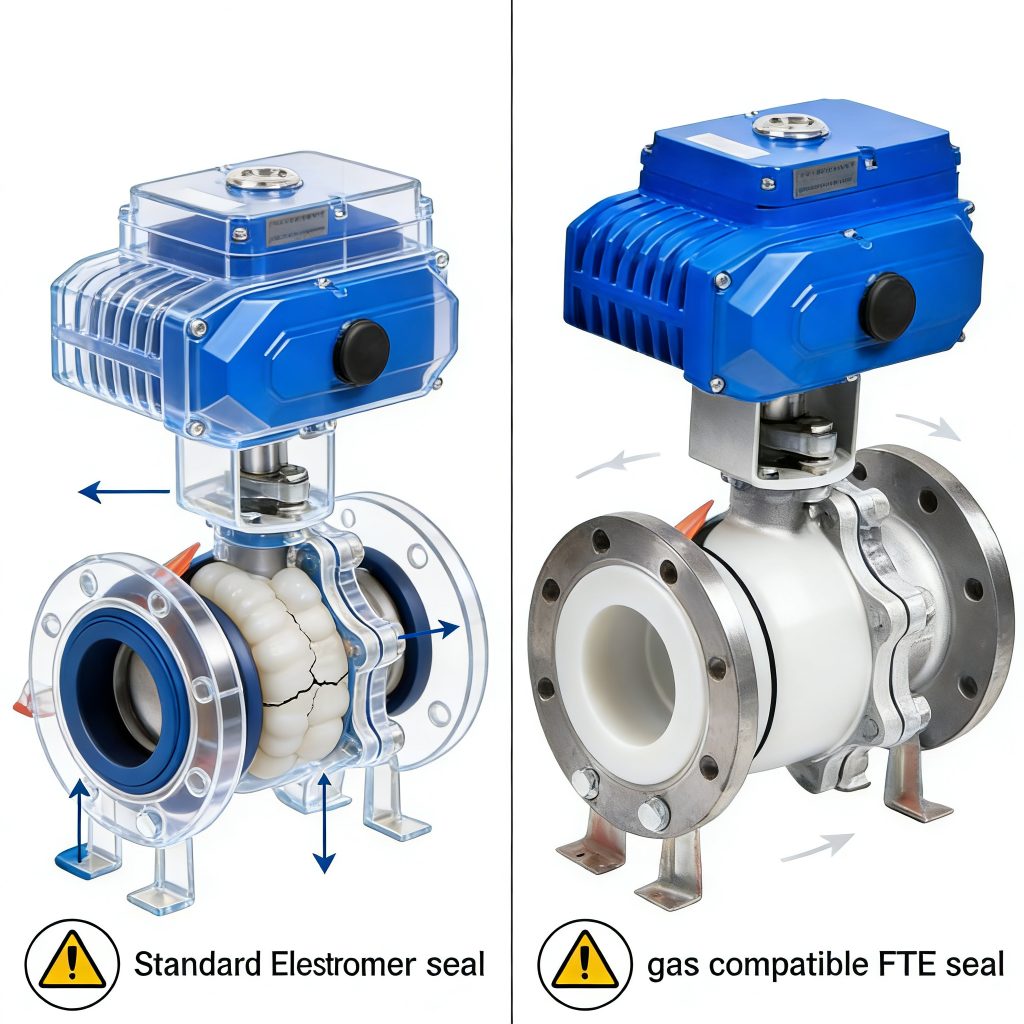
Gas-Specific Seal Requirements
Different gases interact with seals in different ways. Here’s what you need to know:
- Natural Gas / Methane:
- Recommended: PTFE (Teflon) or RPTFE (Reinforced PTFE) are the industry standards. They are chemically inert and provide a long service life.
- Avoid: Standard Buna-N (NBR) or EPDM seals.
- LPG / Propane:
- Recommended: High-grade PTFE or specialty elastomers specifically rated for LPG service are necessary due to its higher vapor pressure and different chemical properties.
- Sour Gas (H₂S Present):
- Required: This highly corrosive environment will destroy standard seals. You must use either specially formulated PTFE compounds or, for a more robust solution, specify metal-seated ball valves that eliminate elastomers entirely.
- Hydrogen and Other Specialty Gases:
- Required: Hydrogen is a tiny molecule that can permeate standard seals. This requires advanced materials like PEEK seats or a metal-to-metal sealing design.
When specifying a ball valve for gas line, always verify the seal material on the datasheet and cross-reference it with the chemical compatibility requirements for your specific gas.
What Critical Safety Features Do Engineers Overlook?
The final factor is moving beyond the valve’s basic function and considering the operational safety features required for maintenance and emergency situations. A valve that only offers shut-off is incomplete in a modern gas system.
Engineers often focus on the valve’s primary function but miss specifying critical, often code-required, safety features like fire-safe design, lockout capability, and blow-out proof stems. These features are designed to prevent catastrophic failures during fires or maintenance procedures.
The Safety Features That Prevent Catastrophic Failures
These are not optional add-ons; they are essential for a safe and compliant gas system.
1. Fire-Safe Design (to API 607):
- Why it Matters: In a fire, the primary soft seals can melt. A fire-safe valve has a secondary metal-to-metal seal that engages, minimizing fuel leakage to the fire.
- How to Verify: The valve must be marked as “Fire-Safe Tested” or “API 607 Compliant.”
2. Gas Ball Valve Lockout (LOTO):
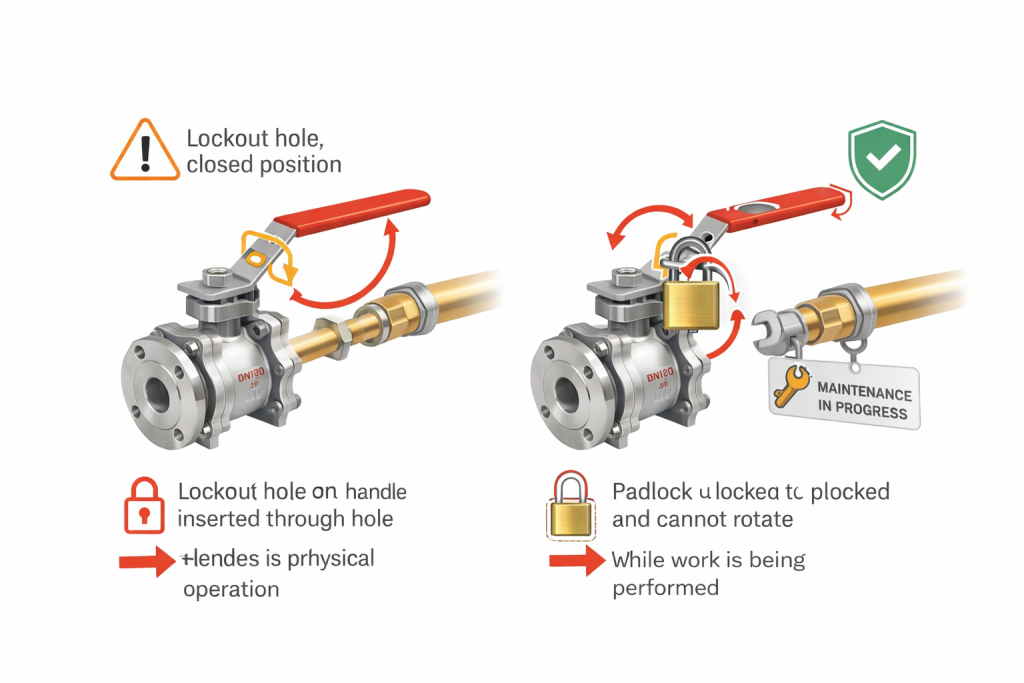
- Why it Matters: OSHA regulations require the ability to lock out energy sources during maintenance. A gas ball valve lockout feature is a physical tab or device that allows a padlock to be affixed, preventing accidental operation while someone is working on the line.
- How to Specify: Ensure the valve model includes an integral or compatible lockout device.
3. Blow-Out Proof Stem:
- Why it Matters: This design feature prevents the valve stem from being ejected under pressure, which would cause an immediate, uncontrolled release of gas.
- How it Works: A shoulder at the bottom of the stem keeps it physically retained inside the valve body. This should be a non-negotiable standard for any gas valve you specify.
Material and Application Selection Guide
| Material | Best Applications | Seal Material | Service Life |
|---|---|---|---|
| 316 Stainless Steel | Corrosive gas, outdoor, marine environments | PTFE/RPTFE | 25-30+ years |
| 304 Stainless Steel | Standard industrial natural gas lines | PTFE/RPTFE | 20-25 years |
| Brass (DZR) | Residential, low-pressure (<5 PSI) | PTFE | 15-20 years |
| Carbon Steel | High-pressure industrial (>500 PSI) | PTFE or Metal | 20-25 years (coated) |
Conclusion
Choosing the right ball gas valve is not about simply matching the pipe size and pressure. It’s about a methodical process of verification that prioritizes safety and compliance. By focusing on the four critical factors that are so often missed—Material Selection, Gas Service Certification, Seal Technology, and Safety Features—you can elevate your specifications from adequate to excellent.
This approach protects your facility, ensures compliance, and delivers the lowest total cost of ownership by preventing premature failures and costly retrofits. Before your next gas valve purchase, use this guide as your checklist. Don’t just select a valve; specify a complete, safe, and compliant solution.
Ready to specify ball gas valves with confidence?
Talk to a BCST Valve gas systems specialist today. We’ll help you navigate the requirements and provide fully certified valves for your project.


 English
 Arabic
 Russian
 French
 Spanish