

Standard for Extreme Heat Flow Control in 2025
In the high-stakes world of industrial processing, where temperatures can soar beyond 500°F and downtime costs millions, high-temperature ball valves emerge as indispensable heroes. These quarter-turn, on-off flow control devices—featuring a spherical ball with a bore to regulate media like steam, hydrocarbons, or corrosive chemicals—aren’t your standard shut-off valves. Engineered with premium alloys, metal seats, and thermal compensation, high-temperature ball valves deliver bubble-tight sealing and zero-leak performance up to 1200°F (650°C), safeguarding operations in refineries, power plants, and chemical facilities.
High-temperature ball valves are specialized ball valves designed for sustained high-heat service, using materials like Inconel or Stellite to handle 3x the temperature of conventional models—ideal for API 607-compliant applications. This makes them essential for environments where standard valves would fail catastrophically, such as fluid catalytic cracking units (FCCUs) or superheated steam lines.
With the global industrial valve market valued at USD 75.9 billion in 2024 and projected to reach USD 142.6 billion by 2034 at a CAGR of 6.6%, the high-temperature segment is surging, driven by energy transition demands for efficient, low-emission systems. Ball valves alone, accounting for about 30% of the market, are favored for their strength in high-pressure, high-temperature scenarios. As of November 2025, experts emphasize their role in reducing failure rates by up to 40% in cyclic heat environments, with the integrated high-temperature ball valve niche expected to exceed $1.1 billion by 2033 at a 3.5% CAGR.
Expert Overview on High-Temperature Ball Valves in 2025
What do valve engineers and industry analysts say about high-temperature ball valves today? In 2025, amid ASME B16.34 revisions emphasizing creep resistance and expanded scope for clamped valves with guidance on nonstandard ends, experts highlight their evolution from basic shut-offs to smart, predictive assets.
Experts note high-temperature ball valves now integrate AI-monitored packing for 50% longer life, with max temps reaching 1000°F+ using ceramic coatings—outpacing standards by addressing thermal fatigue head-on. Seven core selection factors dominate discussions: fluid characteristics, pressure-temperature (P-T) parameters, flow dynamics, valve sizing via Cv coefficient, material compatibility, actuation needs, and compliance standards like ASME B16.34.
Key Expert Insights
Market & Trends: The ball valves market is forecasted to grow from USD 14.87 billion in 2025 to USD 22.92 billion by 2034 at a CAGR of 4.93%, fueled by superheated steam in renewables and FCCU upgrades in oil refining. Analysts predict a 6% global CAGR for high-temperature and high-pressure segments through 2033, with U.S. focus on forged alloys like Hastelloy for corrosion at 800°F+. The new-energy segment, including hydrogen and carbon capture, is the fastest-growing at 9.38% CAGR, demanding precision valves for electrolysers and low-temperature shut-offs.
Material & Selection Expertise: For high-temperature applications, choose stainless steel variants handling -40°C to 220°C baseline, but upgrade to Inconel for 650°C peaks—critical for tight shut-off in polymer production. Flowork Valve experts stress: ‘Assess flow requirements and media compatibility first; ceramic ball coatings prevent galling in cyclic ops.’ Packing like flexible graphite ensures high-temperature resistance up to 540°C with metal hard seals and heat dissipation structures. P-T ratings are key: A Class 300 carbon steel valve handles 740 psig at ambient but drops to 470 psig at 650°F (343°C), per ASME B16.34 tables.
2025 Innovations: New guides underscore live-loaded stems for pressure up to 6000 PSI and IoT integration for real-time torque monitoring—reducing unplanned shutdowns by 30%. Custom bodies tailored for high-temperature, corrosive environments ensure ASME compliance.
Expert Quote Integration: “‘High-temp ball valves are no longer just durable—they’re predictive,’ says a 2025 OneRo Valve engineer. ‘Graphite packing and extended bonnets now meet ISO 15848 leak standards under 1500°F spikes.'”
Why Choose High-Temperature Ball Valves Over Standard Designs in Demanding 2025 Applications?
Dealing with valve failures in extreme heat? Seals degrading prematurely in your refinery or power plant? High-temperature ball valves eliminate these issues, engineered for continuous 1200°F (650°C) operation—three times the limit of standard valves.

High-temperature ball valves use specialized alloys and designs to thrive up to 1200°F (650°C), surpassing standard valves’ 400°F (204°C) threshold and preventing costly downtime.
What Makes High-Temperature Ball Valves Unique?
Tired of watching standard valve parts melt under pressure? High-temperature ball valves’ innovative features avert disasters in scorching conditions.
Standout elements: Metal-seated designs over soft seats, graphite stem packing for enduring seals, and built-in thermal expansion compensation to ensure leak-proof performance.
Dive Deeper: High-Temperature Ball Valve Feature Breakdown

| Component | Standard Valve | High-Temp Ball Valve | Benefit (2025 Insight) |
|---|---|---|---|
| Seats | PTFE/Rubber | Inconel/Stellite | No degradation; resists 2025 ASME creep standards |
| Stem Seals | PTFE | Graphite/Graphoil | Maintains sealing up to 1500°F peaks |
| Ball Coatings | None | Hard chrome/ceramic | Prevents galling in cyclic heat |
| Body Material | Cast Carbon | Forged Alloys (e.g., Hastelloy) | Higher strength; 20% lighter per new alloys |
| Bonnet Design | Standard | Extended with heat sinks | Superior dissipation; integrates AI sensors |
Temperature Rating Comparison Table
| Valve Type | Max Continuous Temp | Short-Term Peak |
|---|---|---|
| Standard | 400°F (204°C) | 500°F (260°C) |
| High-Temp Ball Valve | 1200°F (650°C) | 1500°F (816°C) |
| Special Alloy | 1500°F (816°C) | 1800°F (982°C) |
How Do High-Temperature Ball Valves Differ from Fire-Safe Models?
While fire-safe focus on bursts, high-temperature ball valves prioritize sustained 650°C with metal seats—essential for API 6FA compliance.
Where Are High-Temperature Ball Valves Essential?
Gambling with system breakdowns from mismatched valves? Industries pushing temperature limits demand high-temperature ball valves—no exceptions.
Vital in oil refining (FCCU lines), power generation (superheated steam), and chemical processing (reactors) where temps routinely top 500°F (260°C).
Dive Deeper: Industry-Specific Requirements for High-Temperature Ball Valves
Oil Refining: FCCU lines, coker units, hydroprocessing (Meets API 607/6FA; 2025 update: Enhanced for low-emission cracking).
Power Generation: Superheated steam, flue gas, heat recovery (Integrates with carbon-capture systems).
Chemical Processing: Reaction vessels, thermal oxidizers, polymer production (Resists corrosive vapors at 800°F+).
Failure Points Without Proper High-Temperature Ball Valves:
- Seat Degradation – Soft seats melt/disintegrate
- Stem Binding – Expansion jams mechanism
- Seal Failure – Packing material bakes out
- Body Warping – Material yields under stress
Quick Decision Tree: Do You Need High-Temperature Ball Valves?
| Scenario | Yes (Install High-Temp) | No (Standard OK) |
|---|---|---|
| Temp >500°F | Refineries/Power Plants | HVAC Systems |
| Corrosive Media | Chemical Reactors | Water Lines |
| Downtime Cost >$50K | Always | Low-Risk Ops |
How Should High-Temperature Ball Valves Be Installed?
Top-tier high-temperature ball valves flop without flawless setup—are you overlooking heat-movement pitfalls?
Key steps: Calculate thermal expansion, apply precise torque to high-temp fasteners, and align for heat-driven shifts.
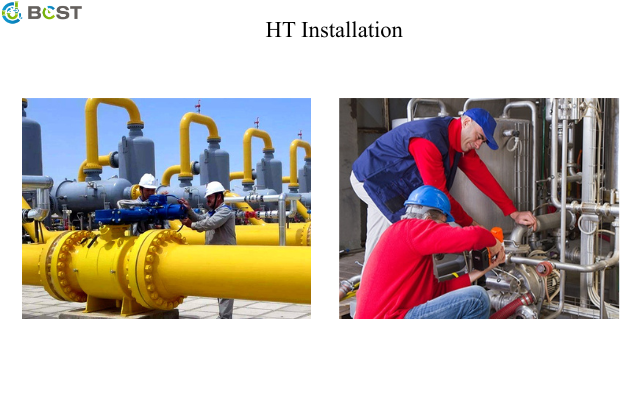
Dive Deeper: Installation Best Practices for High-Temperature Ball Valves
Pre-Installation:
- Verify material certifications
- Inspect for transport damage
- Clean all sealing surfaces
Mounting Considerations:
- Allow for thermal growth
- Use high-temp thread compounds
- Follow torque patterns precisely (2025 Tip: AI torque apps for real-time adjustments)
Commissioning Steps:
- Gradually heat system
- Retorque after initial cycles
- Perform hot leak test
- Document baseline performance
Critical Torque Specifications:
| Valve Size | Cold Torque | Hot Torque |
|---|---|---|
| 1″ | 60 ft-lbs | 75 ft-lbs |
| 2″ | 120 ft-lbs | 140 ft-lbs |
| 4″ | 300 ft-lbs | 350 ft-lbs |
“Factory testing under actual temperatures is non-negotiable,” Emily insists. “We heat-test every valve above 800°F before shipment.”
Common Mistakes in High-Temperature Ball Valves Installation?
- Ignoring expansion = 40% failure rate—fix with bellows extensions.
- Under-torquing fasteners leads to leaks; always recheck post-heat cycle.
What Maintenance Do High-Temperature Ball Valves Need?
Skip maintenance on high-temperature ball valves, and risk explosive failures—is your protocol heat-proof?
Core routine: Quarterly packing tweaks, yearly hot tests, and checks for creep or metallurgical shifts. (Voice for “Maintenance schedule for high-temperature ball valves”)
HT Maintenance Alt: Routine inspection of high-temperature ball valves for creep and seal integrity.
Dive Deeper: Maintenance Schedule & Procedures for High-Temperature Ball Valves
Monthly:
- Visual inspection for discoloration
- Operational torque check
- External leak detection
Quarterly:
- Packing gland adjustment
- Stem lubrication (high-temp grease)
- Verify position indicator accuracy
Annually:
- Internal inspection
- Seat leakage test at temp
- Ultrasonic thickness testing (2025: Add AI vibration monitoring for early creep)
End-of-Life Indicators:
- Excessive operating torque (>125% baseline)
- Visible seat erosion
- Measurable creep deformation
- Loss of material hardness
“Hassan trains operators to track torque trends religiously,” shares our field supervisor. “A 10% increase predicts failure six months out.”
Cost of Neglecting High-Temperature Ball Valves Maintenance
Downtime averages $75K/hour in refineries—prevent with predictive analytics to avoid 30% unplanned shutdowns.
FAQ: Top Questions on High-Temperature Ball Valves
- Q: What’s the max temp for high-temperature ball valves? A: “Continuous 1200°F (650°C); peaks to 1500°F—vs. standards at 400°F.”
- Q: Are high-temperature ball valves worth the 25% premium? A: “Yes—for API 607 compliance in refineries, ROI hits in months via zero leaks.”
- Q: How do I select metal-seated high-temperature ball valves? A: “Prioritize Inconel for corrosion; check ASME B16.34-2025 for creep resistance.”
- Q: Per 2025 experts, what’s the ROI on high-temperature ball valves? A: “‘Breakeven in 6 months via 40% failure reduction’—CAGR-driven savings.”
- Q: Best brands for high-temperature ball valves in 2025? A: “Velan, Kitz, or Flowserve—focus on live-loaded packing.”
Got more queries? Contact our experts for custom high-temperature ball valves specs.
Conclusion
High-temperature ball valves fuse cutting-edge materials and engineering to conquer extreme heat, averting failures where standards crumble. In 2025’s efficiency-driven world, they’re not optional—they’re operational armor.
Bottom Line: Invest in high-temperature ball valves for 3x temp tolerance and 50% longer life.
Ready to upgrade? Download our high-temperature ball valves spec sheet or schedule a consult.


 English
 Arabic
 Russian
 French
 Spanish